Service Balance Also in Deficit
Rapid Spread of Crisis Sentiment in Korean Economy
Current Account Expected to Surplus in September
Many Adverse Factors Including Increased Energy Price Volatility
Optimism Remains Uncertain
Government Focuses on Maintaining Surplus Trend
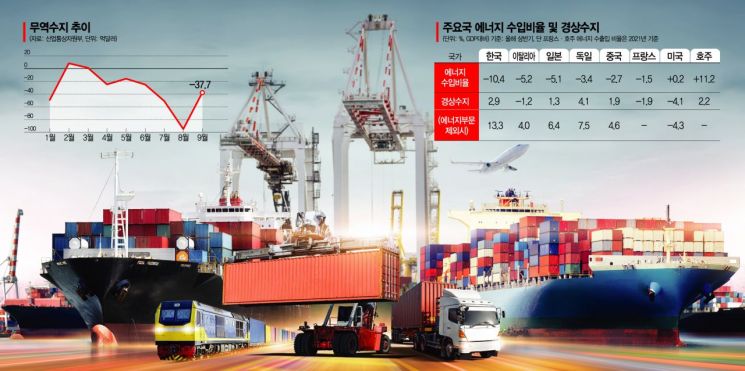
[Asia Economy reporters Seo So-jeong, Kim Hye-won in Sejong, and Moon Je-won] As the trade deficit continues for six consecutive months, the current account balance, which had been a pillar of the Korean economy, turned to a deficit of $3.05 billion in August, rapidly spreading a sense of crisis in the Korean economy. With this year’s fiscal deficit becoming inevitable and the current account balance also turning to a deficit, concerns are growing that a "twin deficit" scenario could become a reality.
The government still expects the August current account deficit to be a temporary phenomenon caused by a large trade deficit and forecasts a return to surplus in September. However, with ongoing uncertainties from the Ukraine crisis, expanded volatility in energy prices, and sluggish exports to China, it is difficult to maintain an optimistic outlook.
◆Service balance turns to deficit following goods balance= Particularly, except for the annual increase in overseas dividend remittances in April, this is the first time since February 2012 (-$2.58 billion) that the current account has recorded a deficit, heightening the sense of crisis. First, exports of key items such as semiconductors slowed, while imports of raw materials surged, leading to a widened goods trade deficit of $4.45 billion in August, which is cited as the main cause of the current account deficit. August exports amounted to $57.28 billion, an increase of $4.1 billion compared to the same month last year. Exports have increased for 22 consecutive months, mainly driven by petroleum products, but the growth rate narrowed due to a decline in exports to China. Imports in August surged by a whopping $14.58 billion from August last year, reaching $61.73 billion.
Kim Young-hwan, head of the Financial Statistics Department at the Bank of Korea, analyzed, "As global recession concerns grow, exports of our leading items such as semiconductors and IT products have slowed, while raw material imports have surged and exports to China have been sluggish, causing the current account to turn to a deficit." In addition to the goods trade deficit, the service balance also turned to a deficit, further worsening the current account situation. The service balance in August recorded a deficit of $770 million, down $1.62 billion compared to August last year. With the easing of COVID-19 restrictions, overseas travelers surged, and the travel balance deficit widened from $860 million in July to $970 million in August.
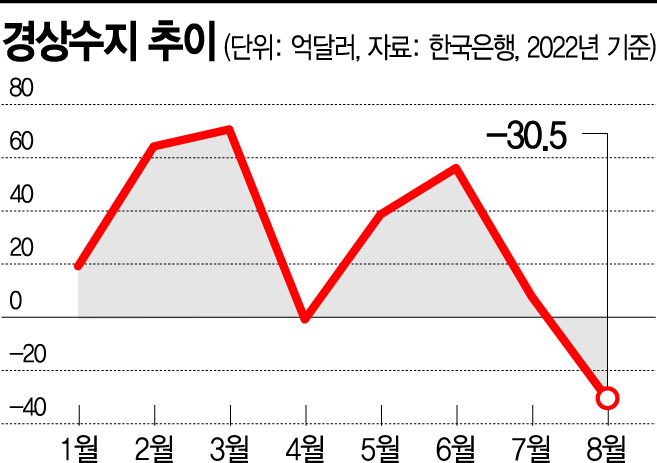
◆Surplus expected in September... increased monthly volatility= The Bank of Korea expects a return to surplus in September as the trade deficit significantly shrinks. They judge that factors such as a surplus in overseas production duty-free exports, a surplus in primary income balance, and a surplus in transportation services will act as positive contributors to the current account surplus amid the reduced trade deficit.
Experts agree that the high uncertainty in external conditions has led to large monthly fluctuations in the current account, and they emphasize the need for vigilance regarding the current account turning to a deficit, a key external indicator. Professor Ha Jun-kyung of Hanyang University’s Department of Economics pointed out, "While it has occasionally happened that the current account showed a deficit in April, it is rare to see a deficit in August, which calls for a sense of crisis." Professor Ha added, "The semiconductor market does not change drastically within a few months, and the Chinese economy faces significant political uncertainties such as the zero-COVID policy. Recently, OPEC Plus decided to cut production, and energy prices may rise sensitively in winter, so downside risks are significant going forward." Furthermore, the current account deficit affects foreign currency supply and demand, potentially pushing the already soaring won-dollar exchange rate even higher.
Professor Kang Sung-jin of Korea University’s Department of Economics also said, "Although the current account deficit can be considered temporary, China’s economic outlook for next year is not favorable, and thus the long-term outlook for the goods trade balance is not positive, making it increasingly difficult to achieve a current account surplus through a goods trade surplus." He added, "During the COVID-19 outbreak, the transportation balance surplus was large and overseas travel was restricted, so the travel balance deficit was not significant, but going forward, this deficit could increase."
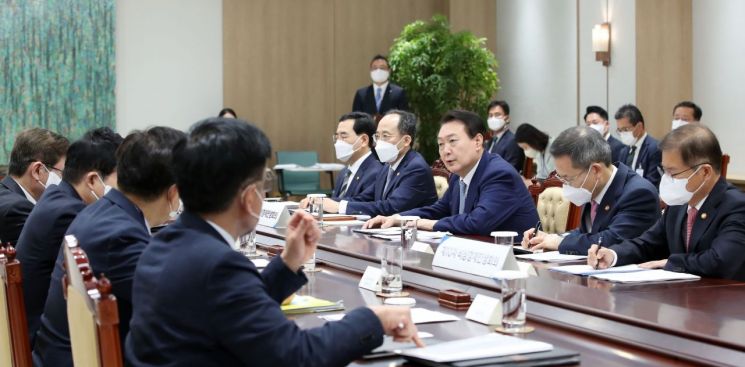
◆Government to make every effort to maintain surplus trend= The government also anticipates that the complex crisis will continue for a considerable period and plans to make every effort to maintain the current account surplus, which serves as a safety net for external soundness. At the Emergency Economic and Livelihood Meeting chaired by President Yoon Suk-yeol with ministers from related departments attending that morning, President Yoon stated, "Although a substantial current account surplus is expected for the year, we will proactively prepare to ensure the surplus trend continues."
Each ministry, including the Ministry of Economy and Finance, is determined to defend the surplus by promoting export expansion and reducing imports through energy-saving efficiency, as well as across key service industries such as tourism, transportation, and content. The strategy is to use this opportunity to strengthen competitiveness in goods and services and structurally improve the current account by reducing excessive overseas dependence on energy. To this end, 18 new measures will be sequentially prepared by early next year. Plans include competitiveness enhancement strategies for six major export sectors?shipbuilding, display, secondary batteries, bio, etc.?and separate support measures specialized for export SMEs.
Choo Kyung-ho, Deputy Prime Minister and Minister of Economy and Finance, said in a meeting with reporters the previous day, "We expect the current account to return to surplus in September," and emphasized, "Many institutions, including the Bank of Korea, forecast a current account surplus well over $30 billion for the year, so we are not worried that the current account deficit will trigger an economic crisis."
© The Asia Business Daily(www.asiae.co.kr). All rights reserved.
![Clutching a Stolen Dior Bag, Saying "I Hate Being Poor but Real"... The Grotesque Con of a "Human Knockoff" [Slate]](https://cwcontent.asiae.co.kr/asiaresize/183/2026021902243444107_1771435474.jpg)


















