Minister Kim Hyun-sook: "Population and Family Gender Equality Headquarters Will Be a Shortcut to Solving Population Issues"
Emphasizing Changes in Era and Environment, Effectively Declares the Abolition of Women's Policies
Abolishing Minister and Vice Minister Positions, Appointing 'Head of Headquarters'; Criticism Over Difficulty in Assigning Responsibility
Women's Groups Claim It Is a Return to 20 Years Ago When Only 'Women and Welfare' Was Advocated
[Asia Economy Reporter Han Jinju] The Ministry of Gender Equality and Family (MOGEF) is on the verge of being abolished for the first time in 21 years and downgraded to the 'Population, Family, and Gender Equality Headquarters' under the Ministry of Health and Welfare. Although the government aimed to eliminate overlapping functions and promote life-cycle-based policies, emphasizing 'population issues' and 'low birthrate,' women's groups opposed the move, calling it an erasure of women and a termination of gender equality policies.
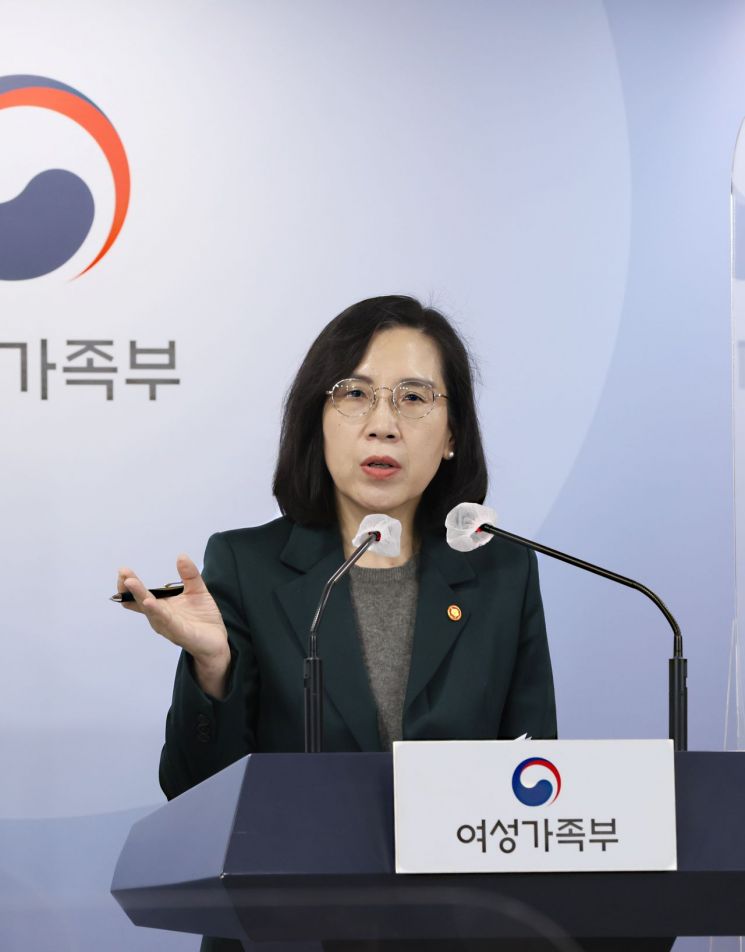
On the 7th, Minister Kim Hyun-sook of MOGEF, at a briefing on government organization reform held at the Government Complex Seoul, rejected interpretations that the abolition plan was a 'turning point card' to avoid a drop in the president's approval rating, saying, "I cannot agree. It is a deliberately imposed frame," and emphasized, "We have been discussing this with experts from various fields as well as the Ministry of Justice and the Ministry of Employment."
Minister Kim emphasized in June that she would create a reform plan by gathering opinions from various sectors, but as the process moved toward abolition, there are criticisms that opinions demanding strengthening of MOGEF's functions were not reflected. In response, Minister Kim said, "It cannot be said that the opinions of all women's organizations and attendees were perfectly reflected, but the opinion not to separate women's violence-related rights work from gender equality policies was incorporated," adding, "The plan was reached through sufficient agreement between the Ministry of the Interior and Safety and MOGEF, and the gender equality policy was also changed to the form most suitable for the current era."
The government organization reform plan mainly involves transferring MOGEF's functions related to youth, family, gender equality, and rights promotion to the Ministry of Health and Welfare to establish the Population, Family, and Gender Equality Headquarters, while transferring women's employment tasks to the Ministry of Employment. The government set the reform direction as △ overcoming the limitations of mini ministries △ integrating policies by life cycle of family members △ promoting policies that are equal for both genders and generations. The main content is to integrate overlapping youth and child policies by age and to shift gender equality policies toward resolving gender and generational conflicts.
Minister Kim said about the new organizational structure, "Family, youth, and gender equality policies will be independently and strongly promoted in connection with child and population policies," and added, "The 'Population, Family, and Gender Equality Headquarters,' which promotes life-cycle-based policies, will be a shortcut to solving population issues."
Minister Kim explained the reason for abolition, saying, "MOGEF failed to reflect the changed social environment and the perceptions of the younger generation, did not actively respond to gender conflicts and power-based sexual crimes, and had aspects of women's policies specialized for 'women' that did not meet public expectations." Emphasizing 'both men and women' in gender equality policies is interpreted as effectively discontinuing women's policies.
Women's groups and academia expressed concerns that the abolition plan would mean the termination of gender equality policies. MOGEF's core value was coordinating government policies from a gender-sensitive perspective and realizing gender equality values. There are concerns that it will be difficult for the Ministry of Health and Welfare to carry out policies from this perspective. Even if the newly established headquarters chief is given a status higher than vice minister and equivalent to minister, the disappearance of existing ministers and vice ministers will inevitably make the responsible entity ambiguous. In response, Minister Kim said, "There are two speakers talking about the gender equality promotion system, and if these two voices are unified, they can produce a much stronger voice."
Professor Shin Kyung-ah of Hallym University said, "The minister and vice minister should have authority to promote policies, but there are many coordination tasks between ministries related to gender equality, so it is questionable what the headquarters chief can do. Since there are laws according to the relevant laws, projects must continue, but the headquarters chief will not be in a position to lead and take responsibility for policies," and criticized, "Just because the packaging called MOGEF is removed does not mean policies or tasks disappear. There is a very high possibility that it will shift to population and childbirth promotion policies without a gender equality perspective."
Women's groups defined the abolition of MOGEF as a regression to 20 years ago and a return to the 'women and family welfare era,' which views women as tools of population policy. One hundred fifteen women's organizations pointed out, "Linking the promotion of gender equality policies blatantly with population and family is no different from declaring the intention to use women again as tools for 'producing' population and confining them to the family domain, which is a complete retreat from the perspective of gender-equal democracy."
Kim Min-moon-jung, co-representative of the Korean Women's Associations United, said, "Twenty-two years ago, under the name of women and family welfare, women were treated as protected subjects and auxiliary to men, but the start of the Ministry of Gender Equality in 2001 was to create policies from a 'gender equality' perspective," adding, "Since the establishment of MOGEF, policies and systems related to gender violence have greatly developed, and including rights promotion tasks in the Ministry of Health and Welfare while going against this history of change ultimately treats women as 'service recipients' rather than rights holders."
© The Asia Business Daily(www.asiae.co.kr). All rights reserved.

















