Orcas with High Intelligence and Social Skills Share and Learn Hunting Methods
Great White Sharks Abandon Core Habitat Due to Orcas
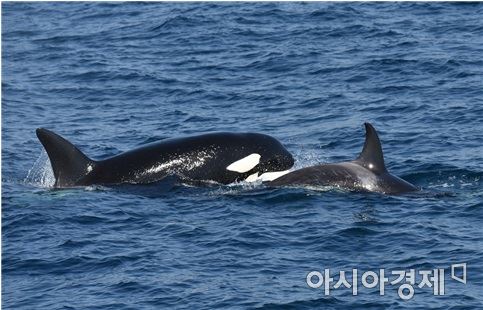 It is already known that orcas prey on sharks, but this is the first time actual hunting behavior has been captured on video. The photo shows an orca mother and calf discovered in March in Uljin, Gyeongsangbuk-do. Photo by Ministry of Oceans and Fisheries
[Asia Economy Reporter Bang Je-il] A pod of orcas hunting great white sharks, famously known from the movie 'Jaws,' was captured by a drone near the waters off South Africa.
On the 5th (local time), according to the British daily The Guardian, a pod of orcas, the top predators in the marine ecosystem, was filmed hunting the notoriously aggressive great white sharks. While it is already known that orcas prey on sharks, this is the first time the actual hunting scene has been captured on video.
The footage was taken near Mossel Bay, a port city in the Western Cape province located in the southwestern part of South Africa. Shark scientist Allison Towner was flying a drone over Mossel Bay on the afternoon of May 16th, filming a pod of five orcas. During filming, when the orcas spotted a great white shark, they scattered and the hunt began in earnest.
The video vividly shows five orcas chasing and hunting the great white shark. Scientists estimated that three more great white sharks were likely hunted in this event.
The Guardian added that among the five orcas hunting the great white sharks, one had previously attacked great white sharks several times, while the other four had not. This demonstrates that orcas can share and learn hunting techniques from each other.
Marine mammal expert Simon Elwen said, "Orcas are very intelligent and social animals," and added, "Their group hunting method is the secret to how orcas can be such efficient predators."
A related paper published in the scientific journal Ecology reported that after the appearance of orcas, the great white sharks, which were observed daily in this area, disappeared.
Researchers explained, "Just before the hunt, great white sharks were observed fleeing in panic in multiple directions in very shallow water less than 2 meters deep," and added, "A female great white shark fitted with a satellite tracking device was present in Mossel Bay on May 14th, just before the hunt, but by the 25th, she had fled to waters 400 km away."
Up to 45 days after the hunt, only one great white shark was sighted in this area. Co-researcher Allison Cock, a shark expert at South African National Parks, said, "Due to fear of the orcas, the great white sharks eventually abandoned their core habitat, which caused a chain reaction impacting the ecosystem and shark-related ecotourism."
© The Asia Business Daily(www.asiae.co.kr). All rights reserved.
















