National Assembly Budget Office '2023 and Medium-Term Economic Outlook'
More Pessimistic Than Government Forecast
[Asia Economy Sejong=Reporter Kwon Haeyoung] A bleak forecast has emerged that South Korea's total fertility rate will fall to the 0.6 range by 2026. Due to avoidance of marriage and childbirth, the ultra-low fertility crisis has led the country to the brink of a "population cliff."
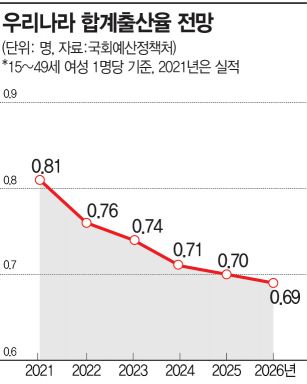
According to the "2023 and Mid-term Economic Outlook" report released on the 7th by the National Assembly Budget Office, the total fertility rate is expected to drop from 0.81 in 2021 to 0.69 in 2026. The total fertility rate refers to the average number of children a woman aged 15 to 49 is expected to have in her lifetime.
The Budget Office projected that the total fertility rate would enter the 0.7 range in 2022, recording around 0.76, then gradually decline to 0.74 in 2023, 0.71 in 2024, 0.70 in 2025, and plunge to the 0.6 range by 2026. This means the fertility rate, which was 1.30 in 2012, will have halved in just over a decade.
This outlook is gloomier than the government's forecast. Statistics Korea had predicted in its population projection released last year that the total fertility rate would be 0.78 in 2026. Statistics Korea expected the total fertility rate to bottom out at 0.70 in 2024 and then gradually rise to 1.0 by 2031.
Jin Ik, Director of the Economic Analysis Bureau at the Budget Office, commented, "According to the domestic population projection results, the total fertility rate is expected to continuously decline," adding, "With the decline in fertility rate and the increase in the elderly population, the number of deaths will rise, leading to natural population decrease." He further noted, "Sustained low fertility due to declining marriage rates and childbirth intentions, increased deaths, and net international population outflow are downward factors for the fertility rate."
The decline of the total fertility rate to the 0.7 range this year is considered a foregone conclusion. Both Statistics Korea and the Budget Office forecast 0.78 and 0.76 respectively, showing no disagreement. It is just two years since the rate entered the 0.8 range in 2020, and the drop to the 0.7 range is imminent. The number of births in the first half of this year fell by 8,116 (6.0%) from a year earlier to 127,138, marking the lowest level since statistics began in 1981, and the total fertility rate for the second quarter has already dropped to 0.75.
Meanwhile, the aging population combined with COVID-19 has caused a significant increase in deaths. The number of deaths in the first half of this year rose by 41,141 (27.0%) from a year earlier to 193,768, the highest since related statistics began in 1983. Due to the lowest number of births and highest number of deaths, the natural population decrease in the first half was 65,631, the largest decline since statistics began in 1983.
The Budget Office forecast that due to the effects of low fertility and aging, the population will decrease from 51.63 million in 2022 to 51.45 million in 2026, an average annual decline of 0.11%. Life expectancy is expected to increase from 81.0 years in 2022 to 82.3 years in 2026 for men, and from 86.7 years to 87.7 years for women during the same period, representing increases of 1.3 years and 1.0 year respectively.
© The Asia Business Daily(www.asiae.co.kr). All rights reserved.

















