Both South Korea and the US Still Face High Inflation
Fed's Tightening Resolve Remains
Officials Continue to Signal Rate Hikes
Credit Risk Remains a Variable
High Possibility of 50bp Rate Hike at October Monetary Policy Meeting
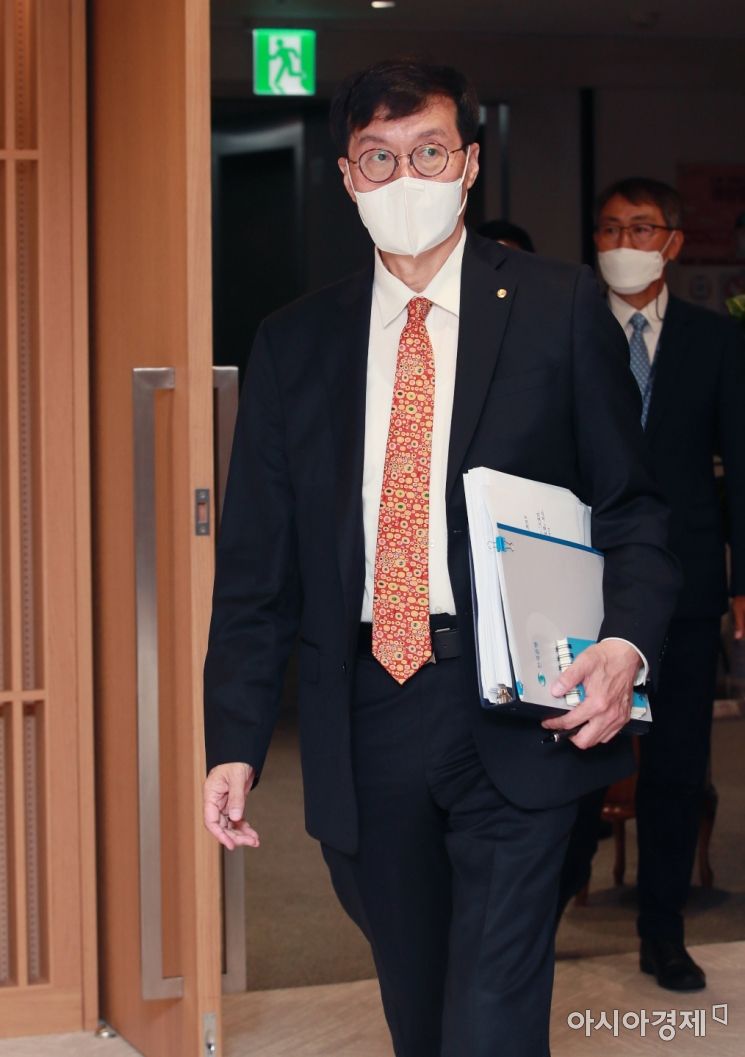 Lee Chang-yong, Governor of the Bank of Korea, is attending the Monetary Policy Committee meeting held at the Bank of Korea in Jung-gu, Seoul on the 13th. Photo by Kang Jin-hyung aymsdream@
[Asia Economy Reporter Hwang Yoon-joo] Kiwoom Securities on the 7th predicted that the Bank of Korea's Monetary Policy Committee (MPC) will raise the base interest rate by 50bp again at the November MPC meeting. Although credit risks have emerged, considering the still high inflation and the U.S. Federal Reserve's (Fed) tightening stance, the possibility of a 'big step' (raising interest rates by 50bp at once) is not small.
◆ Possibility of 'Big Step' at November MPC... Persistent Inflation Burden in Korea and the U.S. = An Ye-ha, a researcher at Kiwoom Securities, stated on the day, "In November, the Bank of Korea is expected to implement a big step rate hike following the Fed's 75bp increase." The basis is the expectation that the dollar's strength and inflationary pressures will continue after October.
The biggest problem is high inflation. Researcher An pointed out, "The U.S. is showing inflation in the 8% range, and Korea is also recording a 5% range inflation rate," adding, "Although the decline in oil prices has slowed the rise in commodity prices, the continued rise in service prices is also a burden."
Although real interest rates are rising rapidly due to the base rate hikes, it is still difficult to expect a policy shift from the Fed. Recent remarks by Fed officials also seem to significantly weaken expectations for a policy change.
On the 5th (local time), Raphael Bostic, President of the Federal Reserve Bank of Atlanta, said in a speech at Northwestern University's policy research institute, "I hope the policy will reach a moderately restrictive point by the end of the year, that is, 4?4.5% (base interest rate)." Mary Daly, President of the San Francisco Fed, also said in a Bloomberg TV interview on the same day that the market's expectations for rate cuts would not become reality.
Considering this, uncertainty about the final interest rate level remains high. Researcher An analyzed, "Currently, the market views the final policy rate level in Korea to be around 3.5?3.75%, but this can change depending on the Fed's stance," adding, "It remains a factor that can increase volatility."
However, the recent shift of attention to financial stability, such as the Bank of England's intervention following the sharp rise in UK interest rates, is a variable. Researcher An evaluated that if credit risks increase, the big step option might be abandoned.
◆ October MPC 'Big Step' Confirmed... "Lower Inflation Expectations" = Meanwhile, researcher An also stated, "At the October 12 MPC meeting, the base rate is expected to be raised by 50bp from the existing 2.50% to 3.00%." This is due to three issues: the Fed's tightening stance, exchange rates, and U.S. core consumer prices.
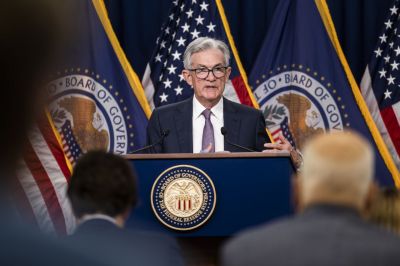
The market has raised the possibility that the Fed will continue giant step hikes in November following the September FOMC. Researcher An pointed out, "While inflation remains in the 5% range, the Fed's tightening pace has become steeper than expected," adding, "Back in July, the scenario of four consecutive giant step hikes in the U.S. was probably not considered."
If the Fed implements high-intensity tightening, Korea will inevitably have to adjust the pace of its rate hikes. Bank of Korea Governor Lee Chang-yong also said after the emergency macroeconomic and financial meeting on the 22nd of last month, "We will consider how our inflation and situation will be affected beyond the expected assumptions and present new forward guidance through the next MPC meeting." The market interprets this as confirming a 50bp hike at the October MPC.
Secondly, due to the Fed's giant step in September, the Korea-U.S. policy rate spread reversed to 75bp. Given recent inflation concerns caused by the sharp rise in exchange rates, the widening of the Korea-U.S. rate inversion is a burden.
Thirdly, changes in external conditions. Although economic conditions have not changed significantly, the likelihood that the U.S. core personal consumption expenditures (PCE) will remain at a high level has increased. Core PCE is one of the indicators the Fed watches. The U.S. core PCE inflation rate for August was 4.9%, higher than the market expectation (4.7%) and July's figure (4.7%).
Researcher An pointed out, "At least, the Fed is not yet giving expectations of a policy shift," adding, "To continuously lower inflation expectations, it will be difficult to give the perception that the rate hikes are nearing the end."
© The Asia Business Daily(www.asiae.co.kr). All rights reserved.


















