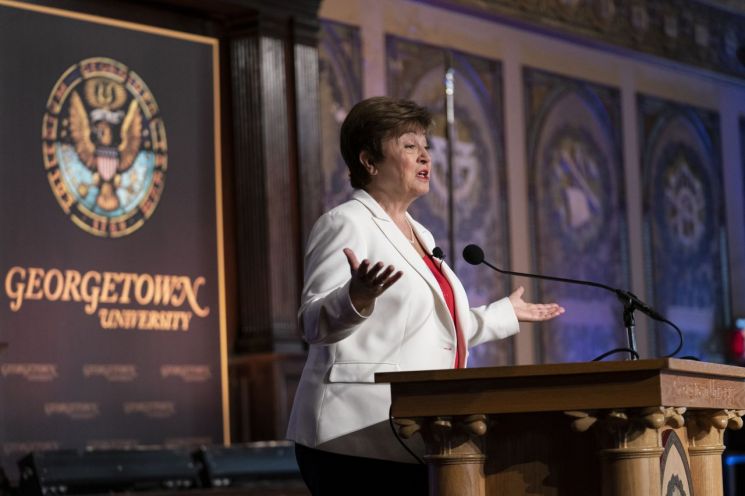
[Asia Economy New York=Special Correspondent Joselgina] Kristalina Georgieva, Managing Director of the International Monetary Fund (IMF), warned that the risk of a global economic recession has increased due to inflation, interest rate hikes, and ongoing supply chain disruptions. She confirmed that the world economic growth forecast for next year, scheduled to be released next week, will be revised downward from the previous 2.9%.
According to local media including The New York Times (NYT), Georgieva announced in a speech at Georgetown University on the 6th (local time) that the global economic outlook reflecting the recently heightened recession risks will be released next week. Georgieva said, "Multiple shocks, including the meaningless (Ukraine) war, have completely changed the economic situation," and pointed out, "Inflation has not been temporary but persistent." She confirmed that the growth forecast for next year will be lowered but did not mention specific figures.
This year, the IMF has continuously lowered its economic outlook. In April, it projected global economic growth rates of 3.6% for this year and next year, but just three months later in July, it revised them down to 3.2% for this year and 2.9% for next year. The IMF plans to hold its annual meeting with finance ministers and central bank governors from various countries next week in Washington DC to discuss the global economic situation.
Currently, the IMF expects that countries accounting for one-third of the global economy will experience at least two consecutive quarters of contraction either this year or next year. Georgieva mentioned, "Even when growth is positive, it can feel like a recession due to real income declines and rising inflation."
She also forecasted that global output will decrease by about $4 trillion (approximately 5,644 trillion KRW), equivalent to the size of the German economy, by 2026. She expressed concern, saying, "This is a significant blow to the global economy," and "The likelihood of worsening is greater than improvement."
The major risks facing the world identified by Georgieva on the day include the prolonged Russian invasion of Ukraine causing concerns over Europe's energy crisis, China's real estate market downturn, inflation in major countries, and simultaneous interest rate hikes. She viewed that these factors are increasing consumer anxiety and halting investment, causing the U.S. economy to lose momentum. In particular, emerging and developing countries, which have already been hit hard by high food and energy prices, are in an even more vulnerable position.
Georgieva stated, "We are undergoing a fundamental change in the global economy toward a more vulnerable world characterized by greater uncertainty, greater economic volatility, geopolitical confrontations, and more frequent and catastrophic natural disasters in a world of relative predictability." She also pointed out that higher debt and liquidity crises could lead to larger and more numerous economic shocks.
She emphasized that central banks must continue firm tightening. She said, "Inflation remains high," and "Fiscal policy should not accelerate while monetary policy is applying the brakes. This would create a very difficult and dangerous situation." She also urged expanded support for emerging and developing countries, noting that capital outflows are being observed due to interest rate hikes in advanced countries and a strong dollar.
Meanwhile, on the same day, U.S. Treasury Secretary Janet Yellen, in a speech at the Center for Global Development, said, "The challenge for major countries facing high inflation is price stability," adding, "However, it is important to recognize that tightening in advanced countries can have international spillover effects." She also noted that significant debt relief may be necessary in many emerging markets during debt crises.
© The Asia Business Daily(www.asiae.co.kr). All rights reserved.

![Clutching a Stolen Dior Bag, Saying "I Hate Being Poor but Real"... The Grotesque Con of a "Human Knockoff" [Slate]](https://cwcontent.asiae.co.kr/asiaresize/183/2026021902243444107_1771435474.jpg)














