Increasing Number of Golfers Seeking Fitting Centers... "No Longer Exclusive to Elite Golfers"
Reconfiguring Heads, Shafts, and Grips of Standard Products for Optimal Conditions
[Asia Economy Reporter Seohee Lee] The secret to playing golf well is simple. You just need to get the distance and direction right. However, this proposition remains an unsolved challenge not only for beginners but also for professional golfers on tour.
Golfers willingly endure effort to hit the ball a little farther and more accurately. They try switching clubs dozens of times or changing their swing form. There is one more method: customizing equipment to fit your body, known as 'Fitting.'
Interest in equipment fitting, once considered the domain of advanced players, is increasing among golfers. This is because even modifying only part of the equipment, without replacing the entire set at a high cost, can create golf clubs that perfectly fit one’s body.
Avoid if You Are an Inconsistent Beginner Golfer
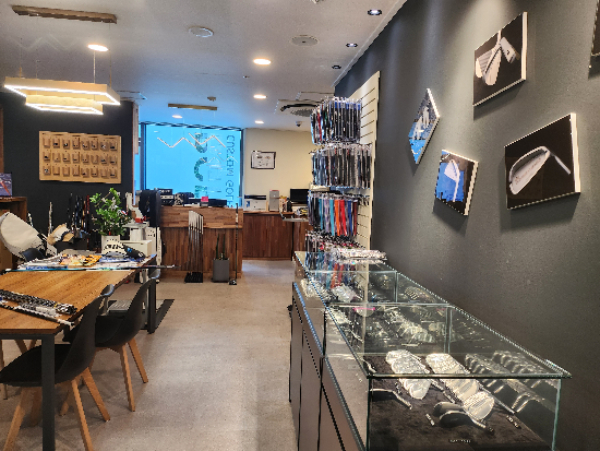
Fitting is, in short, the process of finding equipment optimized for the golfer. Optimization here means that the golfer can consistently hit the center of the clubface.
The first step in fitting is analyzing your swing data. Swing data can be obtained through analysis devices available at fitting centers. In Korea, two main devices are used at swing centers: ‘Flight Scope’ and ‘TrackMan.’
The data obtained includes various metrics, mostly based on the moment of impact between the club and the ball. These include ‘head speed,’ which indicates the speed of the clubhead; ‘dynamic loft,’ the angle of the clubhead; ‘attack angle,’ the direction the head moves; ‘face angle,’ the direction the clubface points; and ‘club path,’ the path the clubhead follows. The fitter analyzes these numbers and adjusts the weight and length of the head, shaft, and grip to find the optimal configuration.
However, if a beginner golfer cannot maintain a consistent swing and is erratic, the swing data will not have meaningful value. Kim Dongwook, head of the BG Golf Fitting Center Indukwon branch, said, “We do not recommend fitting for golfers who have just started. Fitting is meaningful for golfers who have a certain level of ball contact ability and can consistently hit the center of the clubface.”
Check Shaft Stiffness by 'CPM,' Not 'Flex'
To increase distance, first check the weight and stiffness of the shaft.
Generally, shafts used by amateurs weigh between 40g and 70g. Although the difference is only about 30g at most, its impact on the swing is surprisingly significant. If you have a fast head speed but still don’t get good distance, it’s worth checking if you are using a shaft heavier than your capability.
Shaft stiffness is also an important factor in increasing distance. Stiffness is indicated by 'Flex' and is broadly divided into six categories: L, A, R, SR, S, and X, in order of increasing stiffness. However, even within the same 'R' category, actual stiffness can vary slightly.
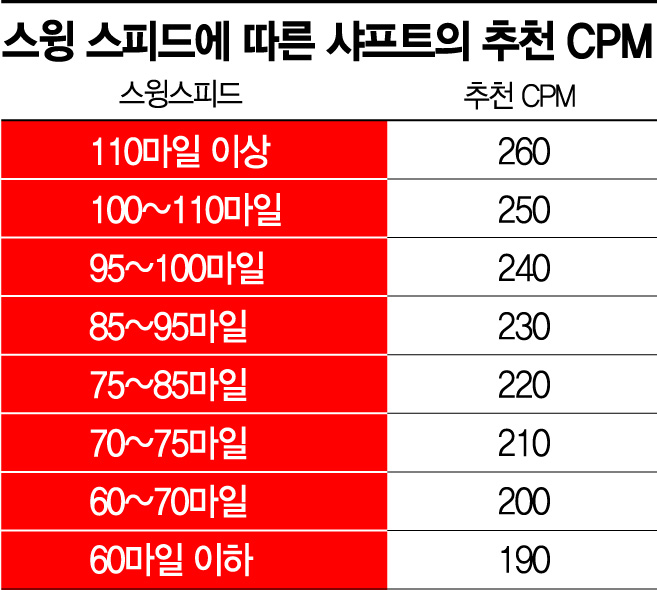
A more accurate standard for measuring shaft stiffness is the ‘CPM (Cycles Per Minute) measurement method.’ This measures the vibration frequency of the shaft per minute. The grip end of the shaft is fixed to a measuring device, and the head end is lightly flicked; then the number of vibrations in one minute is measured. The higher the shaft stiffness, the more vibrations occur in the same time; the lower the stiffness, the fewer vibrations. If you have a fast head speed, it is better to use a shaft with higher stiffness, i.e., higher CPM. Using a shaft that is too soft relative to your speed causes excessive shaking just before the ball contacts the clubface, reducing accuracy. It also prevents you from maximizing the head’s repulsive force, resulting in lost distance.
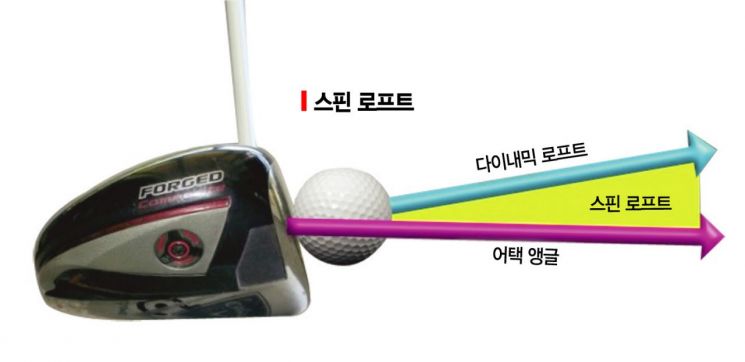
Research also shows that the smaller the ‘spin loft,’ the greater the distance. Spin loft refers to the angle formed between dynamic loft and attack angle. When this angle increases, energy loss occurs from the clubhead to the ball, reducing distance. In this case, increasing distance is more effective by raising the attack angle rather than lowering the dynamic loft.
Head Size and Shaft Length Must Fit Your Body
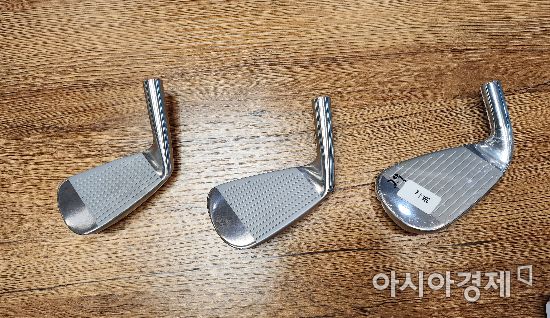 Various types of heads according to skill level. From left to right: advanced, intermediate, beginner.
 [Photo by Lee Seohee]
The distribution of the center of gravity in the clubhead is a decisive factor in determining the ball’s direction.
Generally, golfers use different heads depending on their skill level. Advanced players’ heads have a narrow sole width and a center of gravity concentrated in the middle. When the ball is struck at the exact center of the head, it flies straight in a straight line. Conversely, beginner heads have a wider sole and the center of gravity is spread across various parts of the head. Even if the ball hits slightly off-center, a certain level of accuracy and distance can be maintained, but accuracy is lower overall. If your shots keep going off target, first check whether you are using a head that matches your skill level.
Finding the appropriate club length is also important. If your impact point is formed inside the head, it may mean you are using a shaft that is too long. A longer shaft can increase head speed and improve distance, but it lowers the rate of solid contact.
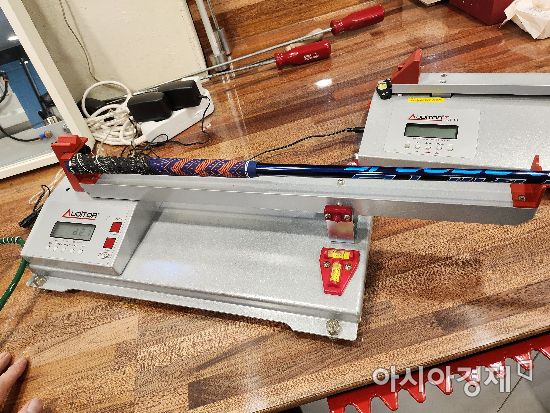
Adjusting Swing Weight Alone Can Change Your Shots
Swing weight is another factor to consider. Swing weight refers to the weight distribution of the head portion relative to the entire club. The higher the swing weight, the heavier the head feels comparatively. Swing weight is measured by fixing the grip end to an electronic device. The measurement is expressed by combining letters A to F and numbers 0 to 9. For example, A9 is one step lighter than B, and C3 is one step heavier than C2. Generally, men use D0 to D2, and women use C5 to C7.
If the swing weight is too high, the body’s center axis sways side to side, causing unstable shots. Conversely, if it is too low, the swing tempo becomes faster and the hitting feel deteriorates, reducing the ability to control the ball. Therefore, it is best to maintain swing weight at a certain level.
Choi Hyunmuk, a professional fitter at Titleist, said, “The factors determining shot distance and accuracy are very complex. Fitting involves finding the best result by adjusting various elements such as the shaft’s kick point and grip thickness.” He added, “Recently, many customers visit fitting centers not only to improve their swing data but also to experience various shafts and heads.”
© The Asia Business Daily(www.asiae.co.kr). All rights reserved.
![Clutching a Stolen Dior Bag, Saying "I Hate Being Poor but Real"... The Grotesque Con of a "Human Knockoff" [Slate]](https://cwcontent.asiae.co.kr/asiaresize/183/2026021902243444107_1771435474.jpg)


















