Pre-Notification of Korea-US-Japan Maritime Missile Drill
Opposition: "Taking Advantage of North Korea's Provocations, Korea-US-Japan Alliance Is Being Dragged In"
Ruling Party: "It's a Routine Drill, Baseless Offensive"
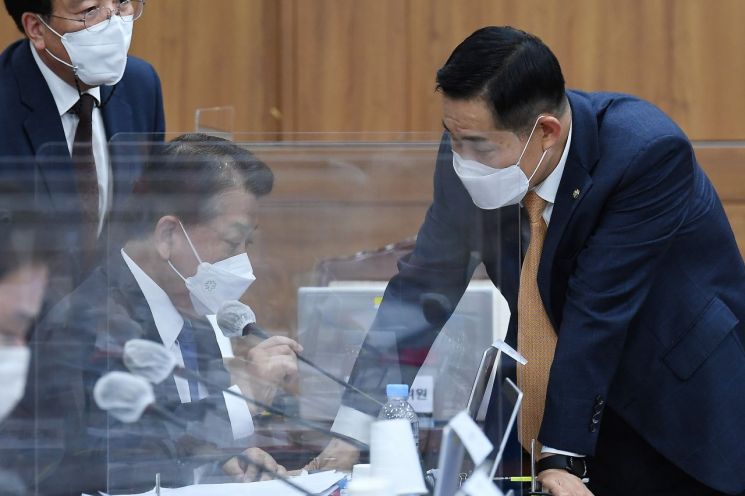 Conversation between the ruling and opposition party secretaries of the National Defense Committee. / National Assembly Press Photographers Group [Image source=Yonhap News]
[Asia Economy Reporter Jang Hee-jun] The National Assembly's National Defense Committee's audit of the Joint Chiefs of Staff ended in disruption after a clash between ruling and opposition parties over whether prior notice was given for the trilateral maritime missile exercise involving South Korea, the United States, and Japan.
Democratic Party lawmaker Kim Byung-joo directly criticized, saying, "I just received a text message about the South Korea-U.S.-Japan maritime missile exercise" as the Joint Chiefs of Staff audit resumed at the Yongsan office on the afternoon of the 6th. He added, "Why is the Joint Chiefs of Staff deceiving and not properly reporting? South Korea is being played by Japan's strategy."
Fellow party member Kim Young-bae said, "This was decided after a phone call between the U.S. and Japanese leaders, and I wonder if South Korea is being passed over without even being able to express its opinion," adding, "Although the trilateral exercise is conducted in international waters, it is not a frequent occurrence near the Korean Peninsula, so why are we just following Japan's lead?"
Opposition defense committee members continued to point out that the exercise was conducted without prior reporting to the National Defense Committee, that the U.S.-South Korea alliance appears to be expanding into a trilateral alliance with Japan following the missile incident, and especially that forming a military alliance with Japan is unacceptable.
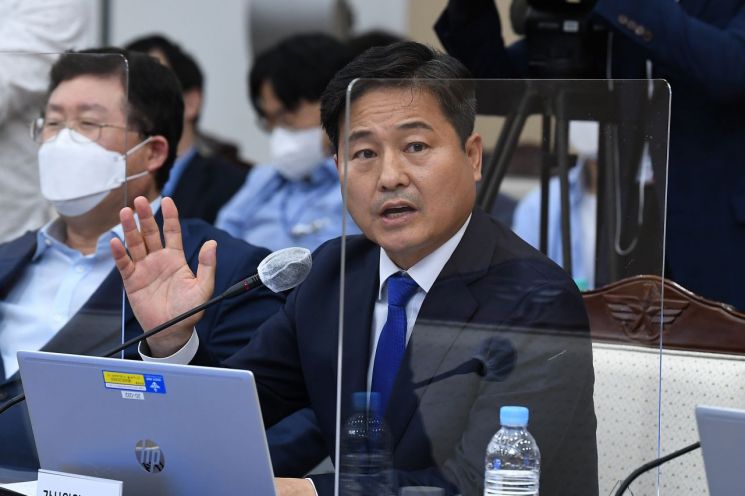 Kim Young-bae, Member of the Democratic Party of Korea. / National Assembly Press Photographers Group [Image source=Yonhap News]
On the other hand, People Power Party lawmaker Kim Ki-hyun argued, "In a situation where North Korea is firing short- and medium-range missiles and may even fire long-range ones, the South Korea-U.S.-Japan missile exercise is naturally necessary," adding, "While real-time reporting is needed if missiles are launched, why should defense exercises be reported in detail? This is a political attack."
Ruling party defense committee members interpreted that since North Korea's missiles passed over the East Sea and reached the Japanese archipelago, it should not be seen as a South Korea-U.S.-Japan alliance but rather as cooperation viewing North Korea as a common enemy. They stated that exaggerating the trilateral exercise as a trilateral alliance unnecessarily stokes excessive anti-Japanese sentiment.
Additionally, the ruling and opposition parties exchanged harsh words over the Presidential Security Service's refusal to allow an inspection of the air defense positions on the roof of the Ministry of National Defense.
Democratic Party lawmaker Kim Byung-joo pointed out, "Originally, after lunch, it was agreed between the ruling and opposition parties to inspect the Ministry of National Defense, the Joint Chiefs of Staff situation room, and the air defense positions on the Ministry's roof," adding, "When National Defense Committee members tried to check the air defense positions, the Presidential Security Service suddenly obstructed and prevented the inspection."
In response, People Power Party lawmaker Shin Won-sik countered, "Although the air defense positions are in the Joint Chiefs of Staff building, operational control is decided by the head of the Security Service, who can make a non-disclosure decision related to presidential security." Fellow party member Han Ki-ho also added, "If prior notice was given and Security Service approval was not granted, it is natural to block access."
As this debate continued between ruling and opposition lawmakers, loud voices were exchanged in the chamber. Committee Chair Lee Heon-seung attempted mediation by saying, "Let's hear the Joint Chiefs of Staff's position on issues such as the lack of prior notice for the trilateral exercise," but ultimately declared a recess.
© The Asia Business Daily(www.asiae.co.kr). All rights reserved.


















