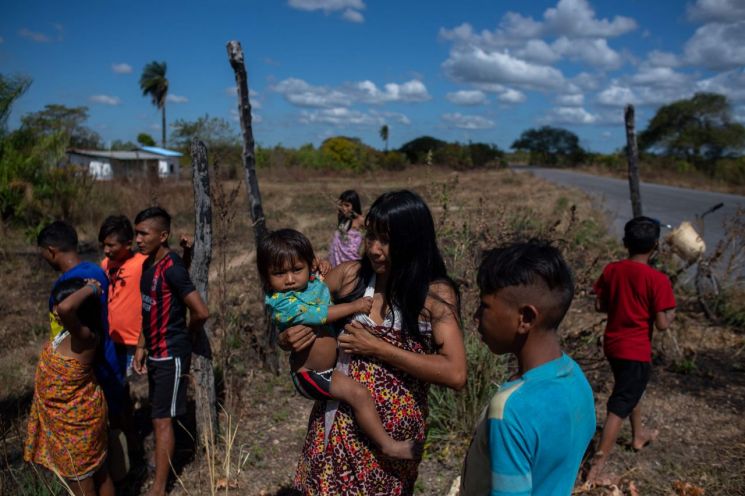
[Asia Economy Reporter Park Byung-hee] In 2020, when the COVID-19 pandemic began, the number of people living in extreme poverty worldwide increased by a record 70 million, Bloomberg News reported on the 5th (local time), citing the World Bank's announcement.
According to the World Bank's 'Poverty and Shared Prosperity 2022' report released that day, the number of people living in extreme poverty worldwide was estimated at approximately 719 million at the end of 2020. The increase of 70 million in one year was the largest since the World Bank began compiling related statistics in 1990.
The World Bank stated that the situation is expected to worsen due to the Ukraine war that broke out on February 24 this year, making it difficult to achieve the goal of eradicating extreme poverty by 2030.
It also predicted that if the current trend continues, about 570 million people, equivalent to 7% of the world's population, will remain in extreme poverty by 2030.
In this report, the World Bank set the daily income threshold for extreme poverty at less than $2.15.
Sixty percent of the extremely poor were concentrated in the Sub-Saharan Africa region. The number of extremely poor people in this region was 389 million, with a poverty rate of 35%.
The World Bank noted that the COVID-19 pandemic severely impacted the lowest income groups, exacerbating inequality. The average income of the bottom 40% income group decreased by 4%, which was twice the decline of the top 20% income group. It also estimated that without government fiscal support, the poverty rate in developing countries would have been 2.4 percentage points higher.
David Malpass, President of the World Bank, said, "The increase in extreme poverty and the decline in shared prosperity are concerning," emphasizing the need to "improve global capital allocation, stabilize currencies, reduce inflation, and adjust macroeconomic policies to foster growth in the middle-income class."
© The Asia Business Daily(www.asiae.co.kr). All rights reserved.
![User Who Sold Erroneously Deposited Bitcoins to Repay Debt and Fund Entertainment... What Did the Supreme Court Decide in 2021? [Legal Issue Check]](https://cwcontent.asiae.co.kr/asiaresize/183/2026020910431234020_1770601391.png)
















