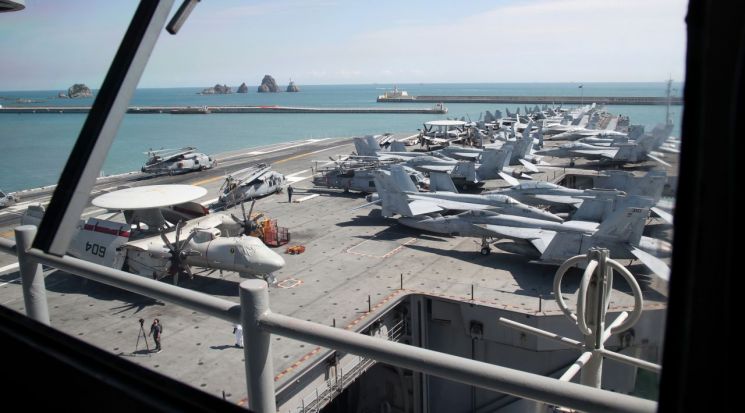
[Asia Economy Yang Nak-gyu, Military Specialist Reporter] The US Navy nuclear-powered aircraft carrier Ronald Reagan (CVN-76, 103,000 tons), which returned to the East Sea following North Korea's missile provocations, conducted ballistic missile defense exercises together with the Republic of Korea Navy and the Japan Self-Defense Forces.
According to the Joint Chiefs of Staff on the 6th, the exercise involved the Korean Aegis destroyer Sejong the Great (DDG, 7,600 tons), as well as the US Navy nuclear-powered aircraft carrier Ronald Reagan (CVN-76, 103,000 tons) and the Aegis destroyer USS Benfold (DDG 65, 6,900 tons) under the carrier strike group. The Ronald Reagan, commissioned in 2003, carries about 90 aircraft including F/A-18 Super Hornet fighters, E-2D Hawkeye early warning aircraft, and EA-18G Growler electronic warfare aircraft, with approximately 5,000 crew members onboard, earning it the nickname "floating military base."
The Japan Maritime Self-Defense Force dispatched the Aegis destroyer Chokai (DDG 176, 7,500 tons), the fourth ship of the Kong?-class. The Chokai was launched in August 1996 and commissioned as part of the 4th Escort Flotilla. It is evaluated to operate anti-submarine helicopters stably due to its installed landing facilities.
South Korea, the US, and Japan conducted the exercise assuming a scenario of North Korean ballistic missile provocations, focusing on mastering detection, tracking, and interception procedures through target information sharing.
The Joint Chiefs of Staff expressed expectations that "through this maritime missile defense exercise, operational capabilities and readiness to respond to North Korea's missile provocations will be further solidified."
The Ronald Reagan carrier strike group entered Busan on the 23rd of last month, conducted combined maritime exercises between South Korea and the US from the 26th to the 29th, and anti-submarine warfare exercises among South Korea, the US, and Japan on the 30th, before moving to Japanese waters.
However, after North Korea launched an intermediate-range ballistic missile (IRBM) flying 4,500 km on the 4th, the carrier group abruptly turned back the next day, the 5th, and re-entered the East Sea.
North Korea also conducted short-range ballistic missile (SRBM) provocations on the 25th of last month, the day before the South Korea-US joint exercises, on the 28th and 29th during the joint exercises, and on the 1st of this month, which is the day after the South Korea-US-Japan exercises and the Republic of Korea Armed Forces Day. After the IRBM launch on the 4th, it is analyzed that North Korea demonstrated operational capability of deployed weapons by launching two types of SRBMs mixed together on the morning of the same day.
© The Asia Business Daily(www.asiae.co.kr). All rights reserved.

















