Do Not Force 'Sacrifice'... 'On-Time Departure' Is Essential
"Think of It as Your Company" Leads to... "But I'm an Employee?"
Lack of Responsibility vs Working Harder to Leave on Time
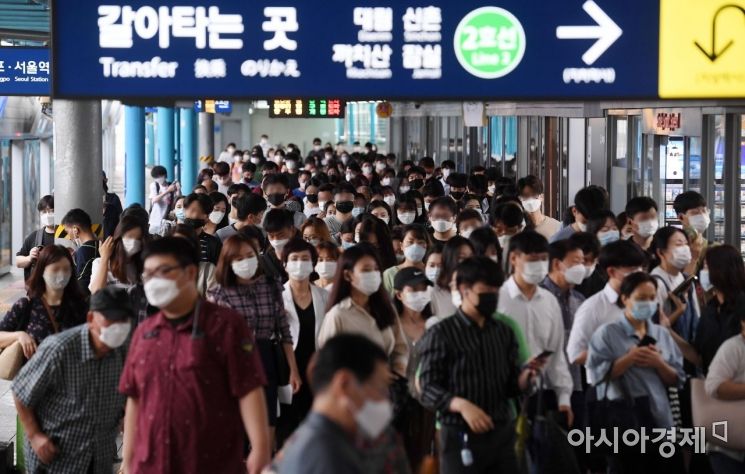
[Asia Economy Culture Intern Reporter Young] # A, a second-year office worker, leaves the company right at 6 p.m. It takes about 10 seconds to turn off the computer and another 10 seconds to pack up the bag. It takes less than a minute from saying goodbye to taking the elevator out of the building. A said, "Staying longer at work doesn't improve productivity," adding, "I prefer exercising or self-development after work rather than overtime pay."
For the MZ generation, who highly value 'work-life balance' and 'work environment,' so-called 'sharp quitting' is routine. Some ask why leaving work on time is a problem, but in Korean society, such sharp quitting still often draws disapproval. In fact, some older generations say it shows a lack of responsibility as a team member. When colleagues remain working, leaving early is criticized as selfish behavior beyond mere individualism.
In this context, people in their 20s and 30s show great interest in work-life balance, which means balancing work and life. The Korea Federation of Small and Medium Business analyzed 268,329 data points from social and online media related to MZ generation employment in SMEs from 2019 to May this year. The results showed that work-life balance and work environment accounted for 27.9%, higher than salary. In 2019, MZ job seekers' top interest was self-growth potential at 40.5%, followed by working hours at 14.9%. However, in the May survey this year, working hours rose to 25.8%, surpassing self-growth potential at 21.3%.
This has led to a kind of generational conflict. When a boss says, "Think of this as your company and work hard," the response is often, "I'm an employee, you know?"
On the other hand, the MZ generation finds it hard to understand the very demand for overtime. Office worker B said, "Leaving work on time doesn't mean doing a sloppy or half-hearted job," adding, "I actually work hard because I want to leave early." He explained, "There is also the image of the 'K-office worker' who seems indifferent but performs well. They reach a level where they complete tough tasks quickly and leave early."
According to the 'Comprehensive Diagnosis Report on Generational Conflict and Corporate Culture in Korean Companies' released by the Korea Chamber of Commerce and Industry, six out of ten office workers felt generational differences. Especially, perceptions of leaving work on time and work instructions showed marked differences by generation. Older generations claimed leaving on time showed 'lack of responsibility for work.' However, younger generations countered that normalizing overtime is inappropriate. Unlike the older generation who work out of a sense of duty, the MZ generation places more importance on working hours as stated in their labor contracts.
 Buildings clustered along Teheran-ro in Gangnam-gu, Seoul, remain illuminated late into the night. Photo by Jinhyung Kang aymsdream@
Gen Z, born in 1999, also ranked companies that do not allow leaving work on time as the top 'companies to avoid for employment.' The Korea Research Institute for Vocational Education and Training surveyed 8,353 people born in 1999 in 2019 and 2020 about 'job characteristics that make young people reluctant to work or lead to resignation.' The result showed that 'workplaces where working hours are not respected' scored 2.94 out of 4, ranking first in avoidance.
Workplaces that do not respect working hours were avoided regardless of gender or education level, followed by ▲uncomfortable commuting environment (2.74 points) ▲lower-than-expected salary (2.74 points) ▲non-regular employment (2.68 points) ▲companies without a five-day workweek (2.55 points).
Also, in a 2020 survey by Saramin on 'the types of companies MZ generation least want to join,' 'companies with many overtime and weekend work' ranked first at 31.5%. The reasons chosen were 'fear of losing physical and mental health' at 44% and 'lack of personal life' at 38.7%. Experts say that for the MZ generation, companies are less about lifelong employment and more about self-growth potential and work-life balance.
Experts analyze that people in their 20s and 30s want to separate work life from personal life and live proactively. Professor Kwak Geum-ju of Seoul National University's Department of Psychology said, "The MZ generation, who value work-life balance, clearly distinguish between private and public spheres," adding, "They separate their company persona from their after-work self and prioritize personal life over the company." She continued, "They think more about hobbies that improve quality of life than about company work."
© The Asia Business Daily(www.asiae.co.kr). All rights reserved.

















