[Asia Economy Reporter Jeong Hyunjin] The Biden administration in the United States has officially begun the process to establish detailed regulations related to subsidy payments under the Inflation Reduction Act (IRA), which excluded Korean-made electric vehicles from subsidy eligibility. Attention is focused on whether Korea's position can be reflected in the detailed regulations, given the practical difficulty of amending the law.
On the 5th (local time), the U.S. Department of the Treasury and the Internal Revenue Service (IRS) announced that they will mention six individual items related to tax benefits provided under the IRA and collect public opinions from stakeholders by July 4.
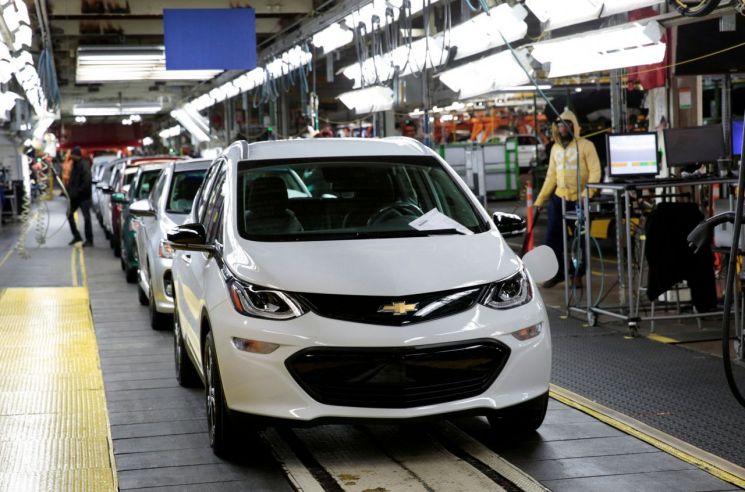
A key point from Korea's perspective concerns the maximum $7,500 (approximately 10.5 million KRW) tax credit benefit for clean energy vehicles, i.e., electric vehicles. Since last month, the IRA added the condition of 'final assembly in North America' for subsidy eligibility, meaning that Hyundai and Kia, which export electric vehicles entirely manufactured in Korea for sale in the U.S., do not qualify for the benefit.
Additionally, starting next year, to receive $3,750, at least 50% (gradually increasing to 100% by 2029) of the battery components must be manufactured or assembled in North America. To receive the remaining $3,750, at least 40% (increasing to 80% by 2027) of the critical minerals in the battery must be mined or processed in the U.S. or countries with which the U.S. has a Free Trade Agreement (FTA).
At the same time, if the entity mining, processing, or recycling the critical minerals or manufacturing and assembling the battery components is a 'Foreign Entity of Concern,' subsidies will be excluded starting from 2025 and 2024, respectively.
Therefore, the definition of the term 'final assembly in North America' itself is crucial. If this criterion is not met, subsidies cannot be received even if the critical mineral or battery component requirements are fulfilled.
The Treasury Department requested opinions in this notice on whether it is necessary to clarify the definition of 'final manufacture or assembly' related to 'battery components' and which regions are included in 'North America.' They also sought input on how to calculate the value and proportion of critical minerals and factors or definitions to consider when determining whether critical minerals were mined or processed, or battery components were produced or assembled in North America.
Simultaneously, they requested opinions on whether the definition of 'Foreign Entity of Concern' needs to be clarified. The IRA borrowed the definition from the Infrastructure Act when referring to Foreign Entities of Concern, but there have been criticisms that it is too broad, including companies under the jurisdiction of countries such as China and Iran.
The Treasury plans to hold roundtable discussions (public hearings) involving key stakeholders over the coming weeks to hear diverse opinions. Treasury Secretary Janet Yellen stated in a press release, "The Treasury is prepared to fulfill its responsibilities related to the implementation of the IRA and looks forward to engaging with stakeholders and the public who will benefit from the provisions of the law."
© The Asia Business Daily(www.asiae.co.kr). All rights reserved.

















