Ministry of Land, Infrastructure and Transport Raises Late-Night Taxi Call Fees to Resolve Taxi Crisis
90% of Call Fees Distributed to Taxi Drivers
Mobility Platform Profitability Hit
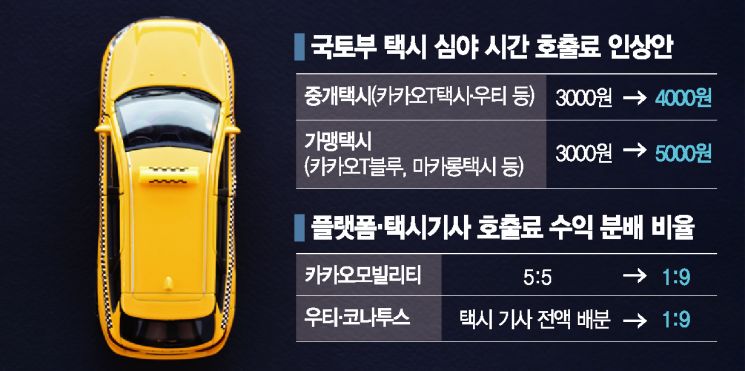
[Asia Economy Reporter Kang Nahum] The government has introduced a policy to expand the late-night flexible call fee to resolve the late-night taxi crisis. The core of the policy is to raise the late-night call fee and ensure that about 90% of the call fee revenue goes to taxi drivers. However, the mobility industry, which has relied on call fees as a main source of income, is once again being seen as a victim of government policy.
Still Operating at a Loss... Raising Call Fees and Giving 90% to Taxi Drivers
According to the Ministry of Land, Infrastructure and Transport and the mobility industry on the 6th, under the new late-night flexible call fee expansion policy, the current maximum call fee of 3,000 KRW during late-night hours (10 PM to 3 AM) will be adjusted to a maximum of 4,000 KRW for intermediary taxis and up to 5,000 KRW for franchise taxis. The plan also includes a provision that 90% of the call fee will go to taxi drivers.
This measure will be piloted in the metropolitan area until the end of the year. The Ministry of Land, Infrastructure and Transport plans to implement it in other regions with severe taxi shortages if local governments, platforms, and the taxi industry request it. Whether to apply the late-night flexible call fee will be optional based on the passenger's preference, and the current free call option will remain available. Additionally, the call fee will be flexibly applied within the upper limit depending on taxi demand and supply.
The late-night flexible call fee will be sequentially launched by each platform starting mid-month along with the lifting of the driving restrictions, and the individual taxi industry plans to support the expansion of taxi supply by organizing and operating late-night shifts.
Accordingly, the current maximum taxi call fee of 3,000 KRW will increase to a maximum of 5,000 KRW for franchise taxis such as KakaoT Blue and Makgeolli Taxi, and up to 4,000 KRW for intermediary taxis such as KakaoT and UT. Although consultations with the industry regarding the call fee increase have been completed, it is expected to take about 2 to 3 weeks for platform companies to build the system. It is anticipated that late-night taxis can be called with the increased call fee within this month.
Unable to Cover Platform Operating Costs... Concerns Over Blame Shift if Taxis Are Unavailable
Although this plan was prepared through industry consultations, the mobility industry's true feelings differ. They have relied on taxi call fees as their main source of income but now face a situation where they must give this up.
The biggest impact is expected to be on Kakao Mobility. Kakao Mobility has so far split the franchise taxi call fees 50-50 with taxi drivers. If taxi drivers receive 90% of the call fee, a decline in profitability is inevitable. Kakao Mobility leads the mobility industry in market share but has posted operating losses of 21.1 billion KRW in 2018, 22.1 billion KRW in 2019, and 13 billion KRW in 2020, only turning a slight operating profit of 12.6 billion KRW last year.
Additionally, latecomers in the mobility sector, who have reluctantly distributed the entire call fee to taxi drivers to secure drivers, now face a situation where their choice regarding call fee distribution is virtually eliminated by this policy, making business operations difficult.
A representative from a mobility platform expressed concern, saying, "With an unfavorable distribution structure leading to inevitable profit decline, raising the call fee may cause users to leave."
Another concern in the mobility industry is the possibility of government policy failure. If the call fee is raised but taxi driver supply does not improve and taxis remain unavailable, users are likely to hold the platform they use responsible.
An industry insider said, "When taxis are unavailable, passengers tend to blame the platform they are using immediately. We have implemented various win-win policies so far, but if the government's policy to raise call fees fails, there is concern that mobility platforms will once again be seen as greedy companies only interested in money."
© The Asia Business Daily(www.asiae.co.kr). All rights reserved.

















