- North Korea's Additional Ballistic Missile Provocation Prompts "Strong ROK-US Alliance and ROK-US-Japan Security Cooperation"... NSC Warns of "Strong Response"
- Yoon to Talk with Japanese Prime Minister Kishida in Afternoon, May Discuss North Korea Cooperation and ROK-Japan Relations Normalization
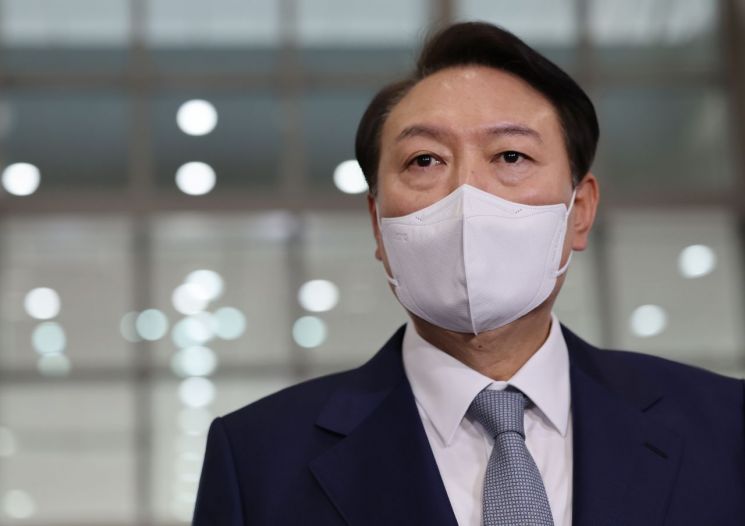
[Asia Economy Reporter Baek Kyunghwan] President Yoon Suk-yeol stated on the 6th regarding North Korea's additional ballistic missile provocations, "Our government will thoroughly protect the lives and safety of our people based on a strong ROK-US alliance and ROK-US-Japan security cooperation." This indicates a firm preparedness against North Korea's continuous provocations. President Yoon has repeatedly warned that North Korea's nuclear provocations will face resolute responses from allied countries and the international community.
On the morning of the same day, President Yoon, speaking to reporters on his way to the Yongsan Presidential Office, expressed concerns that "security situations internationally, including Ukraine, are not easy," and made these remarks.
He repeatedly emphasized the ROK-US and ROK-US-Japan security alliances. President Yoon explained, "This morning, North Korea launched two short-range missiles, and the day before yesterday, they launched an IRBM (Intermediate-Range Ballistic Missile) with a range of 4,000 km targeting Guam and passing over the Japanese archipelago." He added, "Guam is where major U.S. strategic assets are stationed in case of emergencies on the Korean Peninsula. The IRBM aims to strike strategic assets deployed on the Korean Peninsula." Furthermore, he elaborated, "Because the situation is serious, the aircraft carrier Ronald Reagan, which had completed the ROK-US joint exercises and was heading to its next destination, entered our waters around 8 p.m. last night."
An emergency National Security Council (NSC) Standing Committee meeting was held again after two days. The National Security Office convened the NSC Standing Committee chaired by Kim Sung-han to discuss countermeasures related to North Korea's launch of two short-range ballistic missiles. The committee members focused on the fact that this provocation occurred while a United Nations Security Council meeting was being held to discuss North Korea's ballistic missile launches, strongly condemning it as an unacceptable challenge to the international community. They also warned that North Korea's provocations will face even stronger responses, as demonstrated by the redeployment of the U.S. carrier strike group to the East Sea.
President Yoon is expected to focus on discussing coordinated responses to North Korean missiles during a phone call with Japanese Prime Minister Fumio Kishida in the afternoon. In particular, they are likely to express condemnation of North Korea's intermediate-range ballistic missile that passed over Japanese airspace the previous day and share ways to closely respond to North Korea's nuclear and missile provocations through trilateral cooperation based on the ROK-US alliance and the US-Japan alliance. According to the Japanese Prime Minister's Office, Prime Minister Kishida expressed a desire to communicate with President Joe Biden of the United States by phone and then with South Korea regarding security issues.
There is also interest in whether the two leaders will begin dialogue to normalize South Korea-Japan relations beyond security cooperation. When asked by reporters on his way to work whether past issues would be discussed in addition to security cooperation during the South Korea-Japan summit call, President Yoon replied, "I do not know exactly what topics will be discussed or mentioned during the call with Prime Minister Kishida, but yesterday, Prime Minister Kishida made quite progressive remarks in the Japanese parliament."
He continued, "Looking at public opinion in Japan's political circles, they are important neighbors with whom we must jointly address various international challenges, and there have been remarks about the early normalization of South Korea-Japan relations, so I think related matters will be mentioned." This is interpreted as President Yoon subtly expressing expectations for progressive discussions between the two leaders on past issues between South Korea and Japan, including compensation for forced labor victims.
© The Asia Business Daily(www.asiae.co.kr). All rights reserved.
![Clutching a Stolen Dior Bag, Saying "I Hate Being Poor but Real"... The Grotesque Con of a "Human Knockoff" [Slate]](https://cwcontent.asiae.co.kr/asiaresize/183/2026021902243444107_1771435474.jpg)
















