EU Legislative Speed... Leading Global Discussions
South Korea Cautious Amid Big Tech Offensive... National Assembly Suddenly Adopts 'Caution' Despite Bill Proposal
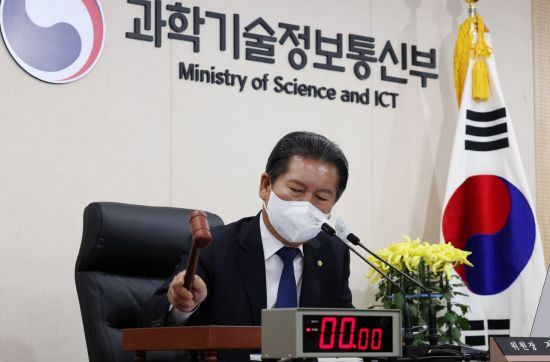 On the 4th, at the National Assembly Science, Technology, Information and Broadcasting Committee's audit of the Ministry of Science and ICT held at the Government Sejong Complex, Committee Chairman Jeong Cheong-rae of the Democratic Party is striking the gavel.
 [Photo by Yonhap News]
[Asia Economy Reporter Oh Su-yeon] The National Assembly, which had proactively sought to collect network usage fees from big tech companies, is now holding back, seemingly cautious of YouTubers. While the Korean political sphere hesitates, the European Union (EU) is accelerating its legislation, likely taking the lead in the global discussion.
According to major foreign media and related industries on the 6th, the EU is reportedly preparing a bill that requires big tech to share network costs. Reports indicate that the EU is considering ways for large content providers (CPs) to contribute to infrastructure funding without undermining the concept of net neutrality. In May, the EU Commission announced it would release a draft of the Connectivity Infrastructure Act by the end of the year.
If the EU enacts this bill, it will be the world's first legislation concerning network infrastructure investment costs, thereby seizing the lead in global information and communication technology (ICT) policy. Regarding this, investment bank Barclays projected that if the bill is enacted, it would bring annual profits of 3 billion euros (approximately 4.2186 trillion KRW) to the European telecommunications industry.
While the EU is speeding up legislation related to network usage fees, the Korean political sphere, which had previously initiated legislation on network usage fees, has recently adopted a cautious stance. Initially, lawmakers from both ruling and opposition parties proposed seven bills related to network usage fees and contract agreements, forming a broad consensus and even holding a public hearing last month before proceeding with legislation. The Democratic Party included a law to prevent free-riding on networks among its 22nd National Assembly livelihood legislative tasks and formed a task force (TF) to prevent big tech's unfair practices.
However, recently, they appear to be holding back amid public pressure from big tech. Google YouTube has encouraged participation in petitions opposing the network usage fee bill, and Twitch lowered video quality citing increased operating costs in Korea. Moreover, on the 2nd, Lee Jae-myung, the party leader, posted on Twitter, "There seem to be issues with the network usage fee law," which reversed the momentum. Jeong Cheong-rae, a member of the Science, Technology, Information and Broadcasting Committee from the Democratic Party, told Ddanzi Ilbo, "This is a narrow and distorted patriotic marketing effort to protect a small number of domestic internet service providers (ISPs), which risks causing the collapse of domestic CPs."
On the 4th, during the Ministry of Science and ICT's audit by the Science, Technology, Information and Broadcasting Committee, Democratic Party lawmaker Jang Kyung-tae pointed out that telecommunications companies have not submitted data that could serve as a legislative basis, stating, "The very attempt to resolve conflicts between private companies through legislation is problematic."
Disputes between ruling and opposition party secretaries in the committee also continued. When Park Sung-joong of the People Power Party criticized, "The opposition held a public hearing to collect network usage fees, but after Google, Netflix, and others jointly attacked creators, they seem to have backed down," Cho Seung-rae of the Democratic Party responded, "You should ask the ruling party's position, not the opposition's. They need to clarify their positions and then ask."
Additionally, the Ministry of Culture, Sports and Tourism expressed concerns during the Culture, Sports and Tourism Committee audit the previous day, submitting a stance to Democratic Party lawmaker Lee Sang-heon that "there are opinions that this could increase the burden on domestic content creators, so sufficient opinion gathering is necessary." Although the ruling and opposition parties had formed a consensus during the first half of the National Assembly, diverging opinions have begun to emerge, making legislation on network usage fees likely to face difficulties.
Meanwhile, discussions on network usage fees are also expected to continue during the Korea Communications Commission audit held on the same day. The National Assembly has decided to summon Nancy Mable Walker, head of Google Korea, and Reginald Shomtonson, head of Netflix Services Korea, to the comprehensive audit of the Korea Communications Commission scheduled for the 21st.
© The Asia Business Daily(www.asiae.co.kr). All rights reserved.

















