China Overtakes Dollar as Russia's Top Payment Currency... Prioritizing National Interests
Limited Internationalization of Yuan Due to Low Global Trust
[Asia Economy Senior Reporter Cho Young-shin] The Chinese yuan has surpassed the US dollar, the key global currency, to become the largest settlement currency in Russia. Some argue that China is gaining practical benefits of internationalizing its currency through the Russia-Ukraine war. There is also analysis that China is reducing the use of the dollar in international trade to strengthen its foreign exchange defense capabilities.
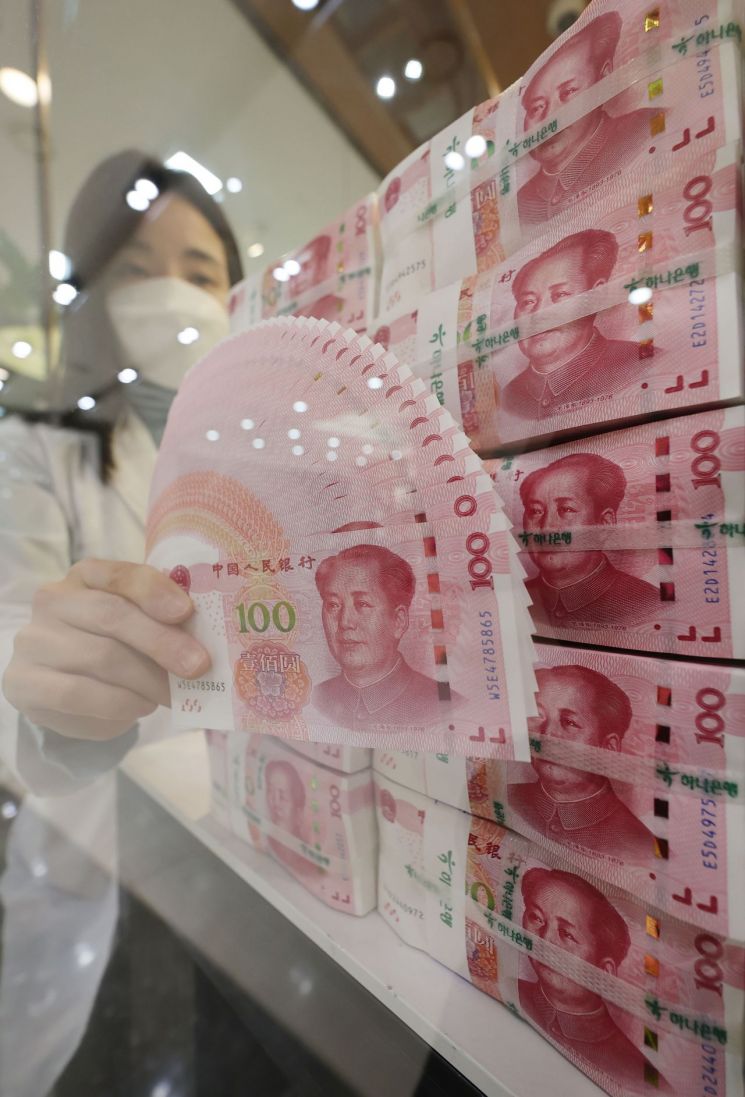
Chinese media including Shanghai Securities News reported on the 6th that on the 3rd (local time), the number of yuan-ruble transactions at the Moscow Foreign Exchange Market reached 64,900. The total transaction amount that day was 70.3 billion rubles (approximately 1.664 trillion Korean won), marking an all-time high.
On the same day, the number and amount of ruble-dollar transactions were only 29,500 and 68.2 billion rubles, respectively. This is the first time the yuan has overtaken the dollar in Russia.
On the following day, the 4th, the transaction amount between yuan and ruble was 63.9 billion rubles (46,000 transactions), exceeding the ruble-dollar transaction amount of 59.4 billion rubles (21,500 transactions).
In this regard, Chinese media analyzed that the yuan surpassed the dollar due to increased trade between China and Russia. According to the General Administration of Customs statistics, from January to August this year, the trade volume between China and Russia reached 117.2 billion dollars (167 trillion Korean won), a 31.4% increase compared to the same period last year.
According to the Society for Worldwide Interbank Financial Telecommunication (SWIFT), the total yuan settlement amount in August surged by as much as 9.25% compared to the previous month. China also uses its own payment system, the "Cross-Border Interbank Payment System (CIPS)," so the actual yuan settlement amount is estimated to be higher than SWIFT data.
After Russia's invasion of Ukraine, as the US and other Western countries imposed sanctions on Russia, trade between China and Russia increased. In particular, on the 5th of last month, China and Russia agreed to settle natural gas sales payments in yuan instead of dollars, which is expected to cause a sharp increase in yuan-ruble transactions. China's state-owned China National Petroleum Corporation (CNPC) signed a contract with Russia's state-owned gas company Gazprom to trade natural gas with 50% payment in yuan and 50% in rubles.
Internationalization of the yuan has been a long-cherished goal pursued by Chinese authorities since 2008. Despite more than ten years of effort, the share of yuan in international settlements remained stagnant. The Russia-Ukraine war has served as a catalyst for yuan internationalization.
As of the first half of this year, the yuan accounted for 2.88% of global foreign exchange reserves (according to IMF), ranking fifth among world currencies. This is the highest ranking since statistics were first published in 2016.
Expanding the share of yuan in international settlements also helps China's financial authorities defend the currency. In the first half of this year, China's natural gas imports from Russia amounted to 2.16 billion dollars (3 trillion Korean won). Since the payment for natural gas imports to Gazprom in the second half of this year was made in yuan, China can preserve its dollar reserves.
Renmin University International Monetary Research Institute researcher Tianzi said, "The risk of the dollar's credibility collapsing is increasing due to the US's irresponsible monetary policy," and added, "As the de-dollarization trend progresses, more countries will recognize the yuan as an international currency."
However, obstacles remain, such as yuan transactions being concentrated in Russia, developing countries using the yuan for settlement payments, low international trust in China's financial system, and rising tensions in the Taiwan Strait. Therefore, there is growing analysis that the expansion of yuan settlement share is temporary and limited.
© The Asia Business Daily(www.asiae.co.kr). All rights reserved.

















