Price Increase Slows for Second Month... 378 of 458 Items in Statistics Korea Survey Rise
116 Items See Over 10% Increase... Significant Food Price Hikes in Cabbage, Radish, etc.
All 39 Dining Out Items Also Rise
[Asia Economy Sejong=Reporter Kwon Haeyoung] Prices of 8 out of 10 consumer price survey items have risen compared to a year ago. In particular, dining out, which recorded the highest increase rate in 30 years, saw price hikes across all items. Although the government maintains the theory that inflation will peak around 'late September to early October' as the inflation rate has slowed for two consecutive months, the rapidly rising perceived inflation is increasing the burden on ordinary citizens.
According to an analysis of Statistics Korea's 'September Consumer Price Trends' on the 6th, out of 458 surveyed items, prices of 378 items increased compared to the same period last year. Fifty items saw price decreases, and 30 items remained unchanged.
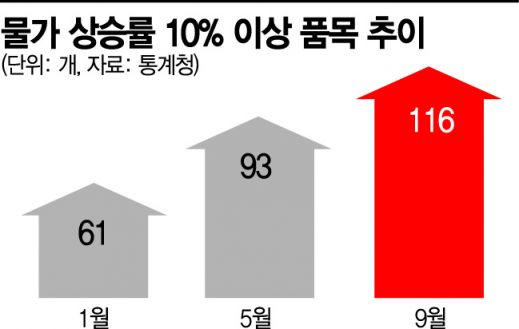
The number of items with inflation rates exceeding 6% reached 204 (44.5%), nearly half of all items. Items with inflation rates exceeding 10% also reached 116 (25.3%). In January this year, 61 items had inflation rates over 10%, but as inflation continued, the number increased to 93 in May and 116 in September.
The price increase in food items, which are mainly placed in shopping baskets, is alarming. Looking at individual items, the price of baechu (Napa cabbage) soared 95.0% compared to a year ago, showing the largest increase, followed by radish (91.0%), cooking oil (55.2%), and carrots (48.1%), all showing significant price surges. Among the top 10 items with the highest price increases, 9 were food items. The price of kerosene, mainly used for indoor heating in winter, also surged 71.4% compared to a year ago.
In the case of dining out, all 39 items surveyed by Statistics Korea showed price increases. Items commonly enjoyed by ordinary people, such as hamburgers (13.5%), galbitang (beef short rib soup) (12.9%), gimbap (12.9%), jajangmyeon (black bean noodles) (12.2%), haejangguk (hangover soup) (12.1%), ramen (11.8%), and tteokbokki (spicy rice cakes) (11.7%), showed steep price rises.
On the other hand, many items with prices unchanged from a year ago were public services. These include road tolls, train fares, subway fares, intercity bus fares, broadcasting reception fees, and administrative fees. City bus fares, real estate brokerage fees, and kindergarten tuition fees decreased compared to a year ago.
Although inflation may have passed its peak or is likely to peak this month as the government expects, concerns remain that high inflation rates of 5-6% will continue for some time. Oil prices and exchange rates are also unstable factors.
Juwon, head of the Economic Research Office at Hyundai Research Institute, said, "Inflation may have passed its peak, but with oil price variables and rising electricity and gas rates, it is difficult for inflation to stabilize rapidly," adding, "As the inflation rate slows down gradually, there is a possibility that the 5% inflation rate will persist for a long time."
© The Asia Business Daily(www.asiae.co.kr). All rights reserved.
![User Who Sold Erroneously Deposited Bitcoins to Repay Debt and Fund Entertainment... What Did the Supreme Court Decide in 2021? [Legal Issue Check]](https://cwcontent.asiae.co.kr/asiaresize/183/2026020910431234020_1770601391.png)
















