Proven Effectiveness Through Joint Development and Field Verification with HiAir Korea
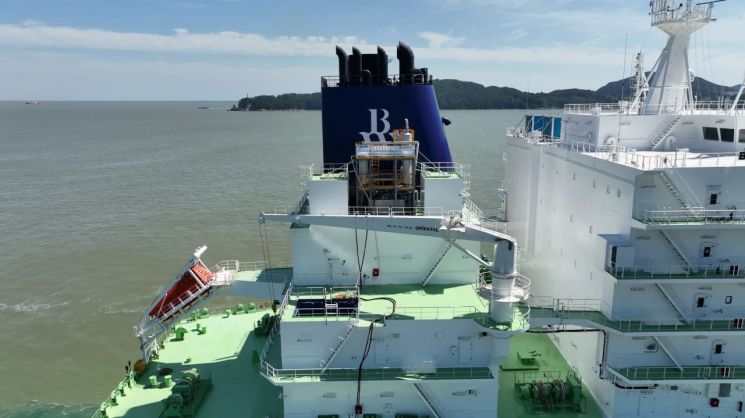 The carbon dioxide capture and storage device (OCCS), jointly developed by Daewoo Shipbuilding & Marine Engineering and HiAir Korea, is installed on an LNG carrier. Photo by Daewoo Shipbuilding & Marine Engineering
[Asia Economy Reporter Jeong Dong-hoon] Daewoo Shipbuilding & Marine Engineering (DSME) announced on the 6th that it has recently completed successful performance verification by installing carbon dioxide capture and storage (OCCS) equipment on an actual LNG carrier.
This successful real-world verification of the OCCS equipment has solidified DSME's position as a leader in the field of eco-friendly shipbuilding through carbon neutrality. DSME has been jointly developing OCCS with the domestic shipbuilding equipment company Hi-Air Korea since 2020.
The OCCS technology verified by DSME absorbs a portion of the carbon dioxide in exhaust gases generated during ship operation through an absorbent sodium hydroxide (NaOH) aqueous solution and converts it into a mineral form. The absorbent solution is then regenerated and reused in the carbon dioxide absorption process. The captured carbon dioxide is stored in mineral form and can be offloaded onshore after docking or discharged into the ocean depending on the results of the ongoing marine environmental impact assessment.
DSME installed this equipment on an actual vessel and completed the continuous process of absorption, regeneration, and mineralization of carbon dioxide contained in the exhaust gases.
DSME’s technology is characterized by very low energy consumption compared to other carbon dioxide capture technologies, and the amount of additional carbon dioxide generated by operating the equipment is also relatively minimal. In particular, the equipment is relatively compact, which is expected to attract significant attention in the market. DSME holds 42 domestic and international patents related to this technology.
The International Maritime Organization (IMO) continues to strengthen regulations on greenhouse gas emissions, including carbon dioxide, based on the Energy Efficiency Design Index (EEDI/EEXI) and Carbon Intensity Indicator (CII) standards. Ships that fail to meet these strengthened regulations face operational restrictions, reducing their competitiveness in the shipping market. The shipbuilding and shipping industries are actively developing technologies to achieve 'carbon neutrality' to prevent global warming.
DSME is closely forecasting the strengthening environmental regulations and market demand from the shipping industry and is developing optimal 'carbon-neutral' ships. OCCS technology is attracting attention as one of the eco-friendly technologies that can proactively respond to global environmental regulations. The successful real-ship verification of OCCS technology is expected to become an innovative greenhouse gas reduction technology in preparation for the 2050 carbon neutrality era.
Seojun-ryong, Executive Vice President and Head of Technology Division at DSME, said, "Through real-ship verification, DSME has established itself as a leader in eco-friendly technology," adding, "We will contribute to overcoming the climate crisis through continuous research and development in step with the rapidly changing global era and meet the demands of shipowners."
DSME is currently conducting joint research and development with the Greek shipping company GasLog and the American classification society ABS to apply OCCS to ships currently under construction.
© The Asia Business Daily(www.asiae.co.kr). All rights reserved.
![Clutching a Stolen Dior Bag, Saying "I Hate Being Poor but Real"... The Grotesque Con of a "Human Knockoff" [Slate]](https://cwcontent.asiae.co.kr/asiaresize/183/2026021902243444107_1771435474.jpg)
















