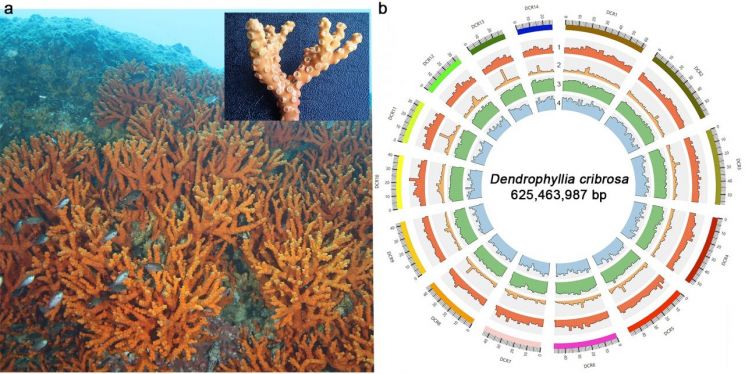
[Asia Economy Yeongnam Reporting Headquarters Reporter Kim Yong-woo] Domestic researchers have decoded the genome of the "Dokdo coral," a species known to be endangered and inhabiting parts of the South Sea and East Coast.
The subject of the study is a marine sessile organism called Dendrophyllia cribrosa, which has the largest colony found in Korea on Dokdo, hence referred to as Dokdo coral.
The Korea Institute of Ocean Science and Technology (KIOST) announced on the 6th that their analysis of the genome of the endangered Dendrophyllia cribrosa living on Dokdo revealed a genome size of 625Mb, with 14 pairs of chromosomes and approximately 30,490 genes.
KIOST explained that this research will serve as an important indicator for observing ecological changes on Dokdo.
Dendrophyllia cribrosa belongs to the order Scleractinia and family Dendrophylliidae. It is a sessile organism with no mobility, distributed only in limited areas along the South Sea and East Coast.
Dendrophyllia cribrosa is designated as a Class 2 endangered wild species, and in 2016, the largest colony in Korea was discovered on Dokdo, measuring 5 meters in width and 3 meters in height, attracting attention.
Unlike tropical corals, these are non-symbiotic corals that do not coexist with microalgae, and they have been considered to have evolved differently from symbiotic corals. However, no specific research results had been presented until now.
According to the "Wildlife Protection and Management Act," endangered wildlife currently at risk of extinction are classified as Class 1 endangered wild species, while those at risk of becoming endangered are classified as Class 2.
Non-symbiotic corals refer to corals that do not coexist with unicellular microalgae, whereas symbiotic corals depend on various forms of biological energy sources by coexisting with unicellular microalgae of the genus Symbiodinium.
The research team led by Senior Researcher Yeom Seung-sik at KIOST’s South Sea Research Institute Risk Analysis Research Center, in collaboration with Dr. Kim Jeong-eun’s team from the Genome Research Foundation (Chairman Park Jong-hwa), collected Dendrophyllia cribrosa from Ddong-yeo, Dokdo, Ulleung-gun, Gyeongsangbuk-do in 2020.
The joint research team decoded and analyzed the genome, securing high-quality chromosome-level genome information, and published their findings in a paper.
According to the study, the non-symbiotic coral Dendrophyllia cribrosa has expanded genes related to the Acyl-CoA metabolic process and carbohydrate transporters compared to symbiotic corals, indicating that it obtains cellular energy through these pathways.
In particular, due to the influence of immune-related genes, it is expected to have a high ability to protect itself from invasion by external microorganisms.
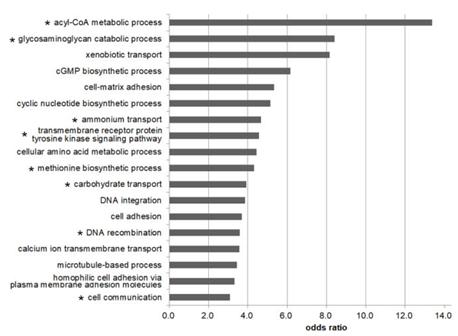
The Acyl-CoA metabolic process activates fatty acids and is essential for supplying large amounts of energy. Carbohydrate transporters are molecules that move carbohydrates, an important energy source, inside and outside cells and between cells.
KIOST Director Kim Woong-seo said, "With this research achievement, we hope to establish a new paradigm for the conservation of endangered coral colonies and contribute to preventing global marine ecological disasters."
He also added, "We hope this will contribute not only to the sovereignty over Korea’s marine biological resources but also to the protection of sovereignty over its inherent territory."
This research was conducted as part of the "Sustainable Use Research of Dokdo (Principal Investigator Park Chan-hong)" and the "Post-Genome Multi-Ministry Genome Project."
Going forward, KIOST plans to further pursue research to elucidate the metabolic and physiological characteristics unique to non-symbiotic corals.
© The Asia Business Daily(www.asiae.co.kr). All rights reserved.


















