UN Security Council Open Meeting Condemns North Korea's Ballistic Missile Launch
Chair's Condemnation Statement Fails Due to China and Russia Opposition
[Asia Economy Reporter Inho Yoo] The United Nations Security Council, which convened on the 5th (local time) to discuss North Korea's intermediate-range ballistic missile (IRBM) provocations, ended without any significant conclusions.
However, led by the United States, South Korea, Japan, and Western countries strongly condemned North Korea's missile provocations in an off-the-record statement following the meeting.
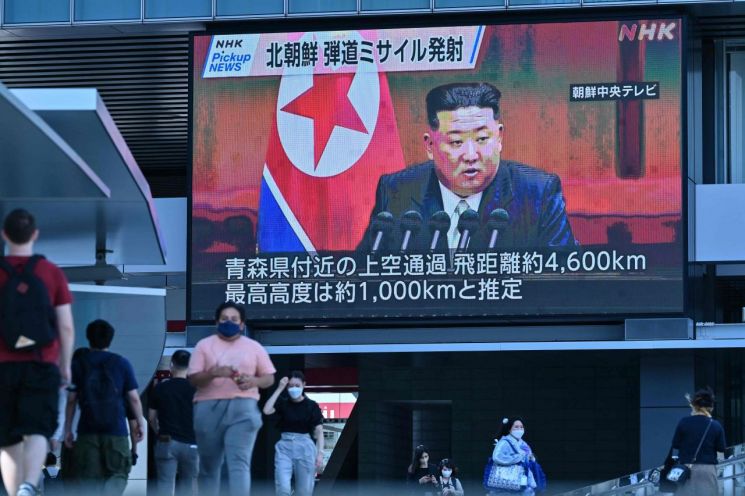
According to the Ministry of Foreign Affairs on the 6th, the UN Security Council convened on the 5th (local time) in New York, USA, to discuss North Korea's intermediate-range ballistic missile provocations. This meeting was the fourth public session this year related to North Korea's nuclear and missile issues.
After public statements by representatives of member states, the Security Council shifted to a closed session to further discuss the North Korean missile issue.
However, it is reported that the meeting failed to adopt a statement condemning North Korea's ballistic missile provocations due to opposition from permanent members China and Russia, despite efforts led by the United States and other council members.
Most council members, including the United States which led the meeting convening, pointed out that North Korea's repeated missile provocations violate Security Council sanctions and urged a firm response.
On the other hand, China and Russia blamed the United States for North Korea's actions and instead defended North Korea, highlighting the differences in positions between the West and China-Russia.
Linda Thomas-Greenfield, the US Ambassador to the UN, indirectly referenced the fact that the Security Council's resolution on North Korea was blocked by vetoes from China and Russia in May, criticizing, "In short, the two permanent members of the Security Council have enabled Kim Jong-un's actions."
She stated, "The Security Council must return to a time when it spoke with a unified voice against North Korea's bad behavior," and raised the need to push for a resolution to respond to North Korea's sanctions evasion.
Hwang Jun-guk, the South Korean Ambassador to the UN invited as a concerned party, criticized China and Russia's vetoes, saying, "North Korea responded with missiles to the Security Council's silence," and urged the implementation of sanctions.
Kimi Hiro Ishikane, Japan's Ambassador to the UN, referred to Japan's intermediate-range ballistic missile that recently passed over Japanese airspace, saying, "We strongly condemn it in the strongest terms," and added, "Silence is not an option."
In response, Geng Shuang, China's Deputy Ambassador to the UN, said, "While paying attention to North Korea's recent launches, we also note the joint military exercises conducted multiple times in the region by the United States and other countries."
He emphasized, "The United States is strengthening military alliances in the Asia-Pacific region and increasing the risk of military competition related to nuclear weapons," and urged, "The United States should take concrete measures to seriously address North Korea's legitimate and reasonable concerns to create conditions for resuming dialogue."
Anna Evstigneyeva, Russia's Deputy Ambassador, also targeted the United States, saying, "The United States and its allies have resumed large-scale military exercises," and "Leaders of South Korea, the United States, and Japan are irresponsibly making remarks about deploying US deterrence measures, including nuclear weapons, on the Korean Peninsula and in the region."
Although the Security Council shifted to a closed session after public statements to further discuss the North Korean missile issue, no conclusions were reached.
However, after the meeting, Western council members including the United States, as well as South Korea and Japan, issued an off-the-record statement condemning North Korea's ballistic missile provocations. Albania, Brazil, France, India, Ireland, Norway, the United Arab Emirates, and the United Kingdom also joined the joint off-the-record statement along with South Korea, the United States, and Japan.
In the statement read by Linda Thomas-Greenfield, the US Ambassador to the UN, it said, "We strongly condemn North Korea's intermediate-range ballistic missile on the 4th and seven other ballistic missile launches since September 25."
These countries pointed out, "North Korea's ballistic missile launches violate multiple Security Council resolutions and pose a threat not only to the region but to the entire international community."
The statement said, "Countries joining here, including the United States, remain committed to diplomacy and urge North Korea to return to dialogue," but warned, "However, if North Korea continues to undermine the international non-proliferation regime and threaten the international community, we will not remain silent."
It also appealed, "We call on all UN member states, especially Security Council members, to join in condemning North Korea's reckless actions and urging it to completely, verifiably, and irreversibly abandon its illegal weapons programs."
Furthermore, it urged UN member states to thoroughly implement Security Council sanctions resolutions against North Korea.
© The Asia Business Daily(www.asiae.co.kr). All rights reserved.

















