Experts in Investment and Industry at Sangui's 'Fair Competition Forum'
"Urgent Need for Legal and Institutional Changes Aligned with Global Trends"
[Asia Economy Reporter Donghoon Jeong] As the era of industrial transformation and economic security dawns, leading global companies are investing in strategic industries through large-scale funding, but it has been argued that South Korea is falling behind global trends due to regulations created in the past.
On the 6th, the Korea Chamber of Commerce and Industry held a special forum on fair competition titled "Strategic Industry Investment, Global Trends and Institutional Improvement Tasks" at the Chamber of Commerce building. Investment, industry, and legal experts who participated as keynote speakers and designated discussants unanimously pointed out the regrettable reality, saying, "Recent investments in future strategic industries are increasing in scale, and collaboration between industry and finance is the trend, but South Korea’s regulations aimed at preventing economic power concentration are even hindering investments for the future."
At the forum, Professor Young Ju Nielsen of Sungkyunkwan University, who has experience managing U.S. investment funds, and Professor Jin-Yeol Joo of Pusan National University Law School gave keynote presentations. Expert panelists included Byung-Ik Jang, Head of PE at KDB Industrial Bank, Eun-Jip Kim, U.S. attorney at Kim & Chang Law Office, Ja-Hyun Koo, Head of Industrial and Market Policy Research Department at KDI, Hyun-Sil Ahn, Director and Editorial Writer at Korea Economic AI Research Institute, and Young-Guk Yoo, Legislative Research Officer at the National Assembly.
The first presentation was delivered by Professor Young Ju Nielsen of SKK GSB, Graduate School of Business at Sungkyunkwan University, on the topic "Global Strategic Industry Investment Trends and Implications," explaining the necessity of strategic industry investment and global investment trends.
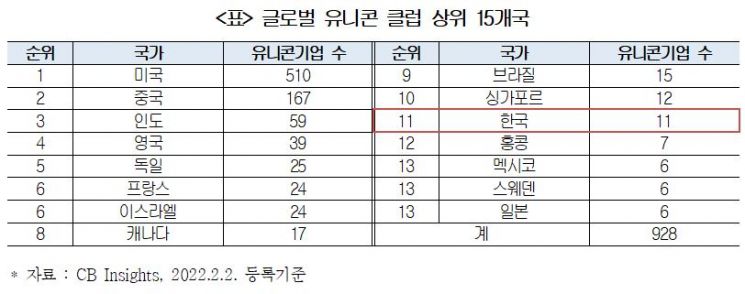
Professor Nielsen stated, "Direct corporate investment in core technologies with future competitiveness is essential from the perspectives of industrial security, technological sovereignty, and even national security, which have recently become issues." He added, "Moreover, strategic industry investment is also crucial from a financial perspective as it serves as the foundation for the emergence of numerous unicorn companies." Currently, South Korea’s ranking in the number of unicorn companies by country has dropped from 5th place in 2019 to 11th place in 2022.
In response, panelist Ja-Hyun Koo, Head of Industrial and Market Policy Research Department at KDI, mentioned, "So far, venture capital has been supplied mainly to platform startups that are easy to scale up in our venture ecosystem, but to respond to technological hegemony competition and secure economic security, support for deep-tech startups based on advanced strategic technologies must be expanded."
Professor Nielsen also noted, "Recent global M&A trends reveal key characteristics," citing three major investment trends: ▲ expansion of investment amounts in core industries in terms of scale ▲ collaboration between industry and finance ▲ policy support through public-private one-team strategies.
As a representative case, he cited the joint investment of $30 billion (approximately 40 trillion KRW) by U.S. semiconductor company Intel and Canadian asset management firm Brookfield at the end of August. Professor Nielsen said, "The Intel-Brookfield joint investment is a large-scale investment plan under the U.S. CHIPS and Science Act, representing a new funding model that raised massive capital through industry-finance convergence." He emphasized, "South Korea also needs active government support and institutional conditions to enable companies to raise large-scale investment funds."
Expert panelist Byung-Ik Jang, Head of PE at KDB Industrial Bank, explained, "About ten years ago, there was an industry-finance convergence investment case called the 'Copa Fund (Corporate Partnership Fund)' formed to activate overseas M&A domestically." He added, "Although fund investment was not actively conducted due to differences in positions between the National Pension Service, which pursues sincerity, and companies seeking strategic approaches, it is a case worth referring to for developing a 'new corporate-led joint investment fund model.'"
The second presentation was given by Professor Jin-Yeol Joo of Pusan National University Law School on the topic "The Need to Abolish or Ease the Separation of Financial and Industrial Capital Regulations under the Fair Trade Act," proposing institutional improvement tasks focusing on regulations under the Fair Trade Act, such as easing restrictions on general holding companies’ ownership of financial company stocks.
Professor Joo argued, "If we blindly regulate domestic conglomerates solely because of their size under the Fair Trade Act while ignoring the reality of global competition, we will ultimately harm South Korea’s growth potential ourselves." He added, "In particular, the Fair Trade Act’s prohibition on general holding companies owning financial company stocks may block the acquisition of advanced overseas technologies essential for future growth, so it is time to consider abolishing this provision."
On the other hand, Young-Guk Yoo, Legislative Research Officer at the National Assembly, said, "The separation of financial and industrial capital regulations under the Fair Trade Act has the unique purpose of curbing economic power concentration by preventing excessive control expansion using third-party capital, systemic risk transfer between finance and industry, and support for affiliated companies using financial capital." He noted, "Since there is concern that general holding companies might use financial companies to expand control through third-party capital, easing the separation of financial and industrial capital regulations requires a cautious approach."
Meanwhile, Eun-Jip Kim, U.S. attorney at Kim & Chang Law Office, stated, "To activate joint investments between industrial and financial capital such as the Copa Fund, it is necessary to review applying related laws and systems like the Capital Markets Act more flexibly," citing examples such as ▲ easing domestic registration requirements for offshore funds (e.g., operating performance), ▲ regulatory differences when concluding advisory or discretionary contracts and when investing in funds, and ▲ easing prohibitions on fund investors’ involvement in management.
Woo Tae-Hee, Executive Vice Chairman of the Korea Chamber of Commerce and Industry, said, "As the global industrial structure rapidly changes recently, future strategic industry technology has become diplomacy, security, and ultimately national power." He added, "To avoid falling behind in technological competition, institutional design that fits the new paradigm is necessary."
© The Asia Business Daily(www.asiae.co.kr). All rights reserved.
!["The Woman Who Threw Herself into the Water Clutching a Stolen Dior Bag"...A Grotesque Success Story That Shakes the Korean Psyche [Slate]](https://cwcontent.asiae.co.kr/asiaresize/183/2026021902243444107_1771435474.jpg)
















