YouTube Tests Paid 4K Video Playback
Concerns Arise Over Targeting Domestic Users
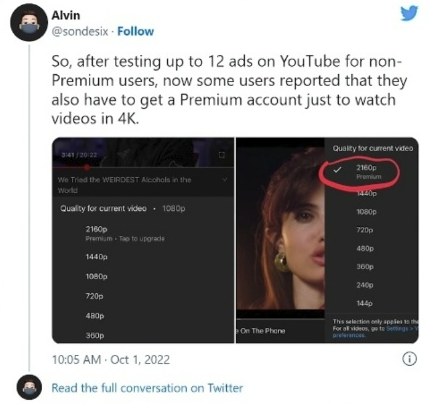
[Asia Economy Reporter Yuri Choi] Concerns are rising that streaming platform Twitch, which lowered video quality for domestic users, and YouTube, which is also restricting video quality, will implement service limitation measures. It is reported that YouTube is testing a plan to provide high-resolution videos only to paid YouTube Premium subscribers, leading to expectations that South Korea will be targeted.
According to foreign media on the 6th, YouTube is recently testing a 4K video option for some users. When selecting 4K-level 2160p resolution, the word 'Premium' appears below, and only YouTube Premium subscribers can play it.
Currently, YouTube provides streaming services tailored to viewers' conditions such as video quality, internet speed, and display environment. Free users can also watch 4K videos with resolutions above 2160p if they watch ads. YouTube Premium, a paid service costing 14,500 KRW per month, offers ad-free video playback and video downloads, but there is no video quality option.
According to the industry, Google is seen as trying to recover revenue losses caused by competitors like TikTok through restructuring YouTube Premium. The plan is to provide 4K ultra-high-definition service only to YouTube Premium users, while general users will be offered videos at a lower FHD (1440p) resolution.
Google has not officially announced the service restructuring, but concerns are emerging among domestic YouTube users. There is speculation that Google might start restricting video quality in South Korea first, amid its public relations campaign using the Network Usage Fee Act as a pretext. Some creators express dissatisfaction, saying "Producing videos in high resolution may become meaningless."
Previously, Twitch, operated by Amazon, also raised anxiety by limiting viewing quality in South Korea. On the 28th, Twitch announced it would lower the maximum video resolution to 720p domestically, citing increased costs. It used the burden of network usage fees as an excuse to pressure the National Assembly by involving users. Two days later, on the 30th, the quality restriction was implemented, increasing user dissatisfaction.
Complaints through telecom companies are pouring in, and petitions opposing the Network Usage Fee Act continue. Open Net, representing YouTube, is conducting a 'Network Neutrality Protection Signature Campaign,' which has nearly 180,000 signatories. Some users are sharing ways to bypass restrictions by connecting to Twitch’s ultra-high-definition service via virtual private networks (VPNs).
As global content providers (CPs) lead public opinion campaigns using users, the Network Usage Fee Act is stalling. Currently, seven amendments to the Telecommunications Business Act mandating payment of network usage fees have been proposed in the National Assembly. Although similar bills were introduced by both ruling and opposition parties, accelerating legislative discussions, the situation rapidly changed as public opinion worsened. Opinions are divided even within the National Assembly.
Meanwhile, the Korea Telecommunications Operators Association (KTOA) delivered a public inquiry letter to Twitch on the same day, expressing regret over the quality degradation. This was a protest against Twitch lowering video quality without prior negotiation or coordination with telecom companies, which led to a flood of complaints. KTOA added that if Twitch provides detailed reasons and information about the quality reduction measures, it will use them to respond to complaints.
© The Asia Business Daily(www.asiae.co.kr). All rights reserved.

















