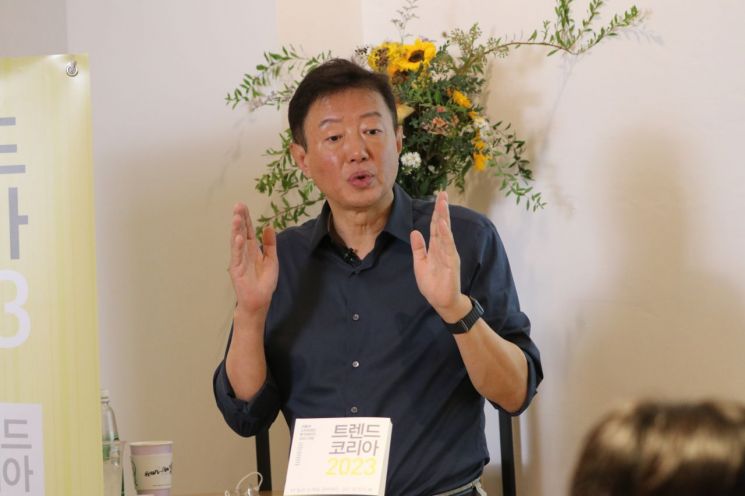
[Asia Economy Reporter Seomideum] The ‘Trend Korea’ series, which has coined numerous new terms such as ‘gashimbi’ (cost-effectiveness in satisfaction), ‘untact’ (contactless), and ‘meaning out’ (meaningful consumption), predicted next year’s trends this year with the concept of ‘Rabbit Jump.’
At the publication press conference held both online and offline on the 5th, Professor Kim Nando analyzed next year’s trend as a year of recession. As the economic downturn deepens, it is like a rabbit digging about three burrows to escape predators, meaning we must prepare stably to make a higher leap.
In this context, Professor Kim predicted that next year will be a year where the miniskirt theory applies. The miniskirt theory suggests that during recessions, women’s skirt lengths shorten, and he explained that the recently popular underbust fashion fits this context. During recessions, whether tops or bottoms, lengths tend to shorten. Color cosmetics sell better than basic skincare products during downturns because consumers prefer higher efficiency relative to cost. He also analyzed that the resurgence of retro fashion and healing books is related to the recession.
One of the trend keywords is ‘average disappearance.’ Professor Kim stated, “The average has lost its meaning,” diagnosing that the premise of normal distribution has collapsed. There are three main reasons: first, intensified polarization; second, intensified N-polarization; third, intensified monopolarization. Professor Kim explained, “In the past, if a popular restaurant was crowded, people would go to another place, but now with delivery becoming routine, more people flock to popular restaurants. To meet such market conditions, supply must become sharper.”
‘Cherry consumers’ focusing on practical benefits were also cited as a trend. The perception of so-called ‘cherry pickers’ (those who benefit without purchasing products or services), which was negative in the past, is changing, and it is expected that individually packaged items, samples, and group purchases will become more active.
‘Index relationships’ are also a trend for next year. Until now, human relationships were maintained based on region, school, age, etc., but in modern society, individual gatherings by interests have become common. Professor Kim explained, “It is difficult to line up relationships simply as close or not close,” adding, “The spectrum of human relationships has become so complex that we need to manage them by attaching indexes.”
This background laid the foundation for the emergence of the so-called ‘Alpha Generation.’ The Alpha Generation, born after 2010, is characterized by a ‘protagonist consciousness.’ In the past, grades were an important evaluation criterion, then the concept of ‘eomchin-a’ (mom’s friend’s son) emerged, and now it has diversified further. Professor Kim pointed to this trend as a key factor in TikTok’s popularity, explaining, “YouTube and Instagram are follower-centered, but TikTok randomly delivers content, so anyone can become a celebrity even without many followers.”
In addition, he introduced ten major keywords including ‘Cherry Consumer,’ ‘Proactive Response Technology,’ ‘Spatial Power,’ ‘Digging Momentum,’ and ‘New Demand Strategy.’
© The Asia Business Daily(www.asiae.co.kr). All rights reserved.
!["The Woman Who Threw Herself into the Water Clutching a Stolen Dior Bag"...A Grotesque Success Story That Shakes the Korean Psyche [Slate]](https://cwcontent.asiae.co.kr/asiaresize/183/2026021902243444107_1771435474.jpg)
















