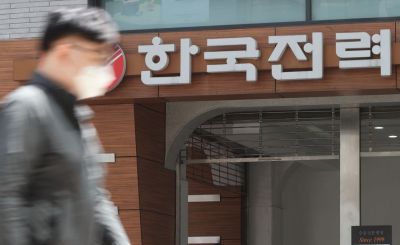
[Asia Economy Sejong=Reporter Dongwoo Lee] Korea Electric Power Corporation (KEPCO) plans to reduce its fuel cost burden by 1.6 trillion KRW this year by partially replacing liquefied natural gas (LNG) power generation with cheaper coal power generation.
KEPCO announced on the 5th that it recently submitted a fiscal soundness plan to the Ministry of Economy and Finance to reduce fuel cost burdens by easing the coal power generation cap system. The coal power generation cap system is a measure that sets a limit on coal power generation to reduce greenhouse gas emissions.
The Ministry of Trade, Industry and Energy set related indicators in last year’s government management evaluation and began implementation to reduce coal power generation by five power generation public enterprises under KEPCO (Namdong, Jungbu, Seobu, Nambu, and Dongseo Power). However, KEPCO and the five power generation public enterprises agreed with the government to ease the cap system this year to secure fiscal soundness.
KEPCO expects to replace about 12.8 TWh (terawatt-hours) of power generated by LNG with coal power generation this year. Considering that LNG power generation was about 160 TWh last year, this means replacing about 8% of the annual LNG power generation with coal power generation.
KEPCO estimates that coal power generation will result in about 1.599 trillion KRW in fuel cost savings this year. Specifically, direct cost savings due to the price difference between LNG (169.88 KRW/kWh) and coal (95.98 KRW/kWh) amount to 945.8 billion KRW.
Additionally, by reducing the most expensive LNG power generation, an overall reduction effect on the system marginal price (SMP) is expected to save an additional 801 billion KRW. Although coal emits more greenhouse gases than LNG, resulting in an increase of 147.8 billion KRW in emission allowance costs, this is much smaller than the cost savings.
KEPCO’s cumulative deficit in the first half of this year is about 14.3 trillion KRW. This is the largest level since its establishment and more than twice the operating loss of 5.9 trillion KRW recorded last year, achieved in just the first half of this year.
A KEPCO official explained, "Considering that coal power generation emits a large amount of carbon dioxide, this plan will be applied temporarily only for this year."
© The Asia Business Daily(www.asiae.co.kr). All rights reserved.

















