Equipped with a 3,000㎡ Large Laboratory 1,000m Underground in Jeongseon, Gangwon-do
Purpose: Confirm Dark Matter Existence and Study Neutrino Properties
World's 6th Largest Scale, Installed with Advanced and Latest Technology Detectors
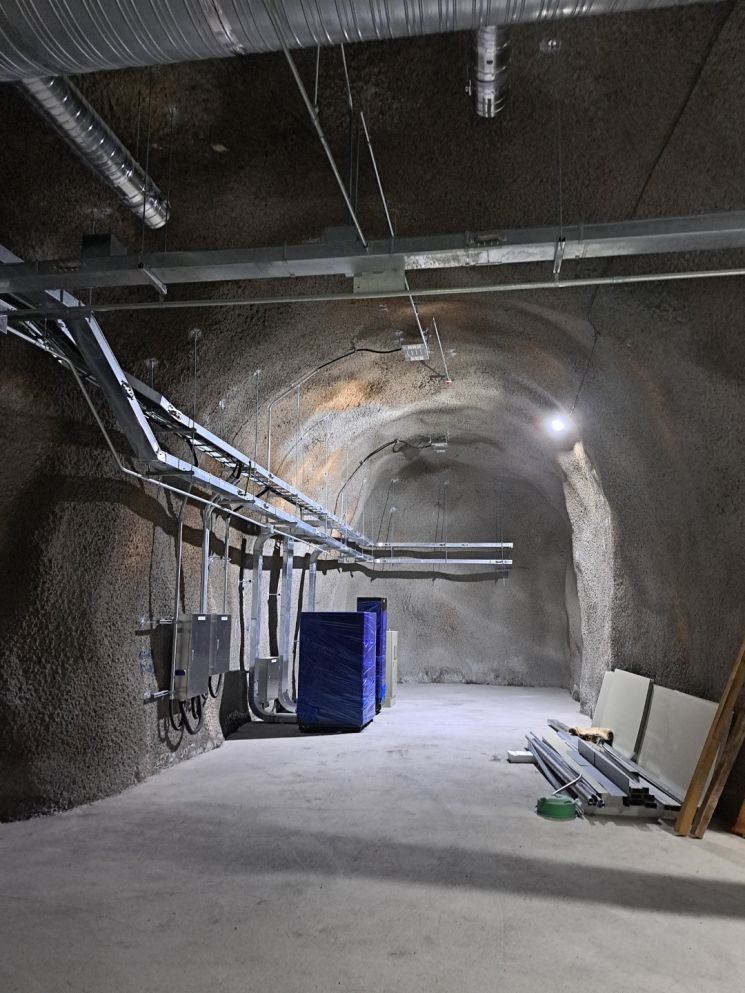
[Asia Economy Reporter Kim Bong-su] A massive laboratory with an area of approximately 3,000㎡ has been completed in an underground tunnel 1,000 meters deep in Jeongseon, Gangwon Province, and research to uncover the secrets of the universe is set to begin.
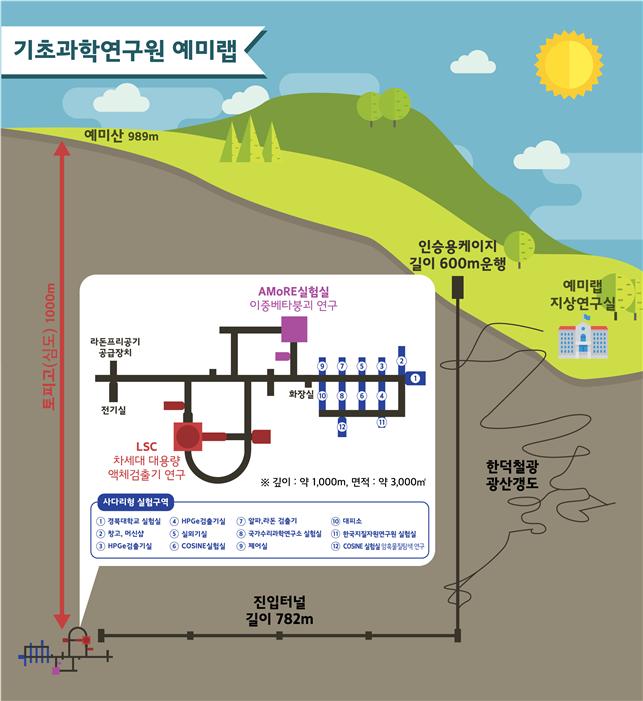
The Ministry of Science and ICT and the Institute for Basic Science (IBS) held a completion ceremony for Yemi Lab on the afternoon of the 5th at Hanbaek Iron Mine in Hanbaek-eup, Jeongseon-gun, Gangwon Province. With an investment of about 35 billion KRW, the aboveground research center remodeled the old Hanbaek Middle and High School buildings, and the underground laboratory was constructed by creating a separate tunnel on the opposite side of the Hanbaek Iron Mine tunnel located in Yemi Mountain. To save costs, the elevator shared with Hanbaek Iron Mine, which runs 600 meters from the underground to the ground entrance, was utilized.
The deep underground experimental facility located at a depth of 1,000 to 1,100 meters completed the underground tunnel construction in August 2020, and last month completed the construction of next-generation large-capacity detector infrastructure and remodeling of the aboveground laboratory. Among similar underground laboratories, it boasts the sixth largest area in the world at approximately 3,000㎡. Until now, the Yangyang Laboratory, located 700 meters underground in Yangyang-gun, Gangwon Province, with an area of 300㎡, was operated, but both size and depth had reached their limits.
The main purpose of this research facility is the search for dark matter, which is presumed to make up the universe but has not yet been discovered, and the study of neutrino properties. These are considered top priority challenges in the global physics community. This is also why the laboratory was installed at a depth of over 1,000 meters underground. Since signals emitted by dark matter and neutrinos are extremely difficult to detect, a research environment that minimizes background noise (such as cosmic rays) is essential. Many countries worldwide have established research facilities deep underground to confirm the existence of dark matter and study neutrino properties.
The IBS underground experimental research team plans to transfer equipment from the Yangyang Laboratory to Yemi Lab starting next year and will actively conduct research exploring the origins of the universe, including the Advanced Mo-based Rare process Experiment-II (AMoRE-II) studying neutrinoless double beta decay and the dark matter search (COSINE-200). The AMoRE-II experiment uses molybdenum to investigate the physical properties of neutrinos. Following the AMoRE-1 experiment conducted in Yangyang, Yemi Lab plans to increase the size of molybdenum crystals from the existing 6 kg to 200 kg.
COSINE-200 is a study searching for dark matter, which accounts for about 26% of the universe but has never been observed until now. It searches for traces of dark matter through collisions between dark matter particles arriving on Earth and crystals (sodium iodide, NaI) inside the COSINE detector. In 2018, the IBS underground experimental research team published a study in the journal Nature showing that the dark matter candidate particle 'WIMP (Weakly Interacting Massive Particle)' discovered by an Italian research team is over 97% likely not to be dark matter, drawing worldwide attention from the physics community.
Other research facilities are also housed in Yemi Lab. The Korea Meteorological Administration has already set up a laboratory for building a national earthquake observation network and verifying the performance of seismic observation equipment. The Korea Institute of Geoscience and Mineral Resources is also utilizing Yemi Lab for deep rock behavior studies, underground space characteristic evaluation and monitoring, and stability research. The National Institute for Mathematical Sciences, Kyungpook National University, Korea Atomic Energy Research Institute, and Korea Research Institute of Standards and Science are also scheduled to move in. Additionally, joint research with overseas institutions such as the U.S. neutrino research group (IsoDAR) is planned.
Oh Tae-seok, First Vice Minister of the Ministry of Science and ICT, said, “In certain basic science fields, large-scale research facilities are essential for producing world-class research outcomes,” adding, “We expect that Yemi Lab, the world’s sixth-largest underground experimental research facility, will develop into a more global research space as domestic and international researchers conduct joint research.” IBS Director Noh Do-young also stated, “I am pleased that Yemi Lab was successfully established without a single safety accident, and we will activate the joint use of Yemi Lab to contribute to achievements in various national science and technology fields.”
© The Asia Business Daily(www.asiae.co.kr). All rights reserved.

![Clutching a Stolen Dior Bag, Saying "I Hate Being Poor but Real"... The Grotesque Con of a "Human Knockoff" [Slate]](https://cwcontent.asiae.co.kr/asiaresize/183/2026021902243444107_1771435474.jpg)
















