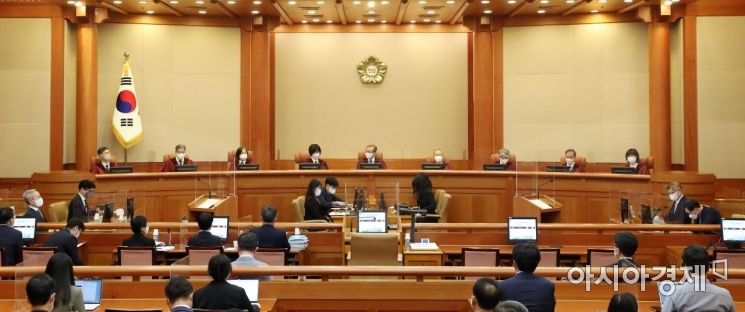
 On the afternoon of September 27, a public hearing on the constitutional dispute case regarding the 'Geomsu Wanbak' (Complete Removal of Prosecutorial Investigation Authority) law was held at the Constitutional Court in Jongno-gu, Seoul. Photo by Hyunmin Kim kimhyun81@
[Asia Economy Reporter Choi Seok-jin, Legal Affairs Specialist] The Constitutional Court has ruled that the provision in the Military Service Act prohibiting concurrent employment for social service agents does not violate the Constitution.
On the 5th, the Constitutional Court announced that it unanimously upheld the constitutionality (dismissal) of the case filed by Mr. A, who was serving as a social service agent and challenged Article 33, Paragraph 2, Main Text, and the latter part of Subparagraph 4 of the same paragraph of the Military Service Act, which prohibits concurrent employment for social service agents, claiming it infringed on the freedom of occupation and general freedom of action.
Mr. A, who was conscripted as a social service agent and served at a branch of the National Health Insurance Corporation, filed a constitutional complaint in May 2019, arguing that Article 12 of the "Social Service Agent Service Regulations," which prohibits concurrent employment in other duties for social service agents even after working hours, infringed on his fundamental rights, and requested the appointment of a public defender.
Article 12 of the Social Service Agent Service Regulations (Prohibition of Profit-making Activities and Concurrent Employment) states, "A social service agent shall not engage in profit-making activities or concurrently hold other duties outside of service. However, an exception is made if the head of the service institution comprehensively judges that it does not interfere with the performance of duties and grants permission."
Subsequently, Mr. A’s appointed public defender judged that concurrent employment for social service agents was a restriction under the superior law, Article 33, Paragraph 2 of the Military Service Act, and changed the subject of the trial to the main text of Article 33, Paragraph 2 and the latter part of Subparagraph 4 of the same paragraph, filing the constitutional complaint again.
Article 33 (Extension of Service for Social Service Agents, etc.) Paragraph 2 of the Military Service Act states, "If a social service agent falls under any of the following subparagraphs, a warning shall be issued, and for each additional warning, the service period shall be extended by five days. However, for persons falling under any of the subparagraphs of Article 89-3, the service period shall not be extended."
Also, Subparagraph 4 of the same paragraph defines "engaging in profit-making activities related to service or concurrently holding other duties without permission from the head of the service institution" as grounds for a warning.
The Constitutional Court first excluded the administrative rule, Article 12 of the Social Service Agent Service Regulations, from the subject of the trial and considered only the provisions of the Military Service Act as the subject.
Previously, the Constitutional Court stated, "A constitutional complaint or claims filed by a petitioner who is a private individual without lawyer qualifications have legal effect and become the subject of constitutional review only if ratified by a lawyer acting as a representative. Therefore, unless ratified by a lawyer representative, the petitioner’s prior claims not included in the representative’s petition are not subject to constitutional review."
In other words, since the principle of mandatory lawyer representation applies to constitutional complaints, the Constitutional Court’s position is that the content of the complaint previously filed by petitioner A need not be considered unless ratified by a lawyer representative.
Meanwhile, Mr. A was released from conscription on August 22, 2019, after filing the constitutional complaint, thus no longer holding the status of a social service agent. Therefore, even if the Constitutional Court ruled the challenged Military Service Act provisions unconstitutional, Mr. A would no longer benefit from such a decision.
However, the Constitutional Court proceeded with the substantive review, reasoning that although Mr. A’s personal subjective interest in rights protection had disappeared, the challenged provisions remain in effect, posing a risk of repeated fundamental rights restrictions on other social service agents, necessitating constitutional clarification.
The Constitutional Court has conducted substantive reviews even when only objective interests in rights protection exist, recognizing that constitutional complaints serve not only individual subjective relief but also the function of safeguarding constitutional order.
Mr. A argued that although there is a need to prohibit concurrent employment for social service agents, the scope of prohibited duties should be limited by law. However, the challenged provisions leave the decision entirely to the head of the service institution, violating the principle of legal reservation and infringing on the general freedom of action and freedom of occupation.
He also claimed that while the legislative purpose of prohibiting concurrent employment to ensure the dedication of social service agents to their duties and the appropriateness of the means are acknowledged, the blanket prohibition of all concurrent employment without considering the type of duty or the degree to which dedication is impaired, and the uniform requirement of prior permission for concurrent employment, violate the principle of minimal infringement and the balance of interests.
However, the Constitutional Court’s judgment differed.
The Court stated, "Social service agents must faithfully perform their military duties as manpower resources for national security and must not leave service without just cause. Furthermore, as persons performing public duties, social service agents hold a public status equivalent to public officials, necessitating fairness and fidelity in their performance of duties, comparable to public officials."
It continued, "The challenged provisions principally prohibit concurrent employment by social service agents and allow exceptions only with permission from the head of the service institution to ensure that social service agents devote themselves solely to their duties, thereby guaranteeing fair performance and faithful fulfillment of military obligations. This legislative purpose is legitimate, and imposing warnings and service period extensions on social service agents who engage in concurrent employment without permission is an appropriate means to achieve this purpose."
Regarding Mr. A’s claim that the challenged provisions violate the principle of minimal infringement, the Court pointed out, "The content and length of other duties, the nature of the service institution where the social service agent is assigned, the service field, and working conditions vary greatly. Therefore, it is practically very difficult to establish uniform and consistent regulations for all social service agents by categorizing the types of duties subject to concurrent employment restrictions."
It concluded, "Thus, it is not excessive for the challenged provisions to generally prohibit concurrent employment by social service agents and entrust the head of each service institution, who commands and supervises the social service agents, with the authority to decide on permission for concurrent employment by assessing whether it impairs dedication or fairness in duty performance in each specific case."
The Court also added, "Considering the special status of social service agents performing mandatory service for a certain period, it is not excessive to impose warnings and service period extensions as penalties for concurrent employment without permission."
Finally, regarding the balance of interests, the Court stated, "Given the status of social service agents as military service performers and their public status equivalent to public officials, as well as their service fields and duties, ensuring fair and faithful performance of duties by social service agents is a very significant public interest."
It added, "On the other hand, social service agents are not absolutely prohibited from concurrently holding other duties outside their service duties; they may obtain permission from the head of the service institution in cases of livelihood necessity or other unavoidable reasons, and in fact, a considerable number of social service agents have received permission and engage in concurrent employment. Therefore, the degree of private interest restricted by the challenged provisions cannot be considered greater than the public interest intended by these provisions, and thus the challenged provisions do not violate the balance of interests."
Based on the above grounds, the Constitutional Court concluded, "The challenged provisions do not violate the principle of proportionality and cannot be seen as infringing on the petitioner’s freedom of occupation and general freedom of action."
© The Asia Business Daily(www.asiae.co.kr). All rights reserved.

















