At Least 200,000 Russians Leave Country
Even Those Unsuitable for Military Service Drafted
Heading to Battlefield Without Proper Training
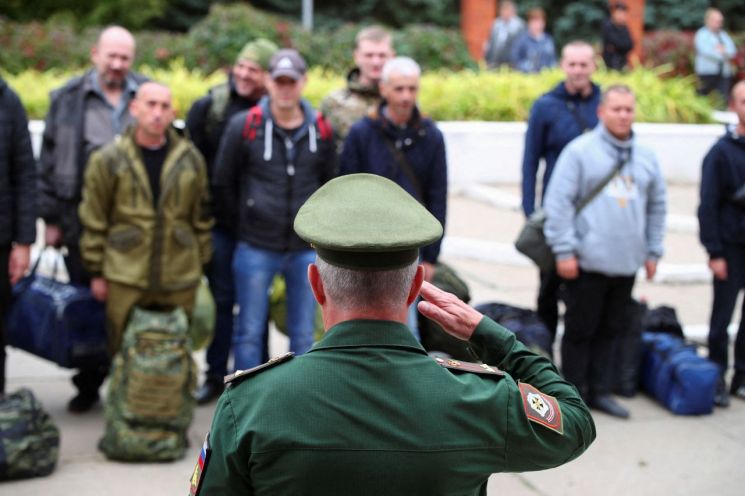 A Russian soldier salutes reservists gathered at a conscription reserve assembly point set up in Volzhsky, Volgograd Oblast, on the 28th of last month (local time). [Image source=Yonhap News]
[Asia Economy Intern Reporter Kim Gunchan] Following Russia's declaration of a military mobilization order, Russians continue to flee abroad to avoid conscription, while reservists mobilized through indiscriminate conscription are heading to the battlefield without proper training. The number of people resorting to extreme measures to avoid conscription is also increasing. Russia plans to begin regular conscription this fall.
Russian President Vladimir Putin announced a military mobilization order related to the Ukraine war on the 21st of last month (local time). This is Russia's first mobilization order since World War II. It is a partial mobilization, not a full one, with 300,000 reservists expected to be conscripted. Regarding this mobilization order, Putin explained, "Those currently in reserve status will be called up, prioritizing those who have served in the military and have experience corresponding to specific specialties."
After the mobilization order was declared, Russians have been fleeing abroad to avoid conscription. At border checkpoints in Mongolia, Kazakhstan, Georgia, Finland, and other countries bordering Russia, vehicle lines have been continuous. There are 14 countries bordering Russia, stretching from North Korea in the east to Finland in the west.
The New York Times (NYT) reported on the 28th of last month, citing statistics from countries neighboring Russia, that at least 200,000 Russians have left their country since the mobilization order. Frontex, responsible for border security in European Union (EU) member states, announced that the number of Russians entering the EU in the week up to the 25th of last month increased by more than 30% compared to the previous week.
A 32-year-old Russian man who arrived in Istanbul, Turkey, told the Washington Post (WP), "My visa to stay in Turkey expires in two months," adding, "I don't know when I will see my family again, and I feel lost about how to live going forward."
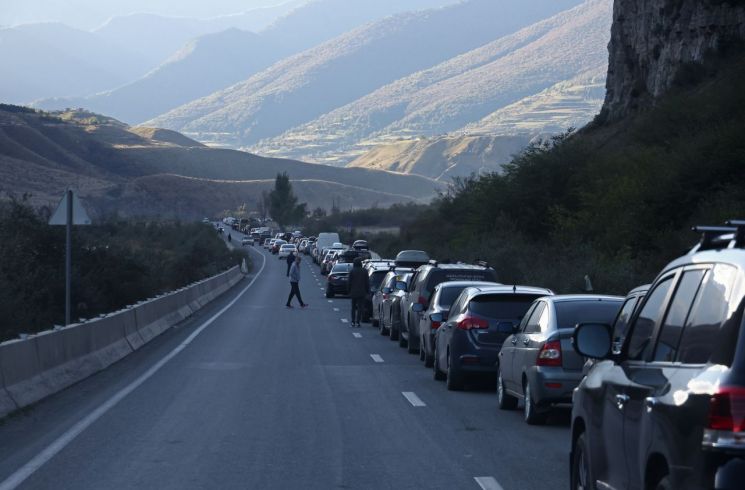 On the 27th of last month (local time), vehicles lined up in Vladikavkaz, the Republic of North Ossetia, Russia, bordering Georgia. [Image source=Yonhap News]
This exodus is related to anxiety over indiscriminate conscription, which is proceeding differently from the mobilization criteria initially announced by the Russian government. The Washington Post (WP) reported on the 27th of last month that since the Russian government issued the mobilization order, even elderly people, patients, and disabled individuals unfit for military service have been conscripted.
According to the media, local officials, to meet conscription quotas set by the central government, notified a 59-year-old man who is blind in one eye due to skin cancer and a 63-year-old man suffering from both diabetes and brain disease to enlist. Facing criticism over indiscriminate conscription, the Russian government acknowledged on the 29th that there were mistakes in the conscription process and promised to correct them.
It is reported that Russians conscripted under the mobilization order are heading to the battlefield without receiving proper training. On the 29th of last month, the Moscow Times reported that the currently mobilized men have received less than two weeks of training or, in some cases, no training at all.
In response, Ben Hodges, former commander of U.S. forces stationed in Europe, expressed concern, saying, "Lack of training will cost Russia thousands of lives," and "Deploying untrained soldiers into combat is a crime." After criticism about the lack of proper training arose, Russian Defense Minister Sergei Shoigu stated on the 4th that "reservists are receiving training at 80 shooting ranges before being deployed to the front lines."
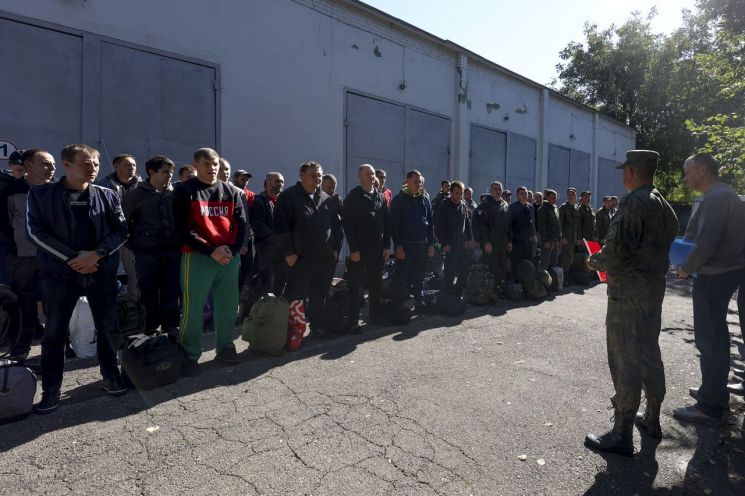 Russian reservists who received the mobilization order gathered around the assembly center in Krasnodar on the 25th of last month (local time). [Image source=Yonhap News]
Amid this situation, the number of people resorting to extreme measures to avoid conscription is increasing. According to the British Telegraph on the 29th, videos have recently appeared on social media showing mobilized reservists breaking their arms or legs by hitting them with hammers. There have also been cases of self-immolation attempts and shootings at military commanders. On the 30th of last month, rapper Ivan Vitaliyevich Petunin (27), who was active under the pseudonym Walkie, made an extreme choice in protest against the mobilization order.
Meanwhile, according to TASS news agency on the 30th of last month, Putin signed a presidential decree to start a "regular autumn conscription" targeting 120,000 people. Russia maintains a conscription system similar to South Korea. Russian men aged 18 to 27 are legally required to serve one year in the military. Those receiving higher education at universities or other institutions must undergo training equivalent to military service.
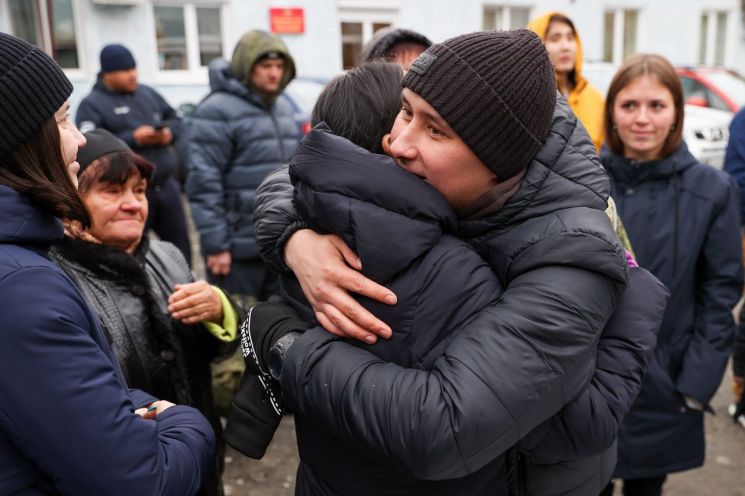 A man enlisting in the Russian military is seen saying goodbye to his family on the 27th of last month (local time) in Chkalovsk, Yekaterinburg, Russia. [Image source=Yonhap News]
The Russian Ministry of Defense stated, "The autumn conscription has nothing to do with the 'special military operation,'" calling it a "routine conscription campaign." The "special military operation" is Russia's official term for the invasion of Ukraine. Russia legally prohibits conscripts from participating in overseas operations. However, it has been revealed that conscripts have participated in the current Ukraine war.
As the Ukraine invasion enters its eighth month and Russia suffers from a severe manpower shortage, it is reported that Russia is even recruiting foreigners willing to participate in the conflict to secure troops.
© The Asia Business Daily(www.asiae.co.kr). All rights reserved.
![User Who Sold Erroneously Deposited Bitcoins to Repay Debt and Fund Entertainment... What Did the Supreme Court Decide in 2021? [Legal Issue Check]](https://cwcontent.asiae.co.kr/asiaresize/183/2026020910431234020_1770601391.png)

















