Minister of Environment: "Consumer burden is wrong... Long-term institutional improvement needed"
'Disposable cup deposit system' responsibility-shifting controversy continues
Environmental groups: "Legislative intent must be considered... Plastic reduction policy is regressing"
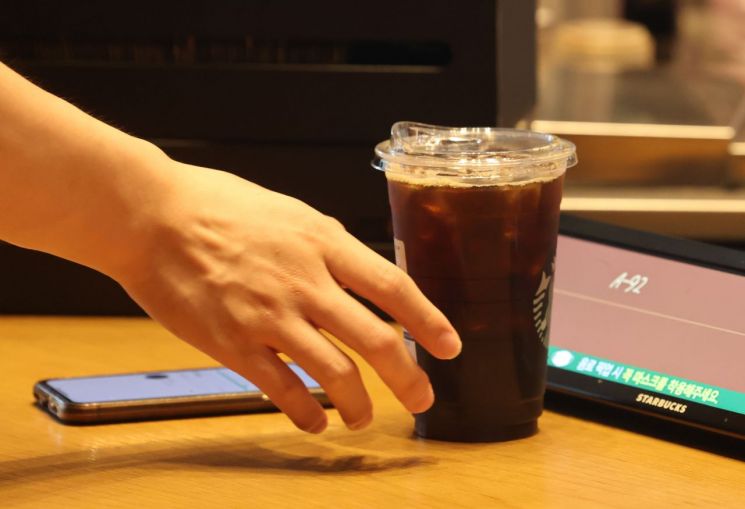 As the use of disposable cups consumed annually at major coffee shops and fast food outlets increases, a citizen is seen taking coffee in a disposable cup at a coffee shop in Seoul last September.
 [Image source=Yonhap News]
[Asia Economy Reporter Yoon Seul-gi] As the government announced that it will proactively implement the disposable cup deposit system in Sejong Special Self-Governing City and Jeju Special Self-Governing Province starting December 2, criticism continues to arise that responsibility is being shifted onto consumers and small business owners. Environmental groups have criticized that the issue of 'shifting responsibility' is causing the purpose of reducing plastic to become unclear.
According to the "Disposable Cup Deposit System Promotion Plan and Small Business Support Measures" announced by the Ministry of Environment on the 22nd of last month, the deposit system for disposable items will be proactively implemented in Sejong and Jeju. The disposable cup deposit system requires including a resource circulation deposit in disposable cups when selling beverages, and returning the deposit when the used disposable cup is returned. According to the revised enforcement regulations, the resource circulation deposit amount has been set at 300 won.
In the pilot regions, benefits will be provided to consumers and participating stores. Stores subject to the deposit system will receive support for costs incurred in implementing the system, such as label fees (6.99 won per item), deposit card fees (3 won per item), and processing support for standard containers (4 won per item), as well as assistance tools to help attach labels (label dispensers) and support for purchasing simple disposable cup collection devices. Consumers will also receive additional 'Carbon Neutral Practice Points' comparable to the discount benefits (about 10% off beverage price, approximately 300 won) offered when using reusable takeout cups at stores.
Originally, the plan was to fully implement the disposable cup deposit system at franchise stores such as cafes starting in June, but small business owners opposed it citing management burdens, and the system implementation was postponed until December 1.
 The Extended Producer Responsibility (EPR) system expands the scope of producers' obligations for environmental improvement to include the recycling of waste generated after consumer use. Photo by Extended Producer Responsibility System website capture.
Although the government plans to strengthen benefits for consumers and participating stores, controversy continues as the burden arising from the process of exchanging disposable cup deposits still falls on individuals such as consumers and small franchise owners.
As a result, voices are calling for an expansion of producer responsibility in the disposable cup deposit system, similar to the Extended Producer Responsibility (EPR) system. EPR focuses on expanding corporate responsibility for environmental improvements from production and sales to consumption, disposal, and recycling. The products subject to recycling obligations under EPR include eight product groups (lubricants, batteries, tires, fluorescent lamps, aquaculture accessories, silage films, gim drying racks, and film products) and four packaging material groups (paper packs, metal cans, glass bottles, synthetic resin packaging).
At the Ministry of Environment’s National Assembly audit held at the Government Complex Sejong on the 4th, Yoon Geon-young, a member of the Democratic Party, pointed out, "Producers are responsible for recycling items such as empty bottles, tires, batteries, and fluorescent lamps, but only consumers bear the responsibility for disposable cups."
Han Hwa-jin, Minister of Environment, also expressed the opinion that it is inappropriate for consumers to bear the deposit burden in the disposable cup deposit system. In response to Yoon’s question, "Is it appropriate for consumers to bear the deposit?" Minister Han replied, "I think it is wrong," and added, "Long-term improvements to the deposit system are necessary."
Environmental groups criticized that large franchise companies, who are stakeholders in the disposable item deposit system, are shifting responsibility onto consumers and franchise small business owners, causing the system to be neglected. Shin Woo-yong, Secretary General of the Seoul Environmental Federation, said, "There was already a two-year grace period during which companies expressed willingness to make efforts, but with the change in government, regulations on corporate profit activities have been relaxed, and companies’ opinions are now more reflected than before."
Shin emphasized, "Stressing that responsibility is shifted to consumers and small business owners in this situation contradicts the legislative intent," and pointed out, "Given the long grace period, companies should have been prepared for the disposable item deposit system." He continued, "Although policies to reduce plastic are showing signs of sequential setbacks, consumers already recognize the need to reduce plastic," and urged, "The Ministry of Environment must fulfill its role so that companies can make efforts to reduce plastic."
© The Asia Business Daily(www.asiae.co.kr). All rights reserved.


















