Price Increase in Imported Fruits and Meats
Consumers Also Buying More Domestic Products
Measures Taken Such as Changing Payment Currency
[Asia Economy Reporter Lim Chun-han] Recently, large discount stores have been engaged in an ultra-low price war, selling even 10 won cheaper, while struggling with high exchange rates. This is due to increasing pressure to raise selling prices as import costs for food items such as fruits and meats rise. Each company is preparing various self-help measures, including changing payment currencies and expanding domestic products.
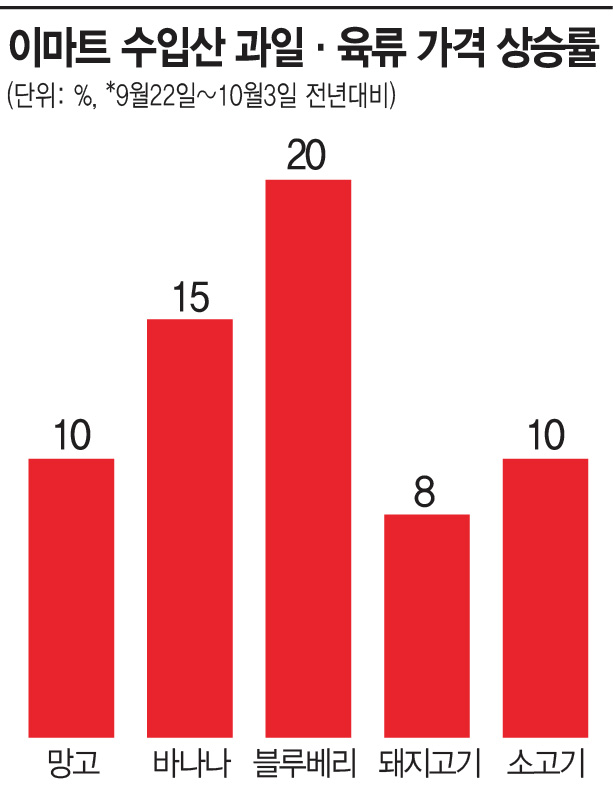
According to Emart on the 5th, from the 22nd of last month, when the won-dollar exchange rate exceeded 1,400 won, until the 3rd of this month, mango prices rose about 10% compared to the previous year, bananas by 15%, and blueberries by 20%. At Homeplus, prices of bananas (10%) and blueberries (13%) also increased. This is because production and labor costs at the production sites have risen since the COVID-19 pandemic, and logistics costs have increased along with the strong dollar, driving up import costs.
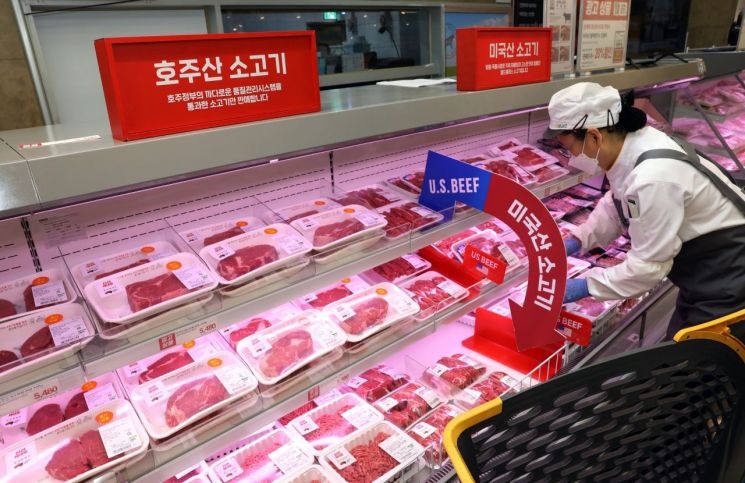
Although the government is applying a 0% tariff quota on imported meat to stabilize prices, import costs are rising due to the exchange rate increase. At Emart, the selling price of imported pork rose about 8% compared to the previous year, and imported beef increased by 10%. In the case of wine, logistics and labor costs have risen since last year, resulting in a basic price increase of 20%. For now, additional price hikes are being minimized through managing existing inventory and minimizing margins.
Consumers are also purchasing more domestic products in response to rising prices of imported goods. Emart reported an 8.2% increase in sales of domestic fruits, while sales of imported fruits decreased by 2.4%. Domestic meat sales rose by 5.8%, whereas imported meat sales dropped by 2.2%. At Homeplus, the sales growth rate of domestic fruits (41%) was higher than that of imported fruits (8%), and the sales growth rate of Korean beef (Hanwoo) (103%) was higher than that of imported beef (35%).
Large discount stores are mobilizing all means to minimize the price increase caused by exchange rate fluctuations. Emart is attempting to make payments in the currency of the exporting country, such as using euros instead of dollars by overseas sourcing buyers. In fact, during the import process of European frozen pork, changing the payment currency from dollars to euros resulted in a 4-5% reduction in import costs.
Shinsegae Group affiliates such as Emart, Traders, No Brand, and SSG.com are conducting integrated purchasing to increase bargaining power and are also increasing sales of domestic products to replace imported goods. Lotte Mart is focusing on discovering European products. In particular, it is looking for importable products mainly from European manufacturers that can be paid for in euros, and plans to visit the international food exhibition held in Paris, France, in mid-month to strengthen collaboration with local companies. Homeplus is developing new sources for imported fruits and securing additional contract volumes of meat from Canada and Australia.
A representative from a large discount store said, "As the won-dollar exchange rate continues to rise, import costs are also increasing. We plan to continue efforts to stabilize prices by stabilizing supply and demand through developing new sources for fruits and meats, and reducing costs by selling single-item products that eliminate unnecessary packaging materials."
© The Asia Business Daily(www.asiae.co.kr). All rights reserved.


















