Swedish Royal Academy to Announce 2022 Nobel Physics Laureates on Afternoon of 4th
Recognition for Experimental Proof of Quantum Entanglement Theory 'Bell Inequality'
Alain Aspect, John F. Clauser, Anton Zeilinger Among Three Recipients
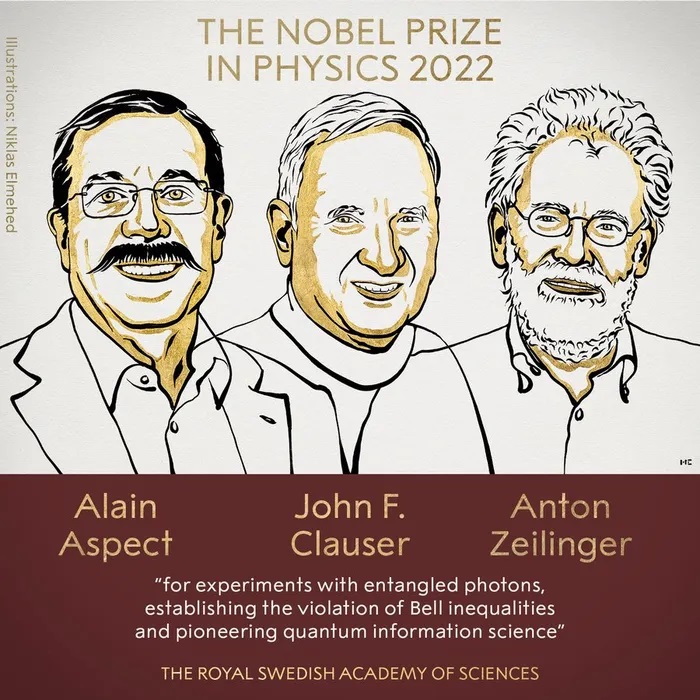
[Asia Economy Reporter Kim Bong-su] "They have proven to the world that the phenomenon of quantum entanglement, which even Einstein could not understand until his death, can actually be realized."
On the afternoon of the 4th (Korean time), the achievements of three quantum physicists who were awarded the 2022 Nobel Prize in Physics were announced. The Nobel Committee of the Royal Swedish Academy of Sciences announced that this year’s Nobel Prize in Physics was awarded to Alain Aspect, professor at ?cole Polytechnique and the Graduate School of Optics at Paris-Saclay University in France; John Clauser, CEO of J.F. Clauser & Associates in California, USA; and Anton Zeilinger, professor of physics at the University of Vienna in Austria.
Clauser conducted experiments in the 1970s, Aspect in the 1980s, and Zeilinger in the 1990s, experimentally proving the 'Bell inequality' theory established by John Stewart Bell in the 1960s to verify quantum entanglement. Quantum entanglement is a fundamental theory of quantum physics stating that particles, the smallest units of matter, are correlated such that their properties are determined simultaneously no matter how far apart they are. This theory was founded by Werner Heisenberg and others who laid the groundwork for quantum physics in the 1920s. Recently, it has become the core of quantum information communication technologies such as quantum cryptography. However, Albert Einstein, considered the greatest genius scientist in human history, who won the Nobel Prize in 1921 for discovering that light is composed of particles (photoelectric effect theory), never accepted modern quantum physics theories such as quantum entanglement until his death.
The Nobel Foundation evaluated them by stating, "They conducted remarkable experiments demonstrating that two particles in an entangled state behave as one even when separated," and "They opened the way for new technologies based on quantum information."
Clauser was born in 1942 in Pasadena, California, USA, and earned his Ph.D. in physics from Columbia University in 1969. He currently works as a research physicist at J.F. Clauser & Associates in Walnut Creek, California. Alain Aspect was born in 1947 in Agen, France, and received his doctorate from Paris-Sud University in 1983. Anton Zeilinger was born in Austria in 1945 and earned his Ph.D. in physics from the University of Vienna in 1971, where he currently works as a professor. Zeilinger’s student Pan Jianwei is famous as a master of quantum physics in China.
Anders Irb?ck, chairman of the committee, explained, "It is becoming increasingly clear that a new kind of quantum technology is emerging," and "The laureates’ research achievements on quantum entanglement, which solved fundamental questions of quantum mechanics, are very important."
© The Asia Business Daily(www.asiae.co.kr). All rights reserved.
![Clutching a Stolen Dior Bag, Saying "I Hate Being Poor but Real"... The Grotesque Con of a "Human Knockoff" [Slate]](https://cwcontent.asiae.co.kr/asiaresize/183/2026021902243444107_1771435474.jpg)
















