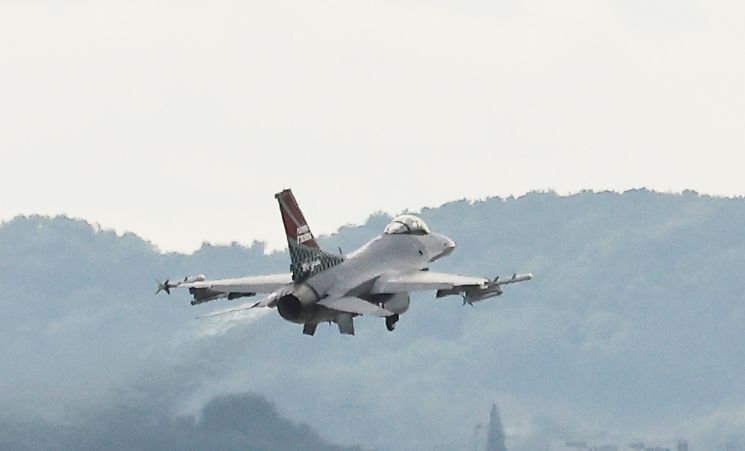
[Asia Economy Reporter Gong Byung-sun] The South Korean and U.S. military authorities conducted precision bombing training along with a joint strike formation flight just 10 hours after North Korea launched an intermediate-range ballistic missile (IRBM).
According to military authorities on the 4th, the Joint Chiefs of Staff announced that the South Korean and U.S. military authorities carried out precision bombing training with four South Korean Air Force F-15K fighter jets and four U.S. Air Force F-16 fighter jets stationed in South Korea participating respectively. The training was conducted about 10 hours after North Korea launched the IRBM at approximately 7:23 a.m. that day.
The F-15K fighters conducted precision bombing training by firing two Joint Direct Attack Munitions (JDAM) at a virtual target set at the Jikdo firing range off the coast of Gunsan, Jeonbuk Province. JDAM is a precision-guided bomb that transforms conventional bombs by attaching guidance systems and wing kits, enabling smart weapon capabilities for precise bombing day and night. It has a range of 24 km with an error margin of only 13 meters and is known to be capable of destroying underground bases, long-range artillery inside caves, and coastal artillery bases.
The Joint Chiefs of Staff stated, "Through this joint strike formation flight and precision bombing training, the ROK-U.S. alliance has demonstrated its determination to respond decisively to any provocation by North Korea and has shown the capability and readiness to precisely strike the origin of provocations with overwhelming allied power." They added, "In response to North Korea’s successive ballistic missile provocations, our military is firmly maintaining the ROK-U.S. combined defense posture while tracking and monitoring related developments to prepare for any additional provocations by North Korea and maintaining a solid state of readiness."
The IRBM launched that morning was fired from the Mupyong-ri area in Jagang Province, North Korea. The missile flew approximately 4,500 km, passing over the Japanese archipelago.
© The Asia Business Daily(www.asiae.co.kr). All rights reserved.

















