'Network Usage Fee Law' Emerges as Major Issue in National Assembly Audit
Google, Netflix Firmly Oppose, Saying "Cannot Pay"
Naver and Kakao Struggle, Unable to Take a Clear Stance
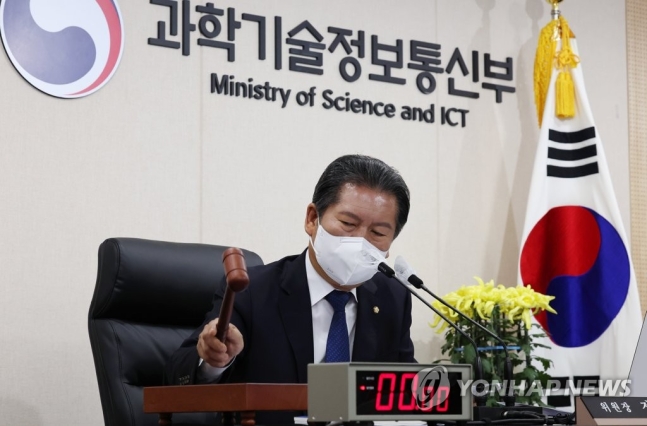 On the morning of the 4th, at the Government Sejong Complex in Sejong City, during the National Assembly Science, Technology, Information and Broadcasting Committee's audit of the Ministry of Science and ICT and the Korea Post, Committee Chairman Jeong Cheong-rae of the Democratic Party of Korea is striking the gavel.
[Asia Economy Reporter Seungjin Lee] The controversy surrounding the 'Network Usage Fee Act (Amendment to the Telecommunications Business Act)' is spreading rapidly. Google (YouTube) has expressed opposition, and Amazon (Twitch) has responded both directly and indirectly by lowering the quality of Twitch services, leading to divided opinions even at the National Assembly's audit. Domestic CPs (Content Providers) such as Naver and Kakao, who are directly affected by this controversy, have been unable to express any clear stance and appear to be in a difficult position.
Global CPs Launch Aggressive Counterattack... Naver and Kakao Remain Silent
According to the National Assembly and related industries on the 5th, the National Assembly's Science, Technology, Information and Broadcasting and Communications Committee (hereinafter referred to as the Committee) has summoned executives from Google and Netflix as witnesses for the comprehensive audit scheduled on the 21st. They plan to continue discussions related to the seven proposed 'network usage fee' bills. Domestic CPs were not selected as witnesses. It is highly likely that only the positions of the US big tech companies and the three telecom operators will be debated in the National Assembly without progress.
Global CPs are taking an active offensive. Ahead of the audit, Google launched a public relations campaign with YouTube creators and advertisers, arguing that they cannot pay network usage fees. Twitch, the game streaming platform, has lowered the video quality for domestic users from full HD (resolution 1920×1080) to HD (resolution 1280×720) since the 30th of last month, in an effort to block the enactment of the Network Usage Fee Act. Netflix has been engaged in a lawsuit with SK Broadband over network usage fees for three years.
On the other hand, Naver and Kakao, which generate less traffic than Google and Netflix, who are currently in conflict, have already been paying hundreds of millions of won annually in network usage fees and are staying out of this issue.
Their intentions are complex. If they join global CPs in blocking the enactment of the Network Usage Fee Act, they do not know what kind of boomerang effect might come back from domestic mobile carriers in the future. Even if the Network Usage Fee Act passes the National Assembly, domestic CPs will be placed in a difficult position. Currently, they negotiate with mobile carriers to determine and pay the network usage fees. However, if the fees are legislated, the negotiation process will disappear, potentially causing a greater burden.
An IT industry insider said, "What domestic CPs want is to eliminate discrimination against global CPs, which does not necessarily mean the enactment of the Network Usage Fee Act. But as this issue has spread to the political sphere, they have become unable to take active measures."
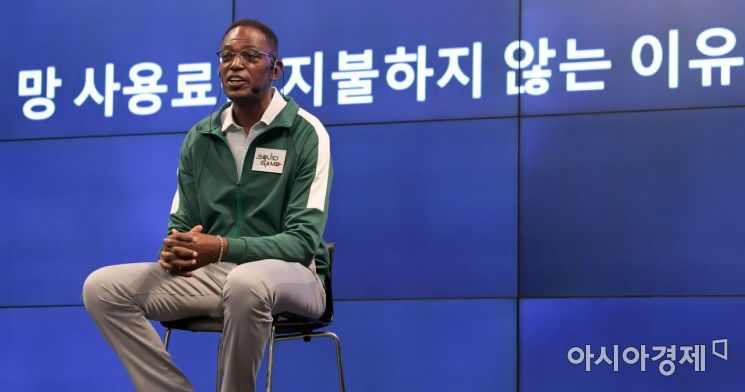 Dean Garfield, Vice President of Policy at Netflix, is answering questions from the press at the Media Open Talk held on the 4th at JW Marriott Dongdaemun Square Seoul Hotel in Jongno-gu, Seoul. Photo by Hyunmin Kim kimhyun81@
Concerns Over Impact on Overseas Business if Network Usage Fee Act is Legislated
The debate over the Network Usage Fee Act could become a burden for companies like Naver and Kakao, which are rapidly expanding their overseas businesses. In particular, as the two companies are expanding their businesses mainly in North America, there are concerns that imposing network usage fees on Google and Netflix, which have corporations in North America, could lead to reverse discrimination by local authorities.
Naver has acquired Poshmark, the largest fashion community in North America, to secure competitiveness in local commerce. It is also continuously expanding its content business locally, centered on webtoons. Kakao is in a similar position. Kakao Entertainment launched a new corporation last year by merging Tapas Media and Radish Media, which it had acquired, expanding its content business areas such as webtoons and web novels.
Moreover, if the legislation of the Network Usage Fee Act in Korea sets a precedent, it could lead to similar movements worldwide. Domestic CPs are already known to pay fees under the name of network usage fees through negotiations in some countries. If such bills are introduced in those countries as well, the negotiation process could disappear, leading to greater cost burdens similar to Korea.
In fact, in July, the Global System for Mobile Communications Association (GSMA) and seven European telecom associations issued a joint statement urging big tech companies to contribute to network investments. They stated, "Big tech companies should contribute their fair share to the growth of the internet ecosystem in preparation for the continuous increase in data traffic." At the end of last month, 16 European telecom companies also issued a statement urging big tech to share network investment costs.
© The Asia Business Daily(www.asiae.co.kr). All rights reserved.


















