Renewable Power Generation Increased from 20,590 GWh to 94,051 GWh
Share of Power Generation Rose Over Threefold from 9.7% to 33%
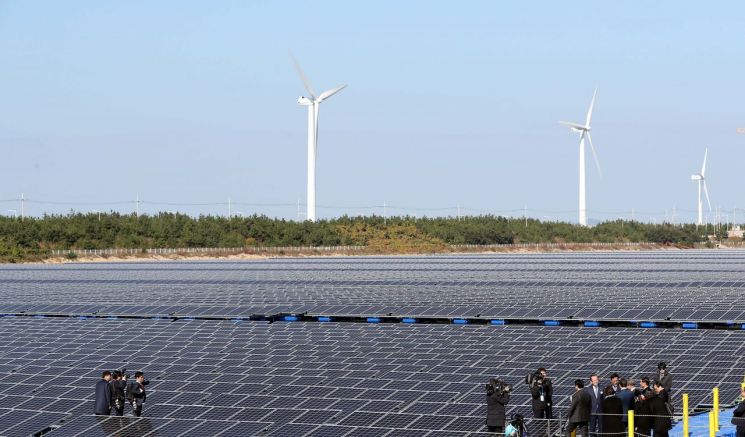 President Moon Jae-in Touring Saemangeum Floating Solar Power Plant
(Gunsan=Yonhap News) Photo by Hwang Kwang-mo = President Moon Jae-in is visiting and touring the Saemangeum Floating Solar Power Plant located in the reservoir in Gunsan, Jeonbuk, on the morning of October 30, 2018. 2018.10.30
hkmpooh@yna.co.kr
(End)
<Copyright(c) Yonhap News Agency, Unauthorized reproduction and redistribution prohibited>
[Asia Economy Sejong=Reporter Lee Jun-hyung] Five power generation public enterprises under Korea Electric Power Corporation (KEPCO) plan to increase renewable energy generation nearly fivefold over the next 10 years, with wind power as the main focus. However, concerns have been raised that the rapid expansion of renewable energy, which has inconsistent generation output, could lead to instability in the power grid.
According to data submitted on the 8th by five KEPCO subsidiaries, including Korea South-East Power and Korea Southern Power, to the office of Ku Ja-geun, a member of the People Power Party, these companies plan to increase renewable energy generation from 20,590 GWh next year to 94,051 GWh by 2035, approximately 4.6 times more. Consequently, the share of renewable energy generation among these five public power enterprises will rise more than threefold from 9.66% to 33% during this period. This means that about 13 years from now, one-third of the power supplied by these subsidiaries to KEPCO will come from renewable energy.
The core of the renewable energy expansion plan is wind power generation. The five public power enterprises intend to increase wind power generation capacity from 1,689 MW next year to 22,067 MW by 2035, about 13 times more. In particular, Korea Western Power plans to expand its wind power capacity from 105 MW next year to 3,306 MW by 2035, approximately 31.5 times. As a result, the proportion of wind power in Western Power’s total renewable energy capacity will increase significantly from 4.5% to 48.5%. Korea South-East Power will also increase its wind power capacity from 309 MW next year to 4,797 MW by 2034, a 15.5-fold increase.
The growth rate of solar power generation is also considerable. The five public power enterprises plan to expand solar power generation capacity from 4,053 MW next year to 15,157 MW by 2035, nearly fourfold. Specifically, Korea East-West Power will increase its solar power capacity from 673 MW to 4,712 MW during this period, a sevenfold increase. Korea South-East Power’s solar power capacity will grow from 743 MW to 4,223 MW, nearly six times more.
The problem is that as renewable energy generation increases, the stability of the power system decreases. Renewable energy, which has inconsistent output, has limitations in providing stable power supply. If renewable energy generation surges when power demand is low, it could overload the power grid and cause large-scale blackouts. Accordingly, KEPCO and others have implemented “output control” measures that forcibly stop power generation facilities when renewable energy generation exceeds necessary levels.
Concerns about power grid overload have already become visible. Jeju, which is rapidly increasing renewable energy facilities aiming for carbon neutrality by 2030, implemented nearly 90 output control measures in the first half of this year alone. Jeju Energy Corporation analyzed that by 2034, output control measures for renewable energy plants in the province will reach 326 times, resulting in losses estimated at around 510 billion KRW.
As renewable energy increases, pressure to raise electricity rates will also grow. According to the Ministry of Trade, Industry and Energy, in August, the settlement price for solar power generation was 212 KRW per kWh, about 3.5 times higher than nuclear power (61 KRW). The settlement price for wind power was also 207 KRW per kWh, 3.4 times higher than nuclear power. Additionally, the investment required to produce 1 kWh of electricity from wind and solar power is 4,059 KRW and 3,422 KRW respectively. Compared to nuclear power (500 KRW), this means investment costs are 7 to 8 times higher.
© The Asia Business Daily(www.asiae.co.kr). All rights reserved.

















