'Bulgwang Miseong' Approval Passed After 2 Years Following Rejection of Feasibility Review
Company Diagnosis Was Incorrect in Cost Analysis at the Time
"Safety Inspection to Be Newly Conducted at Complex Level"
Market Remains Lukewarm Despite Project Progress Potential
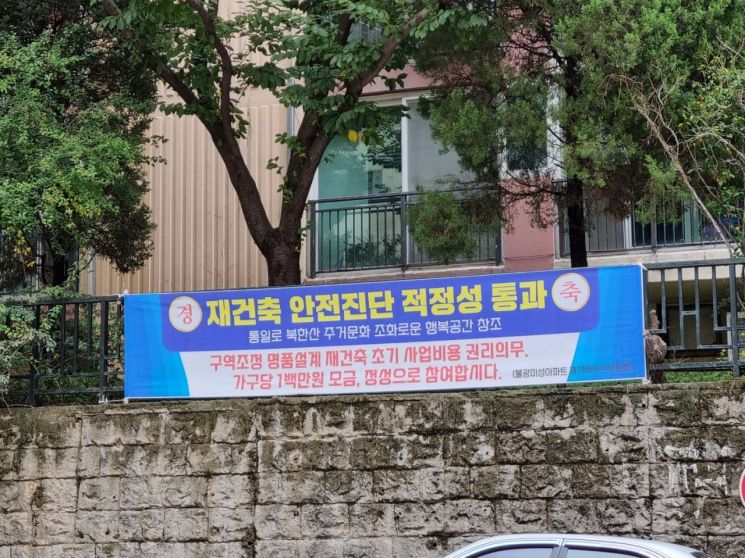 On the 4th, 'Bulgwang Miseong Apartment' in Bulgwang-dong, Eunpyeong-gu, Seoul was visited. A banner announcing the passing of the reconstruction safety diagnosis adequacy is hung within the complex. Photo by Seoyul Hwang chestnut@
[Asia Economy Reporter Hwang Seoyul] The 34-year-old Bulgwang Miseong Apartment in Eunpyeong-gu, Seoul, has passed the second-level safety inspection, known as the adequacy review, after two years. However, despite the hopeful news that the redevelopment project might proceed smoothly, possibly due to the economic downturn, the reactions from buyers and sellers remain lukewarm.
According to Eunpyeong-gu Office on the 4th, the adequacy review result of the reconstruction safety diagnosis for Bulgwang Miseong Apartment in Bulgwang-dong, Eunpyeong-gu, Seoul, on the 29th of last month, received a final evaluation grade of D (54.96 points), which means a "conditional reconstruction" judgment. By passing this safety inspection gate, Bulgwang Miseong Apartment can now move on to the next steps, such as establishing a redevelopment plan. Bulgwang Miseong Apartment was completed in October 1988, making it 34 years old this year. The complex consists of a total of 10 buildings with 1,340 households.
This is the first time in two years since June 2020 that the apartment passed the adequacy review, the second detailed safety inspection procedure, after previously being rejected. Bulgwang Miseong Apartment had received a D grade (conditional reconstruction) in the detailed reconstruction safety diagnosis in October 2019, requiring it to go through the adequacy review, the second-level safety inspection. In the first detailed safety diagnosis, grades A to C indicate maintenance and repair (reconstruction not allowed), D grade means conditional reconstruction (requiring public institution verification), and E grade confirms reconstruction.
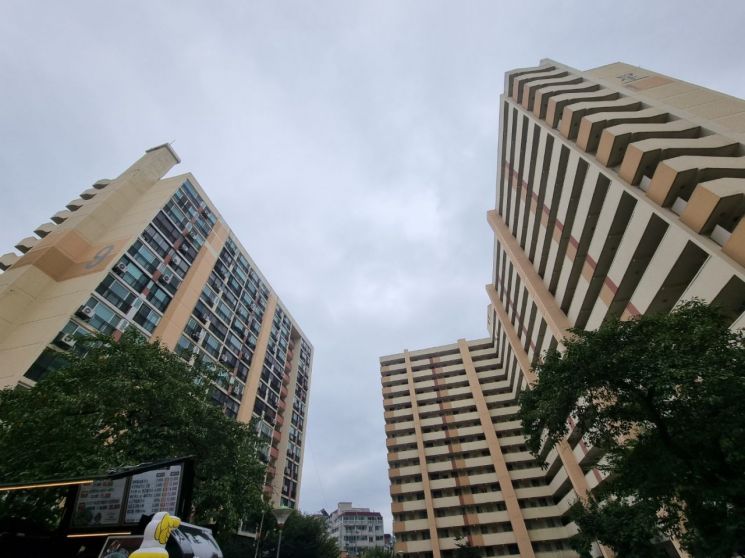 Officials from real estate agencies near the Bulgwang Miseong Apartment complex reported that despite the news of passing the safety inspection, the market reaction has been minimal. Photo by Hwang Seoyul chestnut@
Although the second detailed safety diagnosis was conducted two years ago, the project did not pass the safety inspection due to insufficient evaluation scores. The adequacy review includes detailed items such as ▲structural safety ▲building finishing and equipment aging ▲residential environment ▲cost analysis ▲comprehensive judgment. According to Eunpyeong-gu Office, the cost analysis by the company was judged to be incorrect at that time, leading the residents to reapply for the safety diagnosis. A district official stated, "The cost analysis by the company in charge of the safety diagnosis was incorrect, so after June 2020, the complex initiated a new safety diagnosis," adding, "This time, they changed the company and conducted a new safety diagnosis."
Although there are signs of progress in the project after two years, the market response remains lukewarm. Both buyers and sellers are quiet, according to real estate agency officials. The head of nearby Agency A said, "Several days have passed since the safety diagnosis was passed, but we have not received a single inquiry from buyers," adding, "It seems the biggest reason is that this is not a period when transactions are active." An official from Agency B reported a subdued atmosphere, saying, "Only a few sellers have withdrawn their listings." According to real estate big data company Asil, compared to the 29th of last month (the date of the diagnosis), there was no change in listings, and compared to the 1st of this month, listings decreased from 58 to 54.
Meanwhile, the government declared in August that it would begin improving the safety diagnosis system by the end of the year, drawing attention to whether this will accelerate reconstruction projects in the future. The Ministry of Land, Infrastructure and Transport stated that during the Moon Jae-in administration in March 2018, the weight of structural safety was increased (from 20% to 50%) and the mandatory adequacy review by public institutions was introduced, which significantly lowered the pass rate of safety diagnoses. In the three years before the revision of the safety diagnosis regulations, 56 complexes in Seoul passed the safety diagnosis (as of the announcement), but only 5 passed in the three years after the revision. Therefore, they are considering lowering the structural safety weight to around 30-40% and conducting public institution adequacy reviews only upon local government requests.
© The Asia Business Daily(www.asiae.co.kr). All rights reserved.


















