Professor Lee Jung of Hankuk University of Foreign Studies Law School, FKI Commissioned Illegal Strike Response Report
Professor Lee: "Collective Action Rights May Be Restricted for Public Welfare"
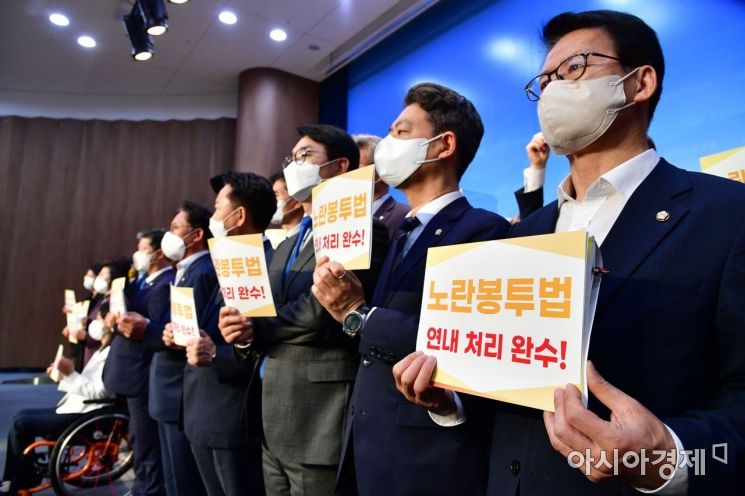 Incumbent lawmakers from the Democratic Party of Korea, the Justice Party, the Basic Income Party, independents, and representatives from civil society organizations held a "Press Conference Urging the Passage of the Yellow Envelope Act During the Regular National Assembly Session" at the National Assembly on the 27th of last month. Photo by Yoon Dong-ju doso7@
[Asia Economy Reporter Moon Chaeseok] An analysis has emerged stating that the so-called "Yellow Envelope Act (Amendment to the Labor Union and Labor Relations Adjustment Act)," which limits companies' claims for damages and provisional seizures related to losses from strikes, is difficult to accept within the current legal framework.
On the 5th, the Federation of Korean Industries released a report titled "The Harms of Illegal Strikes and Disruptive Collective Actions and Countermeasures," commissioned to Professor Lee Jeong of the Graduate School of Law at Hankuk University of Foreign Studies. This report was issued again as political circles showed movements to enact the Yellow Envelope Act following the Daewoo Shipbuilding & Marine Engineering incident, concluding that the law lacks practicality. The analysis views it as an unreasonable legal interpretation stemming from misunderstandings about fundamental labor rights. Professor Lee stated, "Constitutional labor rights are not absolute rights and can be restricted by law when necessary for public welfare," adding, "The right to collective action is not an unrestricted right and, like other fundamental rights, can be limited for public welfare."
Professor Lee's perspective is that constitutional labor rights must also be balanced against property rights. In other words, the principle of immunity should only apply to legitimate industrial actions. He emphasized, "Granting immunity even to clearly illegal acts under the guise of exercising labor rights is a legislative act that shakes the foundation of the existing legal order," and "It is difficult to find precedents for such legislation even in comparative law."
According to the report, strikes as industrial actions should be limited to collectively refusing work to the extent that normal operations are disrupted, but in reality, this is often not the case. In actual industrial sites, union radical actions frequently take the form of illegal acts accompanied by physical clashes or property damage. Representative examples include workplace occupation, occupation of public facilities, blockade and logistics obstruction causing business interference, high-altitude sit-ins, assault, and property damage. The report argues that principled responses are necessary, such as clearly pursuing civil and criminal liability for illegal strikes that have lost legal legitimacy.
In particular, political strikes conducted by unions to enforce specific political demands on public organizations are identified as the biggest problem. Professor Lee explains that these are clearly illegal as they do not align with the purpose of industrial action. Additionally, demanding collective bargaining and initiating strikes against primary contractors who are not in a direct labor relationship is also pointed out as clearly illegal. The report calls for strict law enforcement.
The report advocates ▲principally prohibiting union occupation of workplaces, ▲allowing replacement workers unrelated to the dispute work, and ▲removing criminal penalties for unfair labor practices. According to the report, current labor laws were designed in 1953 based on uniform factory labor. It argues that criminal penalties for unfair labor practices should be removed based on the "principle of equity" (principle of equal weapons) to suit the times. It also states the need to modernize the legal system to strictly apply laws against illegal strikes.
This analysis draws attention as it was released shortly after Kim Moon-soo, the newly appointed chairman of the Economic and Social Labor Council, a tripartite dialogue body, expressed a "cautious stance on the Yellow Envelope Act." Earlier, on the 3rd, Chairman Kim stated, "It is a law with considerable problems," and "While we must ensure that excessive damage to workers does not occur due to damage claims, should we unconditionally restrict damage claims themselves? That is not acceptable." Ultimately, the head of the tripartite dialogue body also highlighted the absurdity of the law, echoing concerns from the business community.
© The Asia Business Daily(www.asiae.co.kr). All rights reserved.
![Clutching a Stolen Dior Bag, Saying "I Hate Being Poor but Real"... The Grotesque Con of a "Human Knockoff" [Slate]](https://cwcontent.asiae.co.kr/asiaresize/183/2026021902243444107_1771435474.jpg)
















