Will 'Former Ministry of Economy and Finance Officials' Strengthen Pension Reform?
Focus on Concrete Measures to Address Blind Spots in Health and Welfare
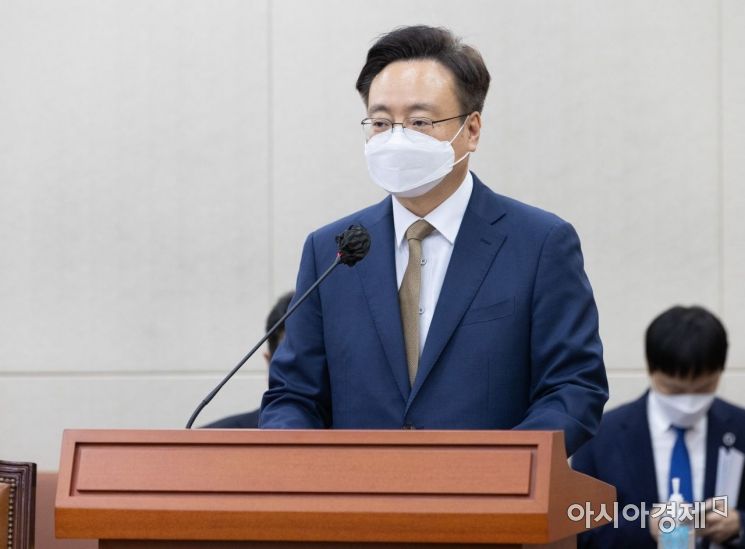 Cho Kyu-hong, nominee for Minister of Health and Welfare, is delivering opening remarks at the confirmation hearing held at the National Assembly on the 27th. Photo by Yoon Dong-joo doso7@
[Asia Economy Reporter Kim Young-won] With the National Assembly adopting the confirmation hearing report for Cho Gyu-hong, the nominee for Minister of Health and Welfare, the long-vacant ministerial position, which had been empty for 140 days, is expected to be filled. Attention is focused on how Cho will address the numerous pressing issues, from pension reform to the blind spots in health and welfare, once he assumes office.
The National Assembly's Health and Welfare Committee held a plenary session on the 4th and adopted the confirmation hearing report for Cho Gyu-hong, nominee for Minister of Health and Welfare. President Yoon Seok-yeol submitted the request for the confirmation hearing to the National Assembly on the 17th of last month, and that day was the deadline for adoption. There were no objections to the adoption of the report during the meeting. If President Yoon appoints Cho as minister, Cho will be able to attend the Ministry of Health and Welfare’s audit sessions scheduled for two days starting on the 5th.
'Former Ministry of Economy and Finance Official'... Will Pension Reform Be an Advantage or a Label of 'Lack of Expertise'?
Since former Minister Kwon Deok-cheol resigned on May 17, the ministerial post has been vacant for 140 days, leaving numerous challenges ahead for Cho.
First, he must address pension reform, which has been actively discussed by the government and the National Assembly. Cho has served in the Ministry of Economy and Finance for over ten years and has also handled welfare budget-related tasks. The Presidential Office explained the reason for nominating Cho as "the right person to lead the Yoon Seok-yeol administration’s core national tasks, including pursuing cooperative pension reform, improving efficiency in social welfare and healthcare fiscal expenditures, reforming the National Health Insurance system, and strengthening essential public healthcare."
At the confirmation hearing on the 27th of last month, Cho expressed his stance on pension reform. He stated, "Pension reform cannot be discussed without guaranteeing payment. The government has always considered payment guarantees, and I believe there is a clause with that intent in the current law. However, if more precise wording is needed during the pension reform discussions, we will actively consult." When sharing his thoughts after being nominated, he added, "I will thoroughly prepare structural reform tasks to secure the sustainability of welfare, such as innovative welfare investment for virtuous cycles between welfare and growth, reforming the National Pension to prepare for the future, addressing low birth rates, and fostering the bio-health industry."
However, there have been consistent criticisms that, as a 'former Ministry of Economy and Finance official,' he lacks expertise in health and welfare fields. During the confirmation hearing, Justice Party lawmaker Kang Eun-mi asked, "There are concerns that having a Ministry of Economy and Finance official as Minister of Health and Welfare might bring a dark age for welfare." Cho responded, "Because I come from the Ministry of Economy and Finance, I can design policies with a more macro and long-term perspective. Even if we carry out the same projects, we can save budgets and operate more efficiently, and I believe I can secure necessary budgets better by utilizing my human network." He emphasized his experience in establishing mid-term financial plans for welfare and responding to healthcare issues as acting minister to address concerns about his expertise in health and welfare.
How Will He Specifically Address the Blind Spots in Health and Welfare?
Attention is also focused on how he will respond to recent incidents related to blind spots in health and welfare. The 'Suwon Three Mothers' case, where individuals in crisis due to unpaid health insurance premiums passed away, and the death of a nurse at Asan Medical Center both occurred while the ministerial post was vacant. At the confirmation hearing, Cho pledged to strengthen the identification of welfare crisis households using big data and other methods to prevent tragedies like the Suwon Three Mothers case.
Regarding issues caused by shortages of personnel in essential medical fields such as critical and emergency care, including the Asan Medical Center nurse’s death, he said he would prepare comprehensive measures such as fee increases and phased support for medical personnel training. The government is also promoting policies like the national responsibility system for essential medical care and public policy fee systems. However, the medical community has responded that these essential medical reinforcement measures are no different from previously implemented policies, so specific alternatives after his appointment are highly anticipated.
Additionally, other challenges Cho will need to address after assuming office include the government’s initiatives on scientific and targeted quarantine, compensation for COVID-19 vaccine damages, and conflicts between industry and medical sectors regarding telemedicine.
© The Asia Business Daily(www.asiae.co.kr). All rights reserved.

















