Q3 US Average New Car Loan Interest Rate 5.7%
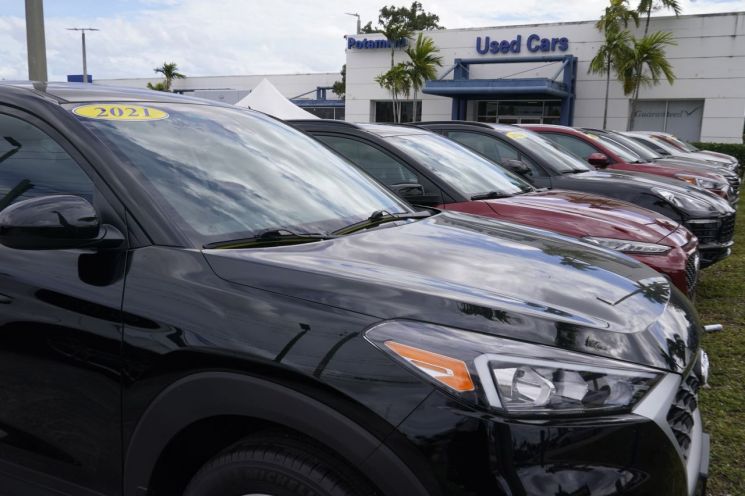
[Asia Economy Reporter Jeong Hyunjin] The global automotive industry, which had faced a crisis due to the semiconductor supply shortage, is now encountering a new obstacle in the form of interest rate hikes. With the U.S. Federal Reserve's (Fed) increase in benchmark interest rates, auto loan rates have surged, and this is expected to negatively impact new car sales.
The Wall Street Journal (WSJ) reported on the 3rd (local time), citing the well-known U.S. automotive information site Edmunds.com, that the average interest rate on new car loans reached 5.7% in the third quarter, the highest in three years. During this period, the average loan amount Americans took out when purchasing a car was $41,347, a significant increase from $38,315 in the third quarter of last year. Among buyers who took out auto loans, the proportion with monthly payments exceeding $1,000 rose by 8% compared to the same period last year.
Charlie Chesbrough, senior economist at research firm Cox Automotive, told WSJ, "Due to the interest rate hikes, consumer desire and ability to purchase have decreased, causing pent-up demand from supply constraints to dissipate rapidly." The firm forecasts that new car sales in the U.S. will decline by 9% year-over-year to 13.7 million units this year.
Randy Parker, CEO of Hyundai Motor America, announced the company's third-quarter U.S. sales results on the same day, stating, "Negative consumer sentiment is spreading in the market. We are certainly concerned about this." However, he added that it is still too early to say that demand is significantly weakening, noting that the impact of Hurricane Ian on sales has made it difficult to accurately assess consumer sentiment.
Hyundai Motor announced that its U.S. market sales increased by 3% year-over-year in the third quarter.
The WSJ report came amid news that the semiconductor supply shortage in the automotive sector is easing. U.S. automaker General Motors (GM) announced on the same day that it sold 555,580 vehicles in the U.S. market in the third quarter, a 24% increase compared to the same period last year. This allowed GM to maintain its position as the number one automaker in the U.S. market for two consecutive quarters, surpassing Toyota Motor Corporation. The New York Times (NYT) analyzed that GM's performance indicates that the semiconductor supply shortage, which had severely impacted the global automotive industry, is beginning to ease.
WSJ reported, "As supply chain issues ease and automakers increase factory production, more new cars and trucks are being supplied, but interest rate hikes and other economic pressures are starting to dampen consumer sentiment toward car purchases." It added that due to the interest rate hikes, U.S. buyers are finding it difficult to accept 'record-high' prices for new cars, signaling the end of the era of 0% financing offers on new vehicles.
© The Asia Business Daily(www.asiae.co.kr). All rights reserved.

















