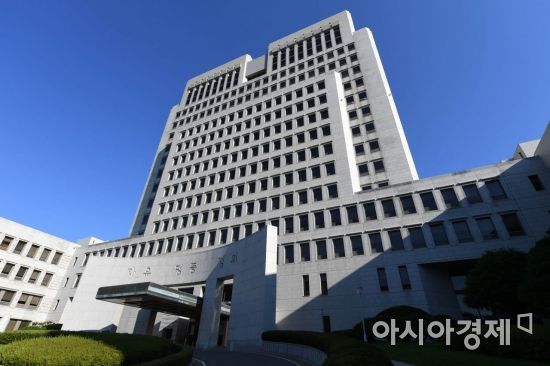
[Asia Economy Reporter Choi Seok-jin, Legal Affairs Specialist] The Supreme Court has ruled that when one of the co-owners of land and the building on it transfers only the building share to a third party, the establishment of a statutory superficies under customary law cannot be recognized.
Previously, there were Supreme Court precedents denying the establishment of statutory superficies when one of the land co-owners transferred ownership of a building held solely on the land to another person. This ruling is the first to clarify that the same legal principle applies to shared buildings.
The Supreme Court's 3rd Division (Presiding Justice Ahn Cheol-sang) overturned the lower court's partial ruling in favor of plaintiff A, who filed a lawsuit against B and the C Foundation Corporation claiming payment of land rent based on the acquisition of statutory superficies, ordering B to pay 34.37 million KRW and the C Foundation Corporation 32.20 million KRW respectively, and remanded the case to the Seoul Central District Court on the 4th.
The court stated, "The lower court's judgment ordering the defendants to pay rent on the premise that customary law statutory superficies was established regarding the land in question contains an error in the legal principle concerning customary law statutory superficies that affected the judgment," and added, "The defendants' appeal grounds pointing this out are valid," explaining the reason for reversal and remand.
Customary law statutory superficies refers to the right, recognized under customary law (similar to superficies under civil law), allowing the building owner to continue using the land when the same person owns both the land and the building on it and then transfers either the land or the building to another person without a special agreement for building demolition, reflecting the parties' intention to allow continued use of the land by the building owner.
A acquired ownership of a 76㎡ site and the wooden house and warehouse (the building in question) on it in Jongno-gu, Seoul, in 1991, each with a 1/2 share together with his grandfather D.
Among these, D's land share was transferred to A's uncle B through inheritance by court ruling in October 2012 after D's death, and then the C Foundation Corporation received it as a gift from B and registered ownership in April 2013. As a result, A and the C Foundation Corporation became co-owners of the land, each holding a 1/2 share.
Meanwhile, regarding the building, in June 2005, uncle B acquired A's share, and D's share was transferred to the C Foundation Corporation in November 2006. Consequently, defendants B and the C Foundation Corporation shared ownership of the building, each holding a 1/2 share.
The land rent for the land in question was 137,497,300 KRW from February 1, 2006, when B acquired the building share, to January 31, 2016, and 128,832,675 KRW from November 14, 2006, when the C Foundation Corporation acquired the building share, to January 31, 2016.
A claimed that statutory superficies under customary law was established on the premise that he simultaneously owned half shares of the land and building, but the building ownership changed. He filed a lawsuit against B and the C Foundation Corporation, who shared the building at the time, claiming one-quarter each of the land use fee corresponding to the period they held the building. Since B and the C Foundation Corporation each owned half of the building, they should bear half of the total land use fee, but because A himself was a co-owner holding a half share of the land, he claimed half of that, i.e., one-quarter each.
The first trial ruled in favor of A. The second trial reduced part of the delayed damages recognized in the first trial but still acknowledged B and the C Foundation Corporation's obligation to pay rent to A.
They recognized the establishment of customary law statutory superficies, considering the case where the land and building were owned by the same person but the ownership changed.
However, the Supreme Court's judgment differed.
The Supreme Court previously stated, "Even if one of the land co-owners owns a building on the shared land and transfers only the land share, causing a reason to consider customary statutory superficies established for that co-owner, if it is considered that customary statutory superficies for building ownership is established regarding the land itself, it would unjustly allow that co-owner to dispose of superficies rights over other co-owners' shares. Therefore, in such cases, customary statutory superficies cannot be established regarding the land."
For example, if Gap owns both the land and the building on it and transfers the building to Eul without a special agreement for demolition, it is naturally presumed that Gap and Eul intend for Eul to continue using the building, so the Supreme Court recognizes the establishment of customary statutory superficies.
On the other hand, if Gap and Eul co-own the land, and Gap solely owns the building and transfers it to Byung, recognizing customary statutory superficies for Byung would allow Gap, one of the land co-owners, to dispose of superficies rights over Eul's land share, which the Supreme Court denies.
The court explained, "Considering these legal principles comprehensively, transferring the building share to defendant 1 (B) does not establish customary statutory superficies regarding the land for that defendant, and since the land and building were not owned by the same person when defendant 2 (the C Foundation Corporation) acquired the building share, customary statutory superficies cannot be recognized for defendant 2 either."
In other words, because the land was co-owned, not solely owned by A when he transferred half of the building share to B, statutory superficies cannot be recognized for B according to existing Supreme Court precedents. Also, since the land and building owners were different when the C Foundation Corporation acquired D's share, customary statutory superficies does not arise.
A Supreme Court official explained, "The Supreme Court has consistently held that in cases of customary statutory superficies in co-ownership, it is not permissible to impose unilateral superficies rights disposals on other co-owners against their will to their disadvantage," adding, "This ruling is significant as the first explicit decision clarifying that the existing precedent applies equally to shared land and shared buildings, where co-owners are the same (both A and D co-owning land and building), and one co-owner cannot dispose of superficies rights over other co-owners' shares."
© The Asia Business Daily(www.asiae.co.kr). All rights reserved.
![Clutching a Stolen Dior Bag, Saying "I Hate Being Poor but Real"... The Grotesque Con of a "Human Knockoff" [Slate]](https://cwcontent.asiae.co.kr/asiaresize/183/2026021902243444107_1771435474.jpg)
















