Abnormal Climate Everywhere... Exact Causes Unknown
Astronomical Economic Losses Due to Climate Change Affecting Not Only China but the Entire Globe
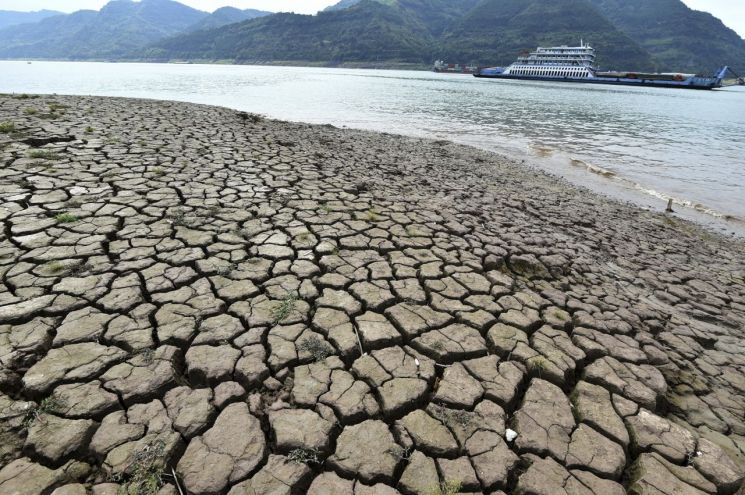 This year, the southern region of China experienced extreme heatwaves and drought. The water area of Poyang Lake in Jiangxi Province, China's largest freshwater lake, has shrunk to 638 km², a decrease of about 80% compared to the water area three months ago. Photo by Yonhap News Agency
[Asia Economy Reporter Bang Je-il] China is suffering from abnormal climate conditions as it simultaneously experiences unprecedented heatwaves, droughts, heavy rains, and cold waves.
The China Central Meteorological Observatory issued a yellow heatwave warning and a cold wave advisory simultaneously on the morning of the 3rd. This is the first time that a cold wave advisory and a heatwave warning have been issued at the same time in China.
The observatory forecasted strong winds and a drop in minimum temperatures by 8 to 12 degrees compared to the end of last month. In particular, the temperature drop in six regions including Jilin Province, Henan Province, Anhui Province, Jiangsu Province, Hunan Province, and Hubei Province is expected to reach 18 degrees. On the 6th and 7th, temperatures are expected to fall further, with minimum temperatures around 0 degrees in some areas.
On the other hand, heatwave warnings were issued for southern regions such as Shanghai, Fujian, Chongqing, and Guangdong during the same period. The observatory forecasted that the daytime maximum temperature in these areas would reach 37 to 39 degrees, with some parts of northern Jiangxi Province and western Fujian Province exceeding 40 degrees.
On the 3rd, the maximum temperature recorded at the Xujiahui observatory in Shanghai was 34.7 degrees. This surpassed the previous highest October temperature of 34 degrees recorded on October 2, 1984.
Especially this year, southern China has experienced severe heatwaves and droughts. The water surface area of Poyang Lake in Jiangxi Province, China's largest freshwater lake, has shrunk to 638 km², a decrease of about 80% compared to three months ago. Poyang Lake has traditionally supplied irrigation water to the agricultural lands in the middle and lower reaches of the Yangtze River, China's largest rice-producing region.
According to China Central Television (CCTV), in mid-August, heavy rains caused floods in the mountainous Datong County of Xining City, Qinghai Province in northwest inland China, resulting in 23 deaths and 8 missing persons. In July, heavy rains of up to 110 mm fell in western Sichuan and Gansu regions, causing 24 deaths and missing persons, flooding for over 40,000 people, and displacement of about 120,000 people.
Earlier in June, three days of heavy rain caused 113 rivers and streams in Fujian, Guangxi, Guangdong, Jiangxi, and Hunan provinces to overflow, flooding many urban areas and triggering landslides. CCTV reported that the water level of the Beijiang River in Guangdong rose to a record 35.8 meters, the highest since measurements began in 1915, causing about 1.5 million people to be displaced, flooding or washing away about 800,000 hectares of farmland, and damaging around 2,000 houses.
Additionally, in Liaoning, the granary of northeast China, 13 large and small floods occurred since June, causing significant damage to crops ready for harvest. To make matters worse, China suffered a major disaster from a magnitude 6.8 earthquake on September 5 in Luding County, Ganzi Tibetan Autonomous Prefecture, Sichuan Province. Sichuan Province reported 93 deaths, 25 missing persons, damage to over 50,000 houses, and displacement of 110,000 people due to this earthquake.
◆ Is China's abnormal climate a shadow of its high-growth policy?
There are also claims that the cause of China's repeated natural disasters due to abnormal climate is its high-growth policy pursued since the reform and opening-up in 1978. Coal-fired power generation, which China has relied on as the driving force for high growth, is a major source of carbon emissions, which are blamed for climate change.
According to the British BBC, the Chinese government is also struggling to devise measures to address carbon emissions. In June 2014, at the 6th meeting of the Central Financial and Economic Leading Group chaired by President Xi Jinping, China adopted a "new energy security strategy" and began promoting carbon reduction policies. In a speech at the United Nations General Assembly in September 2020, President Xi presented the "dual carbon" goal of peaking carbon emissions by 2030 and achieving carbon neutrality by 2060.
Various carbon neutrality policies are underway, including exemptions from registration taxes for new energy vehicles such as electric and hybrid cars, and expansion of renewable energy production such as solar and wind power.
The problem is that the green policy direction wavers whenever there is a risk of economic recession. Sixty percent of China's electricity production comes from coal-fired power plants.
In September last year, the Chinese government eased regulations after a nationwide power crisis occurred due to production facility shutdowns and heating cuts, which happened when it suppressed coal production and use as part of radical carbon reduction policies.
China, the world's largest coal producer and consumer, produced 4.07 billion tons of coal last year, accounting for nearly half of the world's total. Last year's coal production in China increased by 4.7% compared to the previous year, reaching a record high.
◆ The world groans under abnormal climate... Increasing human and property damage
Not only China but the entire world is paying a heavy economic price due to abnormal climate. According to a report released by Munich Re, the world's largest reinsurance company, at the end of August, losses from natural disasters worldwide in the first half of this year amounted to $65 billion (about 84.8 trillion KRW).
This is less than the $105 billion recorded in the first half of last year, but considering that the heatwaves covering the globe are still ongoing and heavy rains are occurring in some countries, economic damage is bound to increase.
Forecaster Munich Re's director said in a media interview, "Natural disasters in the first half were dominated by climate-related catastrophes." Among climate disasters in the first half, the most severe were heatwaves and droughts. Europe experienced the most extreme conditions, and economic damage from heatwaves surged in the US, India, and China as well.
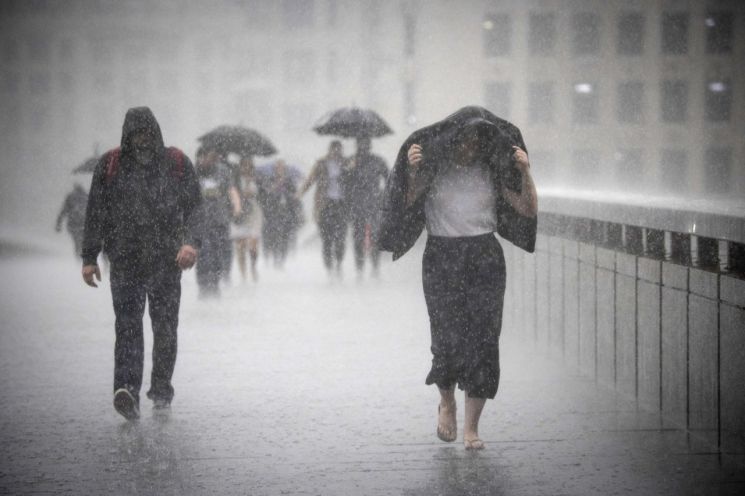
In the US, losses from strong convective storms such as tornadoes in the first half of this year amounted to $28 billion. The Asia-Pacific region suffered $22 billion in losses, and Europe incurred $11 billion.
The top five natural disasters with the largest losses were ▲March 16 Japan strong earthquake ($8.8 billion) ▲February-March Australia floods ($5.9 billion) ▲February European winter storm ($5.2 billion) ▲May China floods ($3.9 billion) ▲April US convective storms ($3.1 billion).
Deaths from natural disasters in the first half of the year totaled about 4,300, 1.9 times higher than the same period last year. Among them, about 1,200 were deaths from a magnitude 5.9 earthquake that occurred in Afghanistan on June 22.
In the UK, heatwaves in July caused railway tracks to warp and fires to break out, halting train operations, and a runway at an airport melted, stopping aircraft operations for several hours.
In France, rising river water temperatures used for reactor cooling raised concerns about power generation disruptions. In Germany, the water level of the Rhine River, a major logistics waterway, dropped significantly, reducing coal transport and raising concerns about worsening energy crises originating from Russia.
In Pakistan, unprecedented prolonged heavy rains caused floods, resulting in numerous casualties and increasing economic damage.
Meanwhile, the International Labour Organization (ILO) estimated in a 2019 report that by 2030, global total working hours will decrease by 2.2% and the world's gross domestic product (GDP) will decline by $2.4 trillion due to heatwaves. This productivity loss is equivalent to the disappearance of 80 million full-time jobs.
The World Meteorological Organization (WMO) analyzed that economic losses from climate-related disasters in the 2010s increased 7.8 times compared to the 1970s.
© The Asia Business Daily(www.asiae.co.kr). All rights reserved.
![Clutching a Stolen Dior Bag, Saying "I Hate Being Poor but Real"... The Grotesque Con of a "Human Knockoff" [Slate]](https://cwcontent.asiae.co.kr/asiaresize/183/2026021902243444107_1771435474.jpg)

















