Police to Conduct Comprehensive Investigation of Stalking Crimes with No Prosecution
Council to Establish Guidelines for Prompt Measures Including Interim Actions
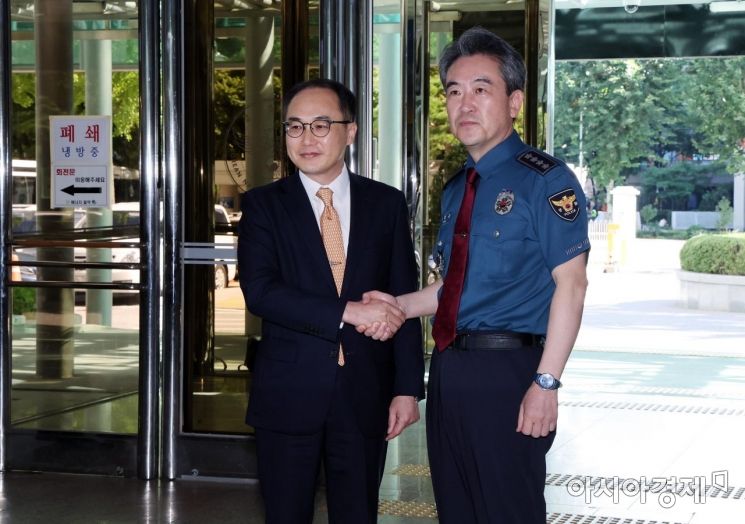 Prosecutor General Lee Won-seok is visiting the Seoul Seodaemun-gu Police Agency on the 19th and greeting Police Chief Yoon Hee-geun. Photo by Hyunmin Kim kimhyun81@
[Asia Economy Reporter Gong Byung-sun] In the wake of the murder case at Sindang Station on the Seoul subway, calls for stronger measures against stalking crimes are growing louder, prompting the police and prosecution to engage in practical consultations.
According to the National Police Agency on the 4th, the National Police Agency and the Supreme Prosecutors' Office announced that they will hold a follow-up practical consultation meeting related to the 'Stalking Crime Response Council' on the 13th. On the 22nd of last month, the Director of the Criminal Affairs Bureau of the National Police Agency and the Chief of the Criminal Division of the Supreme Prosecutors' Office formed the council and discussed its operational direction.
A police official stated, "Metropolitan police agencies and local prosecutors' offices have also established communication systems through consultations between the National Police Agency and district prosecutors' offices," adding, "We are closely cooperating to protect victims by sharing risk assessment data and actively considering provisional measures and detention investigations."
Recently, as civil society has urged strong responses to stalking crimes, the police are pushing forward related measures. On the 19th of last month, Yoon Hee-geun, Commissioner of the National Police Agency, announced at a press briefing, "We will conduct a comprehensive investigation of all stalking cases nationwide that the police have or have already decided not to prosecute." It is known that about 400 stalking-related cases were recently decided not to be prosecuted in Seoul alone. The police explained that they are currently meticulously re-examining stalking cases nationwide, considering factors such as suspect retaliation risk, danger, and the necessity of victim protection measures.
Active measures to protect victims are also being prepared. Although the suspect in the Sindang Station case had already been booked for continuous stalking, there was no way to protect the victim’s safety as the court dismissed the arrest warrant. Through this consultation with the prosecution, the police plan to revise guidelines to enable swift processing of stages from stalking reports to provisional measures and arrest warrant applications. The goal of this measure is to increase the issuance rate of arrest warrants and the acceptance rate of Provisional Measure No. 4. Provisional Measure No. 4 is a system that allows the detention of stalking offenders in a detention center without an arrest warrant, but it has been criticized for its short maximum duration of one month and low acceptance rate.
Additionally, the police have proposed long-term tasks such as "criminal punishment instead of the current fine for violating emergency provisional measures," "establishment of emergency provisional measures," and "reducing the three-step protection decision process (police → prosecution → court) to two steps (police → court)." Emergency provisional measures refer to detaining the offender at the scene in a detention center first and then receiving a court's subsequent judgment, proposed as a way to address the gap of Provisional Measure No. 4, which takes 2 to 5 days.
© The Asia Business Daily(www.asiae.co.kr). All rights reserved.
!["The Woman Who Threw Herself into the Water Clutching a Stolen Dior Bag"...A Grotesque Success Story That Shakes the Korean Psyche [Slate]](https://cwcontent.asiae.co.kr/asiaresize/183/2026021902243444107_1771435474.jpg)
















