Ahead of Competitor Taiwan TSMC, Officially Announces 1.4 Nanometer Plan
Foundry Business Expected to Record Highest Ever Sales in Q2 This Year
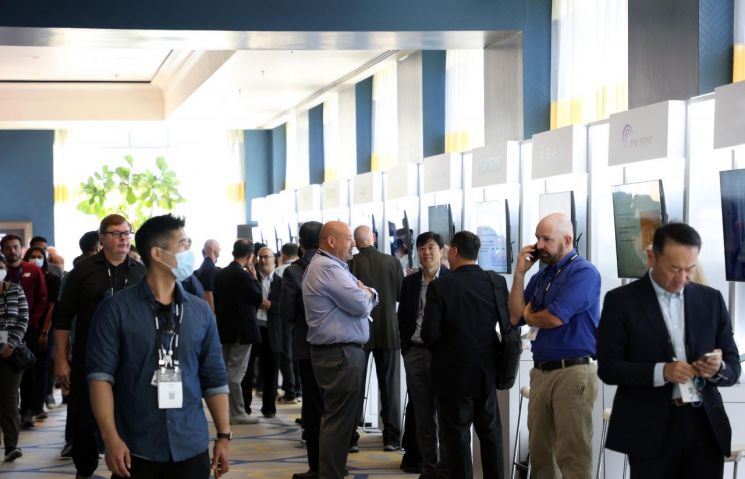 Participants attending the 'Samsung Foundry Forum 2022' held on the 3rd (local time) in Silicon Valley, USA / Provided by Samsung Electronics
[Asia Economy Reporter Kim Pyeonghwa] Samsung Electronics' official plan to mass-produce 1.4-nanometer (nm, one billionth of a meter) chips by 2027 ahead of its competitor Taiwan's TSMC is interpreted as a sign of confidence that it can expand its influence in the foundry market by leveraging its technological prowess. Having previously announced its 3nm mass production plan ahead of TSMC, Samsung Electronics has now expressed its determination to leap to the top position in the foundry sector following its leadership in the memory field through the 1.4nm process.
According to market research firm Omdia on the 4th, the global foundry market is expected to grow at a compound annual growth rate of 13.4%, from $98.6 billion (approximately 141.422 trillion KRW) this year to $145.6 billion (approximately 208.834 trillion KRW) by 2025. Among these, the North American region accounts for more than 50% of the total foundry market, making it a large-scale market. Seven of the world's top 10 fabless companies, including Qualcomm, Broadcom, and Nvidia, are based in North America. Samsung Electronics, recognizing the importance of this region for strengthening its foundry business, has held several related events to actively respond to customer demand.
Samsung Electronics plans to expand the applications of its 3nm process, announced for mass production in June this year, and continue innovating its Gate-All-Around (GAA) based process technology, aiming to introduce 2nm in 2025 and 1.4nm in 2027. This means Samsung has formalized its 1.4nm plan ahead of TSMC, following its earlier lead in 3nm mass production.
The market expects Samsung Electronics' foundry division to record its highest-ever sales in the second quarter of this year. Market research firm TrendForce projected the sales to be $5.588 billion (approximately 8.0115 trillion KRW), surpassing the previous quarter's $5.544 billion (approximately 8.0115 trillion KRW). TrendForce anticipates that Samsung Electronics could achieve record-high sales in the foundry industry.
Samsung Electronics itself has mentioned in its quarterly earnings reports that it has "achieved the highest quarterly performance." This reflects the company's confidence in the growth potential of its foundry business. In its second-quarter earnings announcement, Samsung stated, "If the current growth continues, we aim to reach a profitability level by 2025 that can generate internal investment resources and will focus on the business accordingly."
The market views the expansion of Samsung Electronics' customer base as the reason behind its record quarterly sales in the foundry business. Foundry is a contract manufacturing industry where growth is possible only by securing customers. Samsung's foundry customer count more than doubled compared to 2019, driven by increases in 5G RF and automotive customers last year. Samsung aims to secure more than five times the number of customers by 2027.
In its first-quarter earnings report this year, Samsung Electronics forecasted that its order backlog over the next five years would be eight times the sales of the previous year. The company explained that as it actively promotes orders centered on advanced processes, the order volume is expected to increase further. In its second-quarter earnings report, Samsung also revealed that it secured major customers in high-performance computing (HPC) and mobile sectors for its second-generation 3nm process, targeted for mass production in 2024.
Kyung Kye-hyun, President of Samsung Electronics' Device Solutions (DS) Division, expressed expectations regarding the foundry business last month, saying, "We are actively developing 3nm, and we are improving performance and cost for 4nm and 5nm compared to before, so I think by the end of next year, Samsung Electronics' foundry landscape will look different from now."
© The Asia Business Daily(www.asiae.co.kr). All rights reserved.
![Clutching a Stolen Dior Bag, Saying "I Hate Being Poor but Real"... The Grotesque Con of a "Human Knockoff" [Slate]](https://cwcontent.asiae.co.kr/asiaresize/183/2026021902243444107_1771435474.jpg)
















