National Defense Committee Member Song Gap-seok Analyzes Desertion Status by Military Branch Over 5 Years
Number of Deserters Decreases After Full Use of Soldiers' Mobile Phones
[Asia Economy Yang Nak-gyu, Military Specialist Reporter] It has been revealed that there are four long-term deserters who have not been apprehended despite deserting the military 10 years ago. In particular, one soldier who deserted last year has still not been caught.
According to the "Desertion Status by Military Branch in the Last 5 Years" submitted by the Ministry of National Defense to Song Gap-seok, a member of the National Defense Committee of the National Assembly from the Democratic Party of Korea, as of July this year, a total of 592 soldiers deserted from 2017.
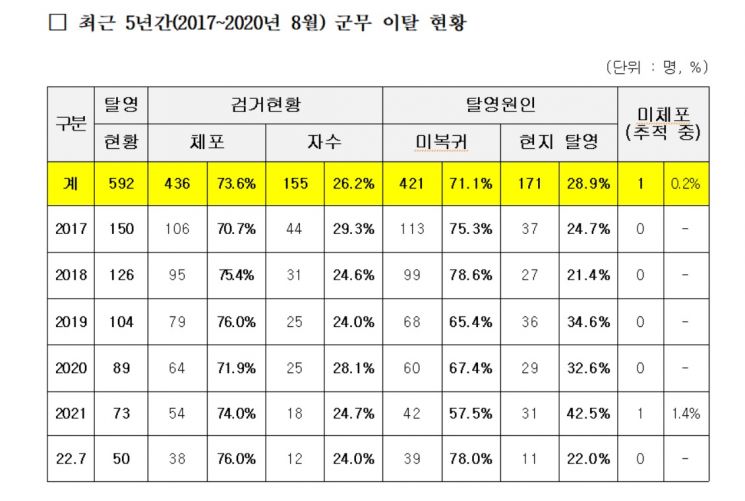
By year, the number of deserters was highest in 2017 with 150, followed by 126 in 2018, and 104 in 2019. After restrictions on leave and outings due to the COVID-19 pandemic and the full allowance of soldiers' mobile phone use, the numbers were 89 in 2020, 73 in 2021, and 50 up to July 2022. Notably, one deserter from last year has yet to be arrested and is still being tracked.
By military branch, the Army accounted for 497 deserters, making up 84% of the total. This was followed by the Navy with 42 (7%), the Air Force with 33 (6%), and the Marine Corps with 20 (3%). Regarding desertion types, 421 cases (71%) were due to failure to return after leave or outing, while 171 cases (29%) were local desertions.
The main method of apprehending deserters was arrest by the military police (DP). Of the total 592 deserters, 436 (74%) were arrested, and 155 (26%) surrendered voluntarily.
Meanwhile, there are still four long-term deserters who have not been caught despite deserting over 10 years ago. Among them, three were cases of failure to return, and one was a local desertion, with two at the rank of Private First Class and two at the rank of Private. The military authorities are currently continuing arrest operations for these four individuals.
Representative Song stated, "Along with strict punishment for deserters, it is necessary to respond to desertion not as an individual problem but as a community issue, and to establish comprehensive measures to prevent recurrence, including improving service conditions and military culture."
© The Asia Business Daily(www.asiae.co.kr). All rights reserved.


















