Electric Vehicle Sales in China Reach 3.84 Million Units from January to September, Year-End Target Likely Raised to 6.5 Million
Tesla, BYD, and Others Launch Major Promotions with '0' Yuan Down Payment
[Asia Economy Senior Reporter Cho Young-shin] China is expected to raise its sales target for new energy vehicles, including electric vehicles, to 6.5 million units this year. At the beginning of the year, China set the sales target for new energy vehicles at 5.5 million units, but as sales surged rapidly, it previously raised the target to 6 million units.

According to Chinese economic media Caijing and Xinhua News Agency on the 4th, it is estimated that electric vehicle sales in China will surpass 3.84 million units by September this year. This means that new energy vehicles account for 26% of all new cars sold this year.
Caijing reported that although the official sales figures for new energy vehicles in September have not been released, it is estimated that more than 580,000 units were sold last month. It also forecasted that the share of new energy vehicles in monthly new car sales will approach 30%.
At the end of 2020, when China announced its 14th Five-Year Plan (2021?2025), it declared that it would raise the sales share of new energy vehicles, including electric vehicles, to 20% by 2025. If the current trend continues, China will achieve this target three years ahead of schedule.
Chinese new energy vehicle manufacturers have also launched promotions to expand sales. They plan to leverage the National Day holiday, the last holiday of the year, to boost sales performance in the fourth quarter. First, American company Tesla is delivering vehicles (Model 3 and Model Y) in China without requiring a down payment to expand sales. Additionally, customers who take delivery of vehicles by the end of the year will receive an insurance subsidy of 7,000 yuan (approximately 1.42 million KRW). In total, 11 types of promotions, including auto installment financing, are being offered.
Chinese companies have also actively joined the National Day promotions. Chinese electric vehicle manufacturers such as Weilai (Nio) and BYD are offering free test drives to customers visiting dealerships during the holiday period and providing special benefits to customers who make advance reservations or trade in electric vehicles. Interest benefits on installment financing are standard.
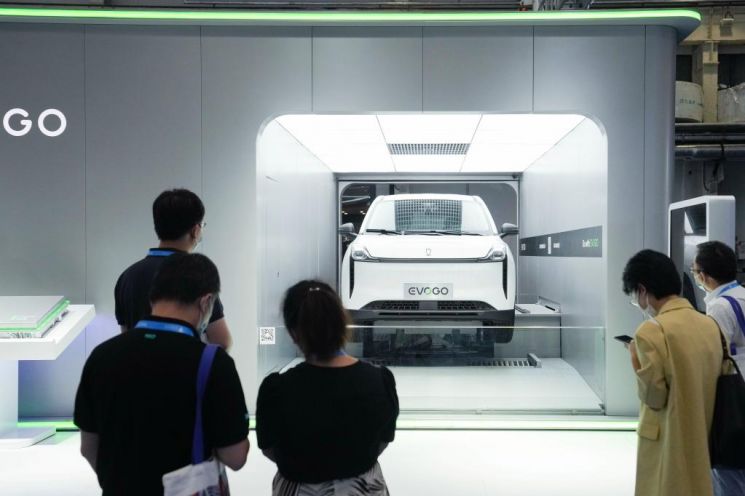
Caijing cited experts saying that depending on the sales performance of electric commercial vehicles, sales of new energy vehicles in China could reach 6.5 million units this year, and policy authorities may revise the target upward.
The surge in sales of new energy vehicles in China is also confirmed by the rapid growth in installment financing. According to the China Banking Association, the amount of auto installment financing loans supported by financial institutions such as installment finance companies in the first half of this year reached 270.987 billion yuan (approximately 55 trillion KRW). Xinhua News Agency reported that the number of vehicles supported by these loans exceeded 3.03 million units.
The Chinese government's expansion of new energy vehicle adoption is closely related to gross domestic product (GDP). Due to lockdown policies following the COVID-19 outbreak in Shanghai, the Chinese economy grew by only 0.4% in the second quarter. The Chinese government's 'Zero COVID' policy caused domestic consumption to plummet. Domestic demand accounts for more than 60% of the Chinese economy. To revive domestic demand, the current situation forces reliance on high-priced automobiles. The Chinese government’s extension of subsidies for electric vehicles and exemption from acquisition tax for one more year is in line with this context.
Chinese Premier Li Keqiang has expressed confidence in a rebound in the third and fourth quarters. At a recent fourth-quarter economic stability work meeting, Premier Li said, "Through strenuous efforts, the downward trend of the economy has reversed, and overall stability was restored in the third quarter," adding, "The fourth quarter economy accounts for the largest portion of the annual economic performance, and policy effects will become evident."
Some in China believe that it will be difficult for the Chinese economy to achieve the initial target of around 5.5% this year, and that an annual growth rate of over 3% would be considered a success.
© The Asia Business Daily(www.asiae.co.kr). All rights reserved.


















