Drug Crimes in the Entertainment Industry Since the 1970s
Various Types Including Marijuana, Philopon, and Ecstasy
Experts Say "Addiction Treatment and Rehabilitation Systems Are Urgently Needed"
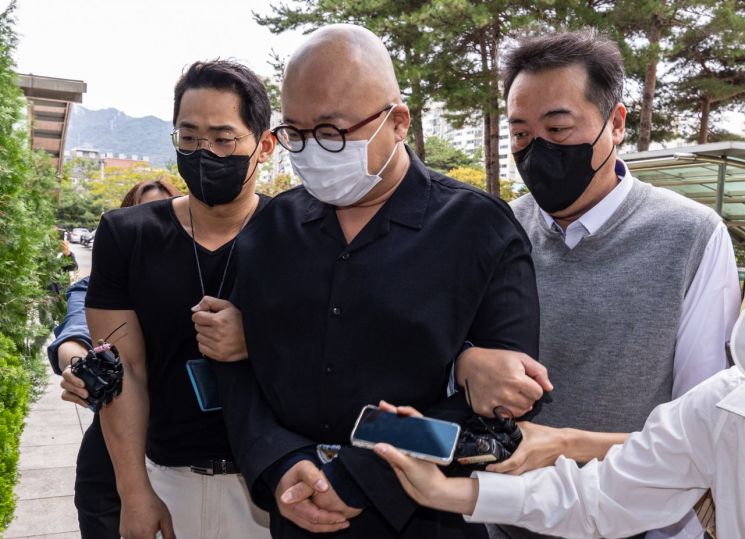
[Asia Economy Reporter Yoo Byung-don] Composer and singer Don Spike (45, real name Kim Min-su) has been arrested on drug use charges, raising concerns that the drug scandals in the entertainment industry could have a negative impact on society.
Don Spike was arrested on charges of using and possessing methamphetamine at a hotel in Yeoksam-dong, Gangnam-gu, Seoul. At the time of his arrest, 30g of methamphetamine, enough for about 1,000 doses, was found in the hotel room. It was confirmed that he had three prior drug-related convictions before this arrest for drug use.
Starting with the "Marijuana Scandal" in 1975, when 18 people including singers Shin Joong-hyun, Cho Yong-pil, and Kim Se-hwan were arrested for smoking marijuana, drug scandals in the entertainment industry have continued steadily. Many singers such as Lee Seung-chul, Psy, the late Shin Hae-chul, Hyun Jin-young, G-Dragon, T.O.P, and Kim Tae-won, guitarist of the band Boohwal, were caught on marijuana charges.
In 1986, stronger drugs began to spread when singer Kim Tae-hwa, Chae Eun-ok, and actress Kim Bu-seon were arrested for habitual methamphetamine use. Actress Hwang Soo-jung, who enjoyed great popularity with a pure image in dramas such as "Heo Jun," became the center of controversy after being arrested on methamphetamine use charges. In 2002, actress Sung Hyun-ah was sentenced to eight months in prison with a two-year probation for habitual ecstasy use. At that time, the prosecution revealed that it had secured a "celebrity drug list" and was investigating about ten people including singers, actors, and comedians, causing a stir.
In 2009, actor Ju Ji-hoon was indicted without detention on charges of using ecstasy and inhaling ketamine, receiving a six-month prison sentence with one year probation and community service orders. Idol singer Park Bom was given a suspended indictment in 2010 on charges of smuggling amphetamines, and Big Bang’s G-Dragon and T.O.P were caught smoking marijuana.
Singer B.I was tried in 2019 on charges of purchasing and partially using marijuana and LSD. The court sentenced B.I to three years in prison with four years probation, ordered 80 hours of community service, 40 hours of drug treatment lectures, and a fine of 1.5 million won. Park Yoo-chun was arrested and indicted in 2019 on methamphetamine use charges and was sentenced to ten months in prison with two years probation.
The problem is that unlike in the past when drug use was seen as a privilege of celebrities and other elites, recently, with easier distribution and purchase of drugs, the trend is spreading to ordinary people as well.
According to the "2021 Drug Crime White Paper" published by the Supreme Prosecutors' Office, last year, 494 students (3.1% of the total) were drug offenders, an increase of 2.4 percentage points from 105 students (0.7%) in 2017. Office workers numbered 1,010 (6.3%) and housewives 195 (1.2%), increasing by 2.6 and 0.1 percentage points respectively compared to four years ago. On the 30th of last month, a man in his 50s, suspected of using methamphetamine at a motel in Gwangjin-gu, Seoul, caused a disturbance claiming to be a "drug offender" and was arrested by the police.
As the status of being a "drug-free country" collapses and drugs spread even among ordinary citizens, there are calls for not only crackdowns and punishments but also treatment and rehabilitation systems.
Park Young-deok, director of the Korea Drug Prevention Movement Headquarters, said, "In Korea, drug addicts are only made into criminals, and there is no way for them to recover," adding, "It is time for the government to pay attention to treatment and rehabilitation." Lee Beom-jin, head of research at the Korea Drug Prevention Movement Headquarters, also emphasized, "Drug addiction is a treatable disease," and "As the social costs caused by drug addicts are rapidly increasing, investment in addiction treatment and rehabilitation is necessary."
© The Asia Business Daily(www.asiae.co.kr). All rights reserved.
![Clutching a Stolen Dior Bag, Saying "I Hate Being Poor but Real"... The Grotesque Con of a "Human Knockoff" [Slate]](https://cwcontent.asiae.co.kr/asiaresize/183/2026021902243444107_1771435474.jpg)

















