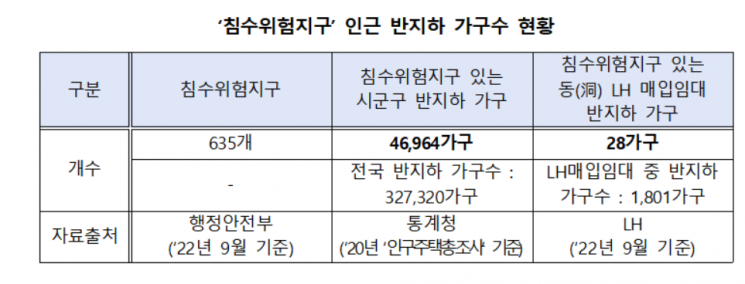
[Asia Economy Reporter Kim Min-young] It has been revealed that there are 46,000 semi-basement households nationwide near flood-prone areas where heavy rain, floods, and inundations are likely to occur. It was also found that 28 LH (Korea Land & Housing Corporation) purchased rental units exist in these high-risk areas.
According to data on the "Status of Semi-basement Households in Flood Risk Zones" submitted on the 4th by Democratic Party lawmaker Kim Byung-wook (Seongnam Bundang-eul), a member of the National Assembly Land, Infrastructure and Transport Committee, from the Ministry of the Interior and Safety, Statistics Korea, and LH, as of September this year, there are a total of 46,964 semi-basement households in 635 flood risk districts nationwide. In particular, 28 semi-basement LH purchased rental units were confirmed to be located in neighborhoods with flood risk zones.
Looking at the status in the Seoul metropolitan area, as of 2020, Seoul has 22,571 semi-basement households in Yangcheon, Gangseo, and Seocho districts, where three flood risk zones are located. In Gyeonggi Province, there are 11 cities and counties including Goyang, Gwangju, Pyeongtaek, Dongducheon, and Pocheon, where 27 flood risk zones are located, with a total of 11,552 semi-basement households. Incheon had no flood risk zones.
Among LH purchased rental units, there were 23 semi-basement households in Sinwol-dong and Sinjeong-dong, Yangcheon-gu, Seoul; 4 in Bangbae-dong, Seocho-gu; and 1 in Gupo-dong and Hwamyung-dong, Buk-gu, Busan.
Although there are still many semi-basement households near flood risk areas, the number of households that have finally relocated after receiving benefits from the "Housing Upgrade Support Project for Vulnerable Groups," implemented by the Ministry of Land, Infrastructure and Transport and LH, is less than half of the eligible recipients.
According to LH data, among 14,480 households targeted for the project in 2021, only 41.6% (6,026 households) completed relocation and support, and among 4,142 households classified as below minimum housing standards or at risk of disaster in basement floors, only 25.5% (1,056 households) completed upgraded relocation.
From January to July this year, only 41.1% (3,423 households) of the total 8,322 project recipients and 47.2% (916 households) of the 1,940 households below minimum housing standards or at risk in basement floors received final support.
LH explained that the low performance in housing upgrades is due to △ a shortage of available rental housing by region and difficulties in matching △ economic difficulties related to moving △ voluntary withdrawal among applicants. They also stated that they are currently operating the Relocation Support 119 Center and providing support for deposits (500,000 KRW), moving expenses (200,000 KRW), and daily necessities (200,000 KRW) for relocating households.
Lawmaker Kim Byung-wook emphasized, “To ensure the safety of semi-basement households, housing upgrade support for semi-basement households near flood risk zones must be prioritized. It is necessary to secure a large number of quality above-ground purchased or rental units near the current residential areas and to make moving cost support more realistic to improve the performance of the housing upgrade project.”
An LH official said, "We have been promoting a project to relocate semi-basement households to above-ground floors starting this year," adding, "For households that cannot relocate immediately, we will also consider their safety by inspecting and reinforcing flood prevention facilities in disaster-prone houses."
© The Asia Business Daily(www.asiae.co.kr). All rights reserved.
![Clutching a Stolen Dior Bag, Saying "I Hate Being Poor but Real"... The Grotesque Con of a "Human Knockoff" [Slate]](https://cwcontent.asiae.co.kr/asiaresize/183/2026021902243444107_1771435474.jpg)
















