Industrial Research Institute Achieves Record High Performance with Successful Arms Export Contracts to Australia and Others
Control Tower Establishment, Royalty Exemptions, and 8 Other Areas Remain Insufficient
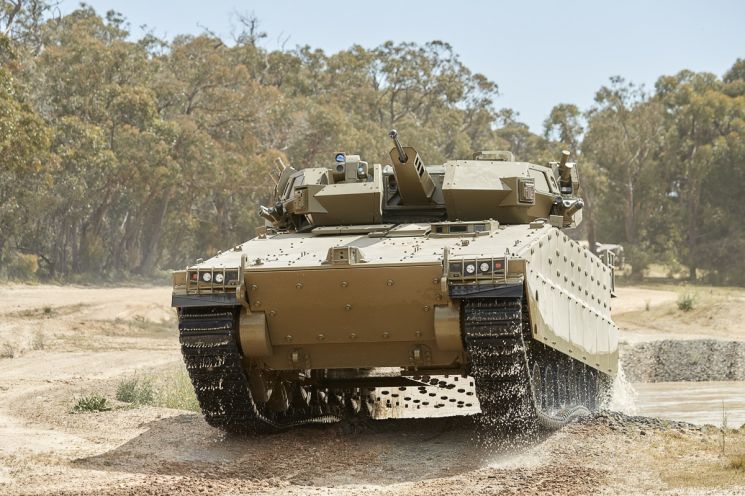 Exports of the Australian Redback armored vehicle (5 to 7.5 billion dollars) are expected to be possible by the end of the year.
[Asia Economy Yang Nak-gyu, Military Specialist Reporter] It is forecasted that this year’s defense industry export value will surpass 20 billion dollars (approximately 28.8 trillion KRW).
According to the report titled 'Analysis of K-Defense Export Support System and Future Tasks for Entering the Global Defense Export Big 4' released by the Korea Institute for Industrial Economics and Trade on the 4th, if South Korea succeeds in signing arms export contracts with countries such as Australia, Malaysia, and Norway by the end of the year, the defense export value for this year is expected to exceed 20 billion dollars.
South Korea’s defense export value has already surpassed 10 billion dollars this year, breaking the previous annual export record of 7 billion dollars. Domestic defense exports had remained at around 2 to 3 billion dollars annually over the past decade, but due to increased demand for weapons amid changes in the global security environment, last year recorded an all-time high of 7.25 billion dollars.
The report analyzed that South Korea’s arms export market, which was previously centered on Asia and North America, has recently expanded to the Middle East, Europe, Latin America, Oceania, and Africa, and that export products have diversified from mainly ammunition and naval vessels to include mobility, firepower, aviation, naval vessels, and guided weapons.
South Korea is expected to continue its order boom for the time being after successfully securing a large-scale export project worth over 10 trillion KRW from Poland in July, including K2 tanks, armored vehicles, and FA-50 light attack aircraft.
If contracts are secured by the end of the year for Australia’s Redback armored vehicles (5 to 7.5 billion dollars), Malaysia’s FA-50 light attack aircraft (700 million dollars), Norway’s K2 tanks (1.7 billion dollars), and Egypt’s K2 tanks (1 to 2 billion dollars), achieving an annual export value of 20 billion dollars is also anticipated.
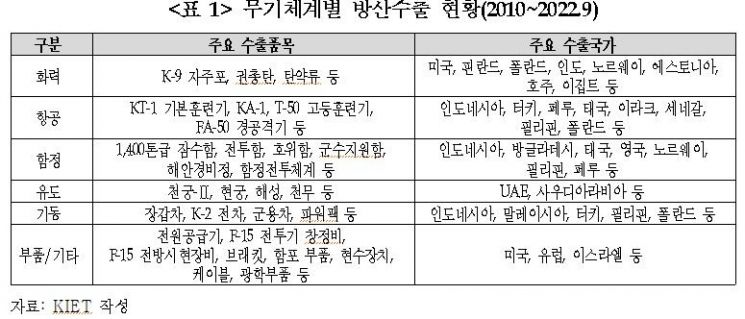
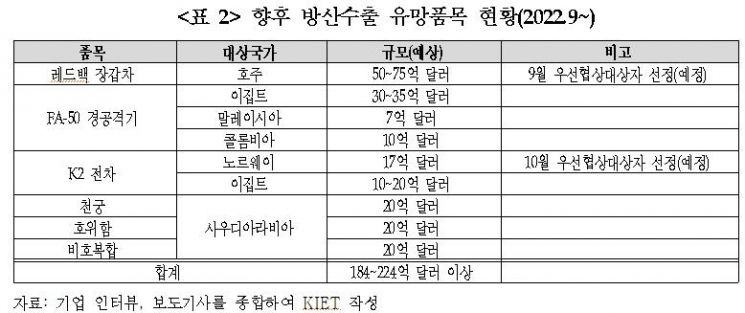
However, the report pointed out that when South Korea’s defense export support system was divided into 13 areas and compared with advanced countries’ systems, it was found to be insufficient in 8 areas.
Five areas?establishment of a control tower, expansion of defense cooperation networks, exemption of technology fees upon export, defense marketing support, and export modification and development projects?were analyzed to be on par with advanced countries.
However, issues were raised regarding the passive and reactive operation of government-to-government (G to G) export contract systems, lack of diversity in 'package deals,' and insufficient defense export finance support.
In terms of defense export finance support, while the United States supports defense exports not only through export credit guarantees but also via Foreign Military Financing Program (FMFP) and others, South Korea’s support is relatively insufficient, limited to selective low-interest and long-term defense export financing through the Export-Import Bank and Korea Trade Insurance Corporation.
Additionally, the report advised that countries like the United States and France provide package support including education, technology, and finance when exporting weapons, recommending the establishment of a 'Smart Defense Cooperation Package.'
Furthermore, the report pointed out as a problem that South Korea’s offset trade performance (exporting domestic parts while purchasing weapons and equipment from overseas) in the past five years has decreased to one-tenth of the level from 2012 to 2016. It also suggested producing export prototype weapons to review export potential from the early stages of weapon development and expanding overseas dispatch organizations and personnel.
Jang Won-jun, a research fellow at the Korea Institute for Industrial Economics and Trade, said, "For South Korea to grow into one of the top four global defense exporters in the future, it is necessary to establish a 'third-generation defense export' strategy that includes diversification of export items, expansion of exports by small and venture companies, and diversification of export entities and methods."
© The Asia Business Daily(www.asiae.co.kr). All rights reserved.
![Clutching a Stolen Dior Bag, Saying "I Hate Being Poor but Real"... The Grotesque Con of a "Human Knockoff" [Slate]](https://cwcontent.asiae.co.kr/asiaresize/183/2026021902243444107_1771435474.jpg)













