After Abandoning Wealth Tax Cut Plan, Aftershocks Persist
"Pound Pressure Will Not Ease"
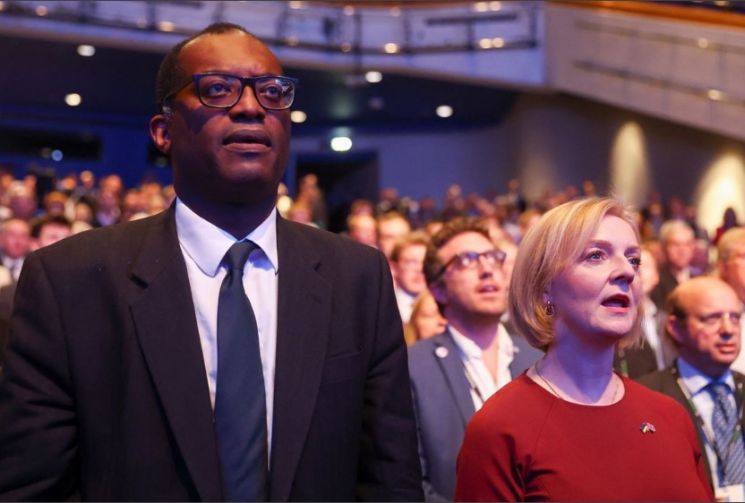 British Prime Minister Liz Truss (right) and Chancellor of the Exchequer Kwasi Kwarteng.
 Photo by Reuters
[Asia Economy Reporter Yujin Cho] UK Prime Minister Liz Truss, cornered by a tax cut policy that caused turmoil in the financial market, has abruptly withdrawn the 'wealthy tax cut plan.' Although it is a withdrawal of only part (?2 billion) of the total ?45 billion (approximately 73 trillion won) tax cut policy package, it is expected to cause significant political damage as she endures the humiliation of reversing her first economic policy since taking office. While the wealthy tax cut plan has been scrapped, the aftershocks of the tax cut policy have not subsided, and there is analysis that she may face pressure for further policy changes.
On the 3rd (local time), major foreign media reported that the decision to withdraw the wealthy tax cut plan could put greater pressure on Prime Minister Truss and Chancellor of the Exchequer Kwasi Kwarteng. It is forecasted that depending on Truss's future political standing and changes in the ruling Conservative Party's approval ratings, additional pressure to amend the tax cut policy package will follow.
Foreign media reported that the decision to withdraw the tax cut plan will pose a major threat to the UK, which has experienced political instability with four prime ministers taking office in the past six years. According to multiple opinion polls, the Conservative Party's approval rating has fallen behind the opposition Labour Party by as much as 33 percentage points, with the Labour Party overwhelming the Conservatives, escalating into a government crisis.
Criticism is mounting within the Conservative Party as well, blaming the Truss cabinet's missteps. A Conservative MP said regarding whether Chancellor Kwarteng should resign to take responsibility for the situation, "I believe his position has significantly weakened." Another Conservative MP pointed out that trust in Prime Minister Truss, who took office on September 6 last month, and the Conservative Party has plummeted to rock bottom, and that they are merely enduring day by day.
Former Transport Secretary Grant Shapps told BBC that even if the tax cut plan is put to a vote in the House of Commons, it would be rejected. Shapps criticized, "Listen to voters struggling with rising living costs due to inflation," adding, "Ordinary households should be the priority, not tax cuts for the wealthy."
There is also analysis that the market impact of the tax cut policy U-turn will not last long. The abandonment of the wealthy tax cut plan is seen as a symbolic move only, and the overall direction of economic policy has not changed.
International credit rating agency Standard & Poor's (S&P) downgraded the UK's sovereign credit rating outlook from 'stable' to 'negative' on the 30th of last month, and assessed that the recent tax cut U-turn movement has not had a substantial impact on the UK economy.
Jane Foley, Head of FX and Interest Rate Strategy at Rabobank, said, "It will become clear whether government measures are sufficient after the Bank of England's (BOE) intervention ends on the 14th," adding, "However, I do not expect the pressure on the pound and UK government bonds to be significantly relieved."
Immediately after the tax cut policy announcement, the pound's value against the US dollar plummeted to a record low of $1.035 on the 26th of last month. It slightly rebounded following the BOE's emergency bond purchase announcement, but the aftershocks of market turmoil continue.
As Prime Minister Truss reversed her first economic policy since taking office, calls for accountability have emerged both inside and outside the political sphere. The UK's Guardian criticized in a column, "Almost all economists see the Truss cabinet's tax cut plan as a disaster for the economy," adding, "It has been proven to be worse than the policies of former Prime Minister Boris Johnson, who resigned in disgrace amid the Partygate and lying controversies."
The Guardian also criticized, "Like fast-forwarding to the latter part of a movie, Truss, who has been in office for less than a month, lost the trust of Parliament, the market, and the public within about a week of announcing the new policy."
Chancellor Kwarteng announced in a statement on the day, "We will not pursue the plan to reduce the top income tax rate (45%) applied to high earners, which was part of the tax cut policies announced in the 'mini-budget' on the 23rd of last month." It is reported that the atmosphere changed rapidly to the extent that several ministers were aware of the announcement before and after Kwarteng's statement.
Until the morning of the previous day, Prime Minister Truss had firmly stated that the tax cut plan would be maintained, but she changed her stance within a day. Sharing Kwarteng's statement, Truss said, "The focus is now on funding world-class public services, raising wages, and building a high-growth economy that creates opportunities across the country."
Earlier, Prime Minister Truss and Chancellor Kwarteng announced a massive tax cut policy worth ?45 billion, including reductions in income tax and stamp duty, along with an energy subsidy support plan worth about ?60 billion.
Among the tax cut policies, the plan to reduce the top income tax rate for high earners sparked opposition and widespread repercussions by lowering the basic income tax rate applied to incomes up to ?50,270 from 20% to 19%, and cutting the rate applied to high earners with incomes of ?150,000 from 45% to 40%, a 5 percentage point reduction.
© The Asia Business Daily(www.asiae.co.kr). All rights reserved.

















