Constitutional Court: "Merely Administrative Guidance, Recommendations, and Information Provision"
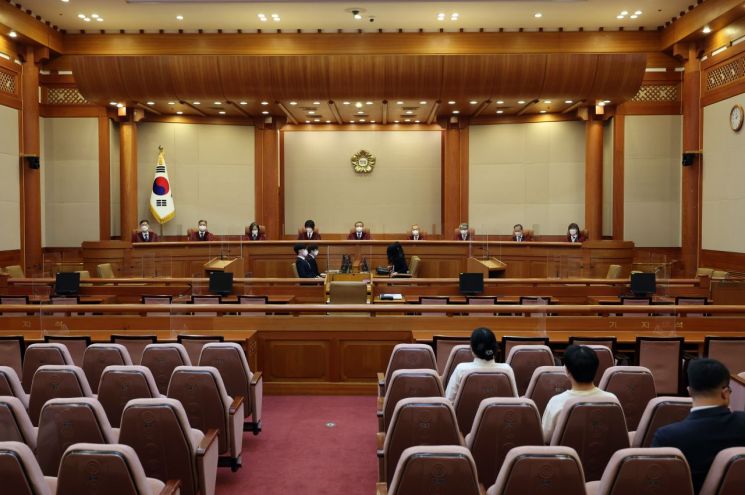 Chief Justice Yoo Nam-seok of the Constitutional Court and other constitutional justices are seated in the Grand Bench of the Constitutional Court in Jongno-gu, Seoul, on the afternoon of the 29th of last month. [Image source=Yonhap News]
[Asia Economy Reporter Heo Kyung-jun] The Constitutional Court has ruled that the policy of the "Joint Task Force of Virtual Currency-Related Agencies" to ban Initial Coin Offerings (ICO) does not constitute an exercise of public authority subject to constitutional review.
On the 4th, the Constitutional Court announced that it unanimously dismissed the constitutional complaint filed by blockchain software developer Company A on September 29, 2017. Company A claimed that the ICO ban policy by the Joint Task Force (TF) of virtual currency-related agencies infringed on fundamental rights without legal basis.
Company A argued that the TF's policy to ban all forms of ICO violated the principle of legality and that the inaction of the executive branch and the National Assembly in taking subsequent legislative measures related to ICO infringed on the petitioners' fundamental rights, thus filing a constitutional complaint.
The Constitutional Court judged, "The government's actions are merely administrative guidance, recommendations, and information provision aimed at informing about the risks that may arise from ICOs and publicly announcing the direction of policies and systems related to finance, which is their jurisdiction, in advance to induce and regulate the behavior of the general public in a certain direction."
It added, "Although it has a de facto effect of leading citizens to follow the intentions of administrative agencies based on their own judgment, it does not impose any legal binding force such as direct acts or omissions."
The Court also cited the results of a survey on 22 companies that conducted ICOs after the second half of 2017. According to data released by the Financial Services Commission in January 2019, domestic companies circumvented the policy by establishing paper companies overseas to conduct "formal overseas ICOs," and most of these companies refused to disclose the use of raised funds to financial authorities.
Furthermore, among these companies, none have been reported to investigative agencies by financial authorities for violations of the Capital Markets Act or other current laws to date.
© The Asia Business Daily(www.asiae.co.kr). All rights reserved.

















