Korea Federation of SMEs Announces Report on 'MZ Generation's Desired Job Conditions'
3 Years 5 Months of Online Discourse Analysis
Increased Interest in Working Hours and Organizational Culture

"Receiving an annual salary close to the minimum wage, exhausted from unpaid overtime and weekend work, resigned within a year"
"Judging that career growth is difficult, decided to change jobs and thinking of resigning soon to go anywhere"
"No young employees, only older employees with long tenure"
"No system and a makeshift work environment. No incentives, performance bonuses, or rewards"
These are excerpts from actual posts by MZ generation youth online. They harshly criticized the small and medium-sized enterprises (SMEs) they are working at or have left.
The Korea Federation of SMEs announced on the 3rd a report titled 'Job Conditions Desired by the MZ Generation in SMEs' containing such content. It compiled and analyzed about 270,000 documents related to SME employment posted over the past 3 years and 5 months on Naver Cafe, blogs, KnowledgeIN, and JobPlanet, with data extraction performed by WiseNut Inc.
This report aggregated and analyzed various online discourses related to SMEs to understand the job conditions desired by the MZ generation. The Federation stated, "We considered that the MZ generation is actively engaged online and expresses themselves candidly." It was prepared to gain insights into what HR systems SMEs, which are experiencing chronic labor shortages, should establish to attract the MZ generation.
Keyword analysis of negative posts about SMEs during this period revealed that 'no experience,' 'resignation,' 'no work-life balance,' and 'minimum annual salary' were the most prominent. Young people pointed out poor working conditions, low wages, and lack of work-life balance as disadvantages of SMEs. There were also posts saying, "There is a lot of overtime and a culture of subtle pressure," and "There are many older employees, so only the juniors keep changing."
However, young people did not only express dissatisfaction with SMEs. There were also posts highlighting advantages such as "Able to use annual leave without pressure," "Can learn various things despite few years of experience," and "Fortunately, there is work-life balance and good people, so I am staying."
Online posts also contained sighs from young people struggling with employment. Posts like "I keep getting rejected at the document screening stage for SMEs. Maybe because I have no experience. My self-esteem is dropping," and "It's almost been a year since I graduated and started preparing for employment. Now my body is tired, so I am looking into SMEs. It's so hard," expressed difficulties in finding jobs. Negative keywords related to SMEs among job seekers included 'document rejection,' 'no experience,' as well as expressions like 'exhausted' and 'helpless.'
In particular, job seekers' concerns about 'experience' have significantly increased recently. Looking at the monthly average number of mentions of experience-related keywords, there were 146 in 2019, 179 in 2020, and 468 last year, a 2.6-fold increase compared to the previous year. Due to the COVID-19 pandemic, companies prefer talents who can be immediately deployed to work, deepening job seekers' concerns about recognition of experience. There was also a complaint post saying, "This was the best interview I've had so far, but everyone except me had experience. If that's the case, shouldn't it be a job posting for experienced hires from the start?"
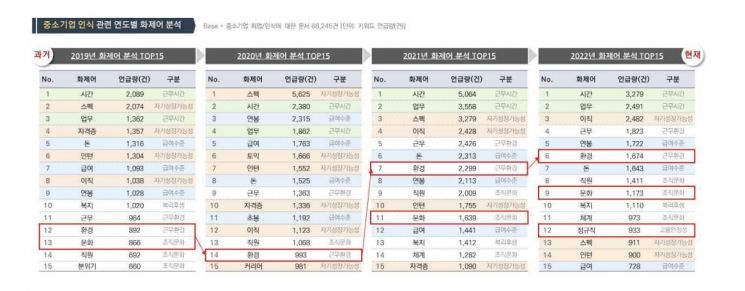
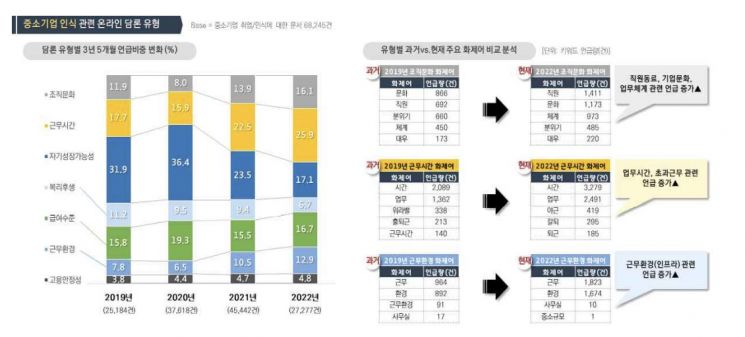
What is the number one interest of the MZ generation in SMEs based on online discourse? This year, it was 'working hours.' It surpassed the interest in 'possibility of self-growth,' which was the top concern until last year. Interest in 'work environment' and 'organizational culture' has noticeably increased since COVID-19. Looking at the ranking of trending words by year, 'specifications' (specs), which was number one in 2020, dropped to 13th this year, while 'environment,' referring to the work environment, rose from 14th to 6th during the same period. This shows that the MZ generation's criteria for deciding to join SMEs have somewhat changed.
The Federation analyzed, "Since COVID-19, the MZ generation prioritizes jobs that guarantee work-life balance and provide opportunities for self-growth when seeking employment in SMEs," adding, "They also consider work environment, organizational culture, and salary levels comprehensively." Furthermore, it advised, "SMEs need to make efforts to improve by providing opportunities for self-growth to the MZ generation and especially considering their high interest in work-life balance." We hope that the software aspects such as work-life balance, organizational culture, and work environment of SMEs will improve in line with the job conditions valued by the MZ generation.
© The Asia Business Daily(www.asiae.co.kr). All rights reserved.



















