The 11th Digital National Agenda Continuous On-site Meeting Held
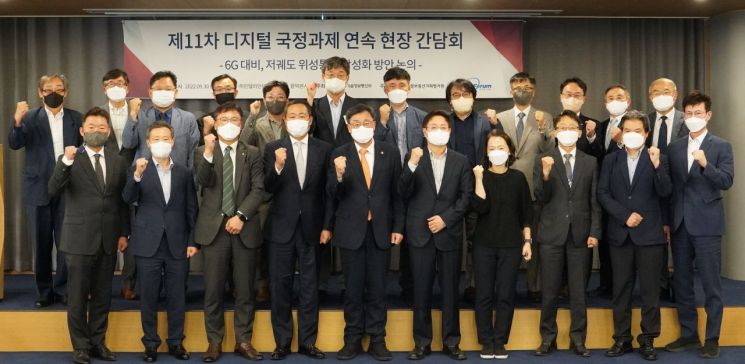 On September 30th, attendees of the 11th consecutive on-site meeting for the Digital National Agenda are taking a commemorative photo at the Intellian Technology headquarters in Pyeongtaek-si, Gyeonggi-do. Photo by Ministry of Science and ICT
[Asia Economy Reporter Oh Soo-yeon] In preparation for the upcoming 6G era, the public and private sectors gathered to discuss measures to revitalize low Earth orbit satellite communications. Voices were raised emphasizing the need to secure frequencies and orbits and to cultivate talent in order to stand shoulder to shoulder with global companies in the satellite communications field. The government plans to support the passage of the preliminary feasibility study (PFS) and form a public-private task force (TF) to provide assistance.
On September 30, Park Yoon-kyu, the 2nd Vice Minister of the Ministry of Science and ICT, held the 11th Digital National Agenda consecutive on-site meeting at the headquarters of Intellian Technologies in Pyeongtaek, Gyeonggi Province. This meeting was arranged as a follow-up to the "Korea Digital Strategy" announced on August 28, to discuss the role of low Earth orbit satellite communications in building a world-class innovative network.
Representatives from leading domestic satellite communication companies such as AP Satellite, AR Technology, LIG Nex1, KT SAT, KAI, RFHIC, SK Telink, Soltop, Intellian Tech, and Hanwha Systems participated in the meeting, along with major research institutions including ETRI, IITP, KAIST, ADD, academic experts, and the Defense Acquisition Program Administration. Additionally, the global low Earth orbit satellite communication company OneWeb expressed its willingness to cooperate with Korean companies through a recorded video.
Overseas, operators like Starlink provide satellite communication services targeting suburban areas where 5G and LTE coverage is insufficient. In contrast, Korea already has a well-established nationwide network, so the attention to satellite communications is relatively low. Although Korea holds global competitiveness in the information and communication technology (ICT) sector, the low Earth orbit satellite communication field is still in its infancy.
However, in the forthcoming 6G era, the importance of low Earth orbit satellite communications is increasing to provide ultra-spatial and ultra-high-speed communication services connecting land, sea, and air based on an integrated terrestrial-satellite network. Compared to geostationary orbit, low Earth orbit satellite communications offer improved usage speeds and reduced latency, supporting the creation of new industries such as Urban Air Mobility (UAM) and autonomous ships. It is expected to respond swiftly to shadow areas like islands and mountainous regions, as well as to the absence of terrestrial networks caused by disasters or wars. Furthermore, it will enable communication services such as Wi-Fi on ships and aircraft where terrestrial networks cannot reach.
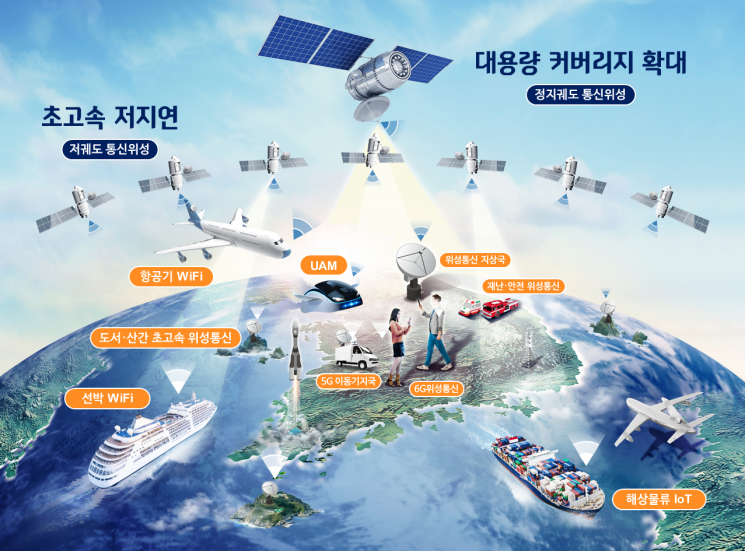 Conceptual diagram of low Earth orbit satellite communication network. Photo by Ministry of Science and ICT
Participants expressed various opinions on support measures to secure global leadership in satellite communications from the perspectives of industry and academia.
Choi Kyung-il, Executive Director of KT SAT, said, "Securing frequencies and orbits is the top priority. If Korea can preemptively secure and test these and push them as international standards, our companies can gain competitiveness and expand globally." He also added, "If we do not have our own system immediately, it is necessary to introduce overseas low Earth orbit systems. However, when issuing licenses, strategies must be established to avoid conflicts or interference with public networks, military networks, disaster networks, etc., and to require consultation with Korean satellite operators."
He emphasized the urgency of support for talent cultivation. Professor Lee Moon-kyu of the University of Seoul said, "The population cliff has begun, and recently research personnel have been concentrated in AI and semiconductor fields, causing other fields to wither. A large-scale talent cultivation system is needed through close collaboration between demand sectors such as industries, schools, research institutes, military, and universities."
Participants also stressed the need to form an industrial ecosystem connected to the global market. Although Korean companies have excellent products, they have sometimes faced limitations in market access to global operators due to a lack of space heritage. Opinions were raised that the government should actively invest in research and development to develop core technologies that meet global standards, secure space heritage through satellite launches, and that public-military cooperation is important in this process.
There were also calls to simultaneously expand the domestic low Earth orbit satellite communication market to foster new digital-based industries and prepare for the absence of terrestrial networks. In particular, when introducing global low Earth orbit satellite communication services domestically, it was suggested to explore ways for satellite communication services to coexist in the 28 GHz band currently used for 5G mobile communication services.
There were also opinions that government investment in satellite communications is necessary. Last year, the low Earth orbit cluster satellite communication system development project failed to pass the preliminary feasibility study.
In response, Vice Minister Park Yoon-kyu said, "We will hold a public hearing in October and strive to have the satellite communication preliminary feasibility study pass on a large scale in November. We need to prepare in advance for frequency acquisition issues and secure experts. I hope to actively respond by forming a public-private TF or consultative body."
© The Asia Business Daily(www.asiae.co.kr). All rights reserved.


















